
My son’s wife deliberately broke my arm — but in doing so, she accidentally destroyed her own future. While I lay there in pain, the security cameras captured everything for the prosecutors.
My son’s wife deliberately broke my arm — but in doing so, she accidentally destroyed her own future. While I lay there in pain, the security cameras captured everything for the prosecutors.
My son’s wife broke my arm in my own kitchen and then screamed for help like I had attacked her.
That was the first thing the police heard when they came through the front door.
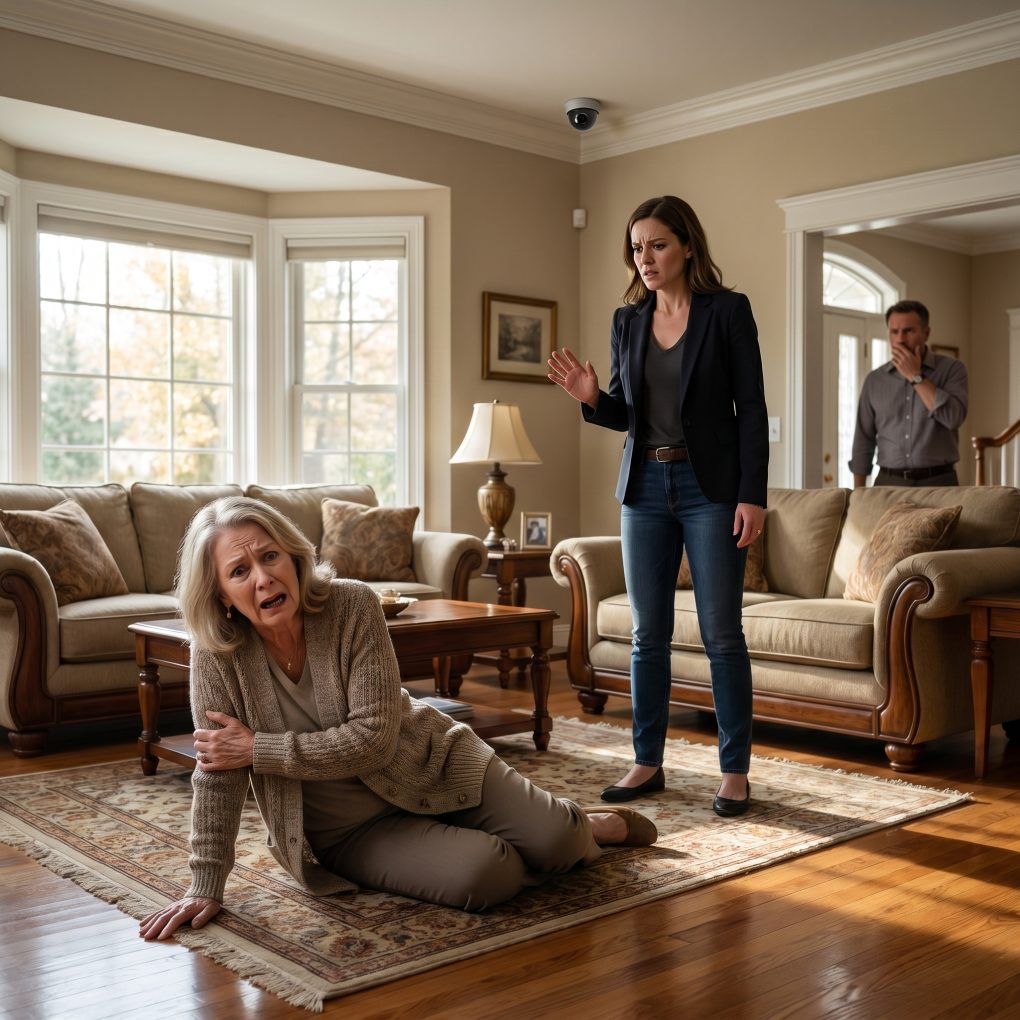
I was on the tile floor beside the island, half-curled around the pain, my left arm bent in a direction no arm should ever bend, while Candace stood three feet away clutching a broken ceramic bowl and sobbing, “She came at me! She slipped! Oh my God, she slipped!”
Slipped.
I still remember staring at her through the white blur of pain and thinking: You stupid woman. There are cameras in every corner of this house.
My son, Ryan, came running in from the garage with grease on his hands and panic all over his face. He looked from me to Candace to the blood on the floor where the bowl had shattered, and for one second I saw the exact moment his marriage and his childhood collided.
“Mom?” he whispered.
Candace grabbed his sleeve. “She was yelling at me again, Ryan. She lunged, and I tried to get away—”
“No,” I said, though it came out thin and weak because the pain was making my vision pulse.
An officer dropped to one knee beside me. “Ma’am, don’t move.”
Candace kept crying.
That part made everything worse. Not just the broken arm. The performance. The way she was already shaping the story while I lay there unable to stand. She had been escalating for months—little shoves disguised as accidents, cruel whispers when Ryan wasn’t around, comments about how the house would “feel lighter” once I was gone. That morning, she finally stopped pretending.
She shoved me.
I hit the island.
Then the floor.
And as the paramedics lifted me onto the stretcher, Candace was still talking.
Still lying.
Still unaware that while I lay there in agony, the security system above the stove had caught every second of her future collapsing.
She thought one violent shove and a few fake tears would turn an old woman into the villain. She forgot the house had eyes — and by the time the prosecutors watched the footage, her whole story was already dead. Full continuation here
The emergency room doctor said the break was clean.
That was his word for it.
Clean.
As if there was anything clean about being seventy years old, lying in a hospital bed with morphine in your veins, while your son sat in a hard plastic chair outside the curtain listening to his wife explain to a deputy how his mother had become unstable lately.
I could hear every word.
Candace knew I could hear every word.
That was the kind of woman she was.
She didn’t scream at you in the beginning. She reworded you. Reframed you. Softened your edges until your protests sounded like symptoms. If you said she was rude, you were emotional. If you said she was manipulative, you were struggling to adjust. If you objected to her taking over my kitchen, my mail, my grandson’s routines, or my son’s time, then you were “having trouble with boundaries.”
She started doing that six months after the wedding.
At first, Ryan didn’t notice because men raised by women like me often don’t recognize disrespect unless it comes through a volume they understand. Candace never gave him that. She did it in smiles. In sighs. In the little comments she dropped when he left the room.
“It must be exhausting for Ryan, managing you like this.”
“Most mothers know when it’s time to step back.”
“You can’t expect to stay the center forever.”
I wasn’t the center.
I was the owner.
That, I think, was the root of everything.
The house was mine.
Always had been.
My husband Paul bought it with me in 1989, but after his heart attack ten years later, he transferred his share to me because “one of us needs clear control if the world gets ugly.” We had seen too many families split homes into war zones after death. Paul believed in preparation. So did I. Ryan knew the house was mine. Candace knew it too. But knowing and accepting are different things. She could live with the first one only if she believed time would solve the second.
Then she got pregnant, lost the baby, and came back from grief meaner, sharper, and more openly resentful than before. I pitied her. That was my mistake. I let her stay in my house through the worst months because Ryan looked hollowed out and because grief makes decent people generous right when bad people become dangerous.
After that, everything accelerated.
She wanted the downstairs office turned into a nursery for “next time.”
She wanted my husband’s workshop cleaned out because it “smelled old.”
She wanted access to the household accounts because she was “the one actually running things.”
And three weeks before she broke my arm, I overheard her on the back porch telling her sister, “Once the old woman finally gets scared enough to leave, the rest gets easy.”
The old woman.
Not Margaret.
Not Mom.
Not even Ryan’s mother.
The old woman.
I should have thrown her out then.
Instead, I spoke to Ryan that night in the den while the baseball game muttered on the television and he kept rubbing his forehead like stress itself could be massaged into decency.
“She wants me gone,” I said.
He sighed. “Mom, Candace says you two keep misunderstanding each other.”
There it was.
Translation.
Again.
I asked him, “Do you think your wife misunderstands me often enough to discuss my removal with her sister?”
His face changed then. Just for a second. But then he said, “She’s grieving.”
A sentence like that is where good sons start becoming bad men.
Because grief explains pain.
It does not excuse predation.
Still, I said nothing after that.
Not to him.
Not to her.
I just checked the camera system.
All four kitchen angles were working.
Cloud backup active.
Motion tagging clean.
That was because Paul had designed the setup himself before he died. After a string of neighborhood break-ins, he installed exterior coverage, driveway recording, and three interior cameras tied to the kitchen and back hall because “every bad family story starts in the room where people think no one is watching.”
He said it laughing.
Turns out he was right.
On the morning Candace attacked me, the argument started over a casserole dish.
Which sounds small until you understand family violence usually does. Not because the trigger matters, but because tension searches for objects to wear.
She was standing at my counter in silk pajama pants and one of Ryan’s T-shirts, using my phone charger and drinking the coffee I had just made, when she said, “I’ve decided we should move your things into the front room.”
I looked up from buttering toast. “No.”
She smiled. “You don’t need the master bedroom, Margaret.”
I set the knife down. “I need exactly as much of my own house as I please.”
She rolled her eyes and opened the cabinet where I kept the stoneware. “You always make everything harder.”
“No,” I said. “I just keep saying no where your husband keeps saying maybe.”
That was the moment.
Her face flattened.
No tears.
No performance.
Just naked hatred, quick and cold.
Then she took one step toward me and said, “You should have left when you had dignity.”
I remember standing.
Remember telling her to get out of my kitchen.
Remember the bowl in her hand.
Then her shove.
Harder than I expected.
Deliberate.
Two hands.
My hip hit the island first.
Then I went down and my arm took the fall.
By the time Ryan came in from the garage, she had already started screaming.
That’s what the prosecutors later liked most about the footage, apparently. Not just the push. The speed of the lie. The way she looked at the camera for half a second before turning her face into panic and shouting for help.
You can learn a lot from that half second.
In the hospital, the responding deputy came behind the curtain after the X-rays and asked me quietly, “Mrs. Holloway, is there security footage?”
I looked at him and said, “Yes.”
He asked where.
I told him everything.
The backup server in the pantry cabinet.
The cloud archive under my name.
The phone app access.
The admin password.
He nodded once and left.
Candace was still in the hallway telling another deputy I had “become aggressive and confused” after breakfast.
Then Ryan came in, eyes red, shoulders collapsed, and sat by the bed.
“Mom,” he said, and that one word was worse than the break because it still sounded like the boy I raised.
I said nothing.
He looked down at his hands. “If you just tell them it was an accident…”
I turned my head and looked at him fully.
He stopped talking.
Because even then—even after hearing her lie, after seeing me on the floor, after knowing what kind of woman his wife had become—some part of him still wanted peace more than truth.
That was when I knew the cameras weren’t just going to decide her future.
They were going to decide his too.
The prosecutor watched the footage twice.
The first time in silence.
The second time taking notes.
I was there in the conference room with my arm in a hard cast and my lawyer beside me, watching the monitor as the kitchen replayed my daughter-in-law’s face in cold digital angles. There she was, barefoot and furious, stepping into my space. There was the shove. There was my body hitting the island, the fall, the break. And there—most devastating of all—was her glance toward the camera before the performance began.
After the second viewing, Assistant District Attorney Laura Kim set her pen down and said, “She knew she was being recorded.”
“Yes,” I said.
Laura nodded. “That helps.”
Helps.
Such a small word for the moment a lie dies.
Candace was charged within the week.
Not attempted murder. People always want that in stories like this, but life is usually meaner and more bureaucratic than dramatic. The charges were aggravated assault on an elderly person and false reporting related to her statements at the scene. Her attorney tried for the familiar language first: misunderstanding, stress, grief, accident under emotional conditions.
Then Laura showed the footage frame by frame.
The plea offers changed after that.
Ryan did not come home for three nights after the arrest.
He stayed with a friend, or so he said. I think, if I’m honest, he stayed with his own shame. When he finally came back to the house, it was to collect some clothes and sit at my kitchen table with the look of a man trying to find out when exactly his life had split and whether there had been a moment he could have stopped it if he had been braver.
“I didn’t know she’d do that,” he said.
I was standing at the sink, one-handed, trying to rinse a coffee mug without splashing the cast.
“No,” I said. “You just knew everything before that.”
He flinched.
Good.
Because that was the truth. He didn’t know she would break my arm. But he knew she resented me. Knew she wanted me out. Knew she lied about me. Knew she framed my boundaries as instability and my ownership as obstruction. He knew all of it. He just kept choosing the smaller discomfort of looking away over the bigger integrity of saying no to his wife.
“What happens now?” he asked.
That question told me something. For the first time in the whole nightmare, he wasn’t asking how to make it go away.
He was asking what was real.
I dried my hands on a dish towel and said, “That depends. Do you mean for her, or for you?”
He looked down.
There it was.
At last.
The understanding that one crime can expose two kinds of guilt at once: the hand that shoved, and the man who spent months making the shove possible by refusing to see it coming.
Candace took the plea three months later.
No trial.
No dramatic courtroom testimony from me.
Just facts, footage, and a woman sitting in a gray suit while the judge described her behavior as deliberate, dangerous, and manipulative. She got probation, mandatory counseling, no contact with me, and enough public humiliation that her own sister stopped speaking to her for a while. That was perhaps the only unearned mercy in the whole thing.
Ryan filed for divorce two weeks after the plea hearing.
Not because he suddenly became heroic. Because reality had finally done what my words never could: it cornered him into choosing between his wife’s lie and the evidence of his own eyes.
He moved out of my house before the papers were final.
That mattered.
He didn’t ask to stay.
Didn’t try the old script about family, stress, temporary trouble, rebuilding.
He rented an apartment over a dentist’s office downtown and started attending therapy with the seriousness of a man who had discovered too late that neutrality is just cowardice with better manners.
Our relationship did not heal quickly.
People love that in stories.
I don’t.
Healing is messy and rude and often slower than forgiveness deserves.
For months, I could not hear his key in the front lock without feeling something cold in my chest. Every time he came by to help with groceries or fix something around the house, I watched him without meaning to, like my body had decided trust was now a mechanical system and needed proof every time. He accepted that. Maybe because he had to.
Then one rainy Saturday, six months after the arrest, he stood in my kitchen—the same kitchen, the same island, the same camera still mounted above the cabinet—and said, “I should have believed you before something broke.”
I looked at him.
Not at the man.
At the sentence.
Because that was the first truly honest thing he had said since before his marriage.
And it did not fix anything.
But it built a place where something else might stand later.
I said, “Yes.”
Then he cried.
Quietly.
Without asking me to comfort him.
That was the beginning.
As for me, I kept the house.
Of course I did.
I kept the cameras too.
Not because I wanted to live in fear.
Because I finally understood how often women like me are asked to rely on memory when paper and footage would serve us so much better.
I turned Paul’s workshop into a sunroom.
Repainted the kitchen.
Had the cracked island edge repaired but not fully replaced, because I wanted one visible scar in the house to remind me that surviving something does not mean erasing it.
My grandson still visits, though less often. He asks where Candace is sometimes, and Ryan tells him carefully that grown-ups can become unsafe when they stop telling the truth. I think that is as good a beginning as any boy can have.
You asked about the day my son’s wife deliberately broke my arm and accidentally destroyed her own future.
This is what really happened:
While I lay there in pain, she thought she was building a story.
But the cameras caught everything.
The prosecutors watched it.
The lie died.
And the future she was planning—in my house, through my son, over my silence—collapsed in under four minutes of footage.
The arm healed crooked for a while before it healed strong.
That, too, felt right.


.jpg)


0 commentaires:
Enregistrer un commentaire