
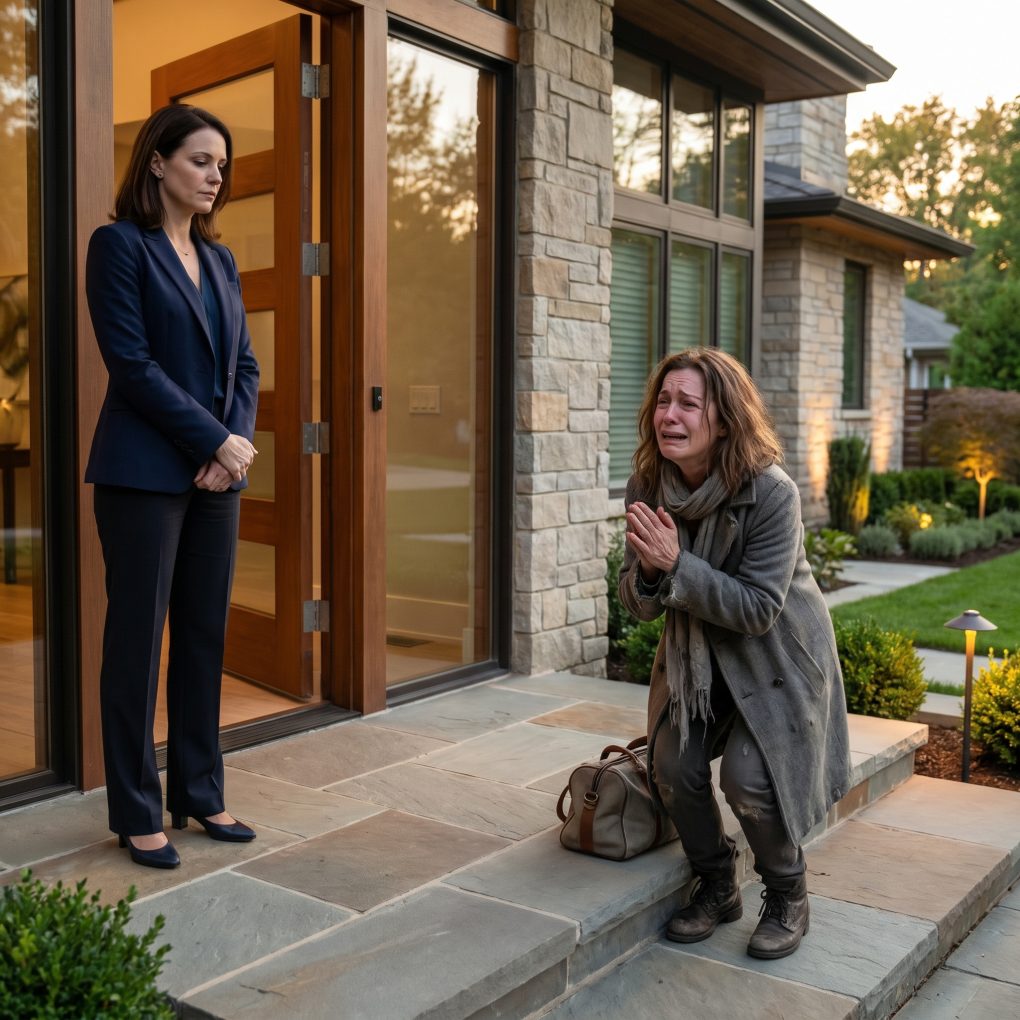
My sister faked cancer to destroy my dream of getting into an Ivy League school, so I exposed her lies and watched her life fall apart. Two years later, she stood on my doorstep in tears, asking if we could be sisters again.
My sister faked cancer to destroy my dream of getting into an Ivy League school, so I exposed her lies and watched her life fall apart. Two years later, she stood on my doorstep in tears, asking if we could be sisters again.
The first lie my sister told was that the doctors had found a mass.
She told it at our kitchen table three weeks before my Yale interview, with both hands wrapped around a mug of tea and our mother already crying before the sentence was even finished.
“Stage two,” Chloe whispered. “They think.”
I remember every stupid detail. The ticking wall clock. The half-folded laundry on the couch. My application binder still open beside me, color-coded tabs sticking out like little flags for the future I had spent four years building. Essays. Recommendation copies. Scholarship notes. Interview prep.
And Chloe—seventeen, pale, shaking just enough to look convincing—saying the one thing guaranteed to turn the whole house into a shrine around her.
The next two weeks became a funeral rehearsal.
My SAT tutor was canceled because Mom “couldn’t leave Chloe alone.” Dad used my college fund for a “specialist” deposit. Teachers excused my late assignments with pity in their eyes. And every time I tried to talk about deadlines or interviews, my parents looked at me like I was selfish for still wanting a future while my sister was “dying.”
Then I found the wig receipt.
Not in a hospital bag. Not next to prescriptions. In Chloe’s desk drawer, under lip gloss and concert tickets and a printed email confirming she had failed AP Chemistry so badly she’d lose the scholarship nomination she’d been chasing.
The receipt was dated two days before her diagnosis.
I stared at it so long my hands started shaking.
That night, I searched harder.
And by midnight, I had screenshots, fake clinic forms, a prepaid burner phone, and a private group chat where Chloe told her friends:
If Emily gets into Yale while I’m stuck here, I’ll actually die. So now she doesn’t get to leave me behind.
My entire body went cold.
I printed everything.
And the next morning, at breakfast, while my parents were discussing whether I should skip my interview to “support the family,” I dropped the stack of papers on the table and said, “Chloe’s not dying. She’s lying.”
My mother slapped me before anyone opened the first page.
She thought exposing the lie would end it. It didn’t. Once the papers hit the breakfast table, the family split wide open—and her sister wasn’t done destroying things yet. The rest of the story is below 👇
My mother slapped me hard enough to turn my face sideways.
Not because the proof was weak.
Because it was strong.
The papers slid across the breakfast table in a messy white fan—receipts, screenshots, fake medical forms, printouts from the insurance portal, and one grainy photo I had taken on my phone the night before: Chloe in her room, laughing into a mirror while adjusting the expensive synthetic wig she had supposedly “lost to chemo.”
For one second after my mother hit me, nobody moved.
Then Dad said, “What is this?”
His voice didn’t sound angry yet.
It sounded scared.
Chloe, sitting there in an oversized hoodie with a knit cap pulled low over her shaved head, went perfectly still. And that stillness told me more than any denial could have.
I put a hand to my cheek and forced myself not to cry. “It’s the truth.”
Mom stood up so fast her chair screeched. “You disgusting, jealous—”
“Read it!” I shouted. My voice cracked. “Just read one page!”
Dad did.
He picked up the wig receipt first, probably because it was on top. His eyes moved. Stopped. Moved again.
Then he reached for the forged pathology report.
His whole face changed.
Mom was still breathing hard beside him, not reading, just waiting to keep defending Chloe until the facts made that impossible. I watched the exact moment denial and comprehension collided in her eyes as Dad slowly handed her the report and said, “Linda… the clinic address is a strip mall.”
Chloe stood up. “It’s not what it looks like.”
That was the first thing she said.
Not I can explain. Not I’m sorry. Just the oldest liar’s sentence in the world.
I laughed, and it came out ugly. “Really? Because it looks like you faked cancer.”
“Emily!” my mother snapped, but there was fear in it now, not certainty.
Dad turned to Chloe. “Where is Dr. Madden?”
Chloe crossed her arms over her chest. “I switched providers.”
Dad’s voice sharpened. “Then why is there no insurance record for treatment?”
She didn’t answer fast enough.
So I did it for her. “Because there was no treatment. Because she uploaded fake claims herself. Because she made a group chat called Operation Malignant with Kelsey and Bri and told them she needed everyone focused on her until my Yale stuff was over.”
Mom actually made a sound like choking.
Chloe’s head snapped toward me. “You went through my phone?”
“You went through my life.”
That landed.
Hard.
Dad sat down like his knees had given out. He looked at Chloe the way people look at sudden wreckage—as if maybe, if they don’t move, it will rearrange itself into something survivable.
“It was Yale?” he asked.
That was what got her.
Not the fraud. Not the fake illness.
The name.
Yale.
Because suddenly the whole thing sounded as petty and vicious as it really was.
Chloe’s eyes filled, but I knew her too well by then. Tears were often the second act, not the truth.
“She was leaving,” Chloe whispered. “Everybody was acting like she was already gone. Teachers, neighbors, Grandma, everybody. Like she was the star and I was just…” She swallowed. “I was failing everything. I was stuck. Nobody cared.”
“I cared,” Mom said automatically.
Chloe looked at her with something close to contempt. “No, you panicked. That’s not the same thing.”
Then she turned to me.
“You have no idea what it’s like to be the sister of someone like you.”
That sentence should have felt good, maybe. Vindicating.
Instead it made me cold.
“Someone like me?” I repeated.
“You always win,” she snapped. “Grades, awards, teachers, Dad’s attention, every stupid article in the local paper—”
Dad actually flinched.
Because there it was too: the family ecosystem that had fed all this. My success. Her resentment. Their guilt. Everybody acting as though balance could be restored if I were asked—again—to shrink for peace.
Chloe had just found a bigger tool.
Cancer.
My mother sat down slowly. “Chloe… tell me this isn’t true.”
Chloe looked at her for a long time.
Then, in a voice so flat it was more frightening than yelling, she said, “I didn’t think it would go this far.”
It was true, then.
All of it.
Mom began crying immediately.
Dad didn’t.
He just looked older.
What happened next should have been simple. The truth came out, we got her help, and maybe my life resumed.
That is not what happened.
Because by noon, half the town knew.
Not because I told them.
Because Chloe did.
She posted first.
A black screen on Instagram with white text:
I never lied about being sick. My family is trying to silence me because my sister is afraid I finally mattered.
Then came crying selfies. Then vague references to “medical privacy.” Then a post implying I had hacked her phone and forged evidence because I “couldn’t stand not being the golden child for one week.”
Her friends reposted everything.
By three p.m., girls from school were texting me things like how could you do this if she’s actually dying? and jealousy is evil.
I stared at my phone in disbelief.
“She’s flipping it,” I said.
Dad took my phone, read two posts, and finally snapped into motion. “Give me hers.”
Mom still wanted to talk first, to reason, to protect. Dad went straight upstairs, pounded once on Chloe’s door, and when she refused to open it, took the hinges off.
I had never seen him do anything like that.
He brought the phone back down.
What he found finished the job.
Not just the group chat. Not just fake claims. There were emails to a local charity about a cancer fundraiser she hoped to “quietly” accept. Draft GoFundMe language. Messages to a classmate asking where to buy realistic nausea makeup. A saved note titled Things to say when people ask about chemo.
And one voice memo.
My voice, recorded without my knowledge three nights earlier while I was crying in my room after canceling my Yale flyout.
In the recording, I said, “I can’t even be mad because if she’s really sick, then I’m a monster for resenting it.”
Chloe had labeled it:
In case I need proof Emily hates me.
That was the moment I stopped shaking.
Something inside me just went still.
Dad called the police because of the insurance fraud. Mom begged him not to. Said counseling first, family first, mercy first. Dad said, “She committed a crime.”
Mom answered, “She’s our daughter.”
And there it was again—that old, poisonous equation in which being family meant other people had to absorb whatever Chloe did.
The officers came just after dinner. They didn’t arrest her on the spot, but they took statements, copies of the forged documents, and her laptop with a warrant request already in motion because the insurance portal upload had triggered a fraud flag on its own.
Neighbors watched from porches.
Our house glowed with the humiliating kind of light people remember forever.
The twist I never saw coming came later that night, when Yale called.
Not with congratulations. Not with sympathy.
With concern.
My alumni interviewer had seen the circulating posts and wanted to know whether I was safe and whether the chaos at home explained why I had missed the flyout, the second interview, and two follow-up deadlines.
I stood in the laundry room clutching the phone while the dryer thumped behind me and said the truth in one sentence:
“My sister faked cancer, and my family let it swallow my application season.”
Silence.
Then the interviewer said quietly, “Send me everything.”
So I did.
Not because I thought it would save anything.
Because by then I was done protecting the wrong person.
The next week was a public slow-motion explosion. School administrators got involved because Chloe had leveraged fake illness for deadline extensions and special accommodations. The local charity withdrew support and publicly clarified that no verified diagnosis had ever been provided. Parents in town started talking. Some were disgusted. Some were weirdly sympathetic. A few blamed me for “not handling it privately.”
Those people were my favorite.
As if private was not the soil the lie had grown in.
At home, my parents split in opposite directions. Dad turned cold, procedural, all consequences and appointments and phone calls to lawyers. Mom spiraled into a grief that had no clean place to go—half mourning the daughter she thought she had, half furious at the daughter in front of her, and somehow still trying to make me soften.
“She needs help,” Mom kept saying.
“So did I,” I answered once. “What I got was sacrificed.”
That shut her up for an hour.
The final blow came when Chloe tried one more move.
She sent Yale an anonymous email from a new account claiming I had fabricated the evidence because I was “known to have obsessive competitive behavior.” Only she used wording identical to a sentence from one of her own drafts on the laptop police already had.
The cyber unit flagged it within a day.
When Dad found out, he didn’t yell.
He just took down every framed family photo in the hallway and placed them face-down on the dining room table like a row of bodies.
By spring, Chloe had lost her scholarship nomination, been charged with fraud-related offenses through juvenile diversion because of her age, and become the cautionary tale people whispered about in grocery aisles.
And me?
I got an email with a Yale subject line I was too afraid to open for twelve full minutes
I got in.
Not because the universe is neat.
Not because merit always wins.
I got in because one exhausted alumni interviewer believed the truth looked like truth, because Yale reopened part of my file after reviewing the documentation, and because somewhere under the wreckage of that winter, my application was still strong enough to survive.
When I saw the word Congratulations, I didn’t scream.
I just sat on my bedroom floor and cried so hard I could barely breathe.
Mom found me there ten minutes later.
For a second, I thought maybe this would be one of those healing scenes people imagine when they say family crisis brings everyone closer. She would see the email, understand everything it had cost, and finally hold me the way mothers are supposed to hold daughters who nearly lost their future.
Instead, she looked at the screen, covered her mouth, and said, “I wish this didn’t have to happen like this.”
Like this.
Not I’m proud of you. Not I’m sorry.
Just grief that Chloe’s collapse had become the path I walked through.
It was the exact moment I understood our family would never repair in the version I had spent years hoping for.
So I left.
Not dramatically. Not with a speech.
I went to Yale in August with two suitcases, a used laptop, a dorm assignment, and a father who drove me in silence almost the whole way because he had become a man who no longer trusted his own instincts enough to speak freely.
At one rest stop in Pennsylvania, he stood beside the car and said, “I should have seen it sooner.”
I looked at him for a long time.
“Yes,” I said.
He nodded once, like he deserved nothing softer, and helped me load back in.
We never found a better sentence than that.
College was not magically easy after that. I had panic spikes every time someone in my family group chat used the word emergency. I hoarded email confirmations. I had trouble believing good news until it survived forty-eight hours. When classmates complained that their siblings were annoying, I sometimes had to leave the room before I said something unkind.
But I built a life anyway.
That is the rude, beautiful thing about survival. It keeps going.
I majored in political science and data ethics. I interned. I made real friends. I learned that ambition didn’t have to feel like treason. I met a professor who once said, gently, “You apologize before speaking every time you disagree. Who taught you that disagreement was damage?” and I cried in her office like a child.
Back home, Chloe’s life unraveled exactly the way lies do when they stop being protected. The juvenile case stayed off the worst public record, but everyone in town knew. The scholarship offers vanished. Friends thinned out. The charity fraud story stuck to her name harder than anything else. Mom kept trying to rehab the narrative—mental health, pressure, sibling rivalry, adolescent breakdown. Some of that was probably true. None of it erased intention.
For two years, Chloe and I barely spoke.
There were sporadic texts on birthdays. One cold email after Grandpa’s funeral. A single message my first spring semester that said, I hope Yale was worth it.
I deleted it without answering.
Then, two years almost to the month after the fake diagnosis exploded our lives, she showed up at my apartment in New Haven.
I opened the door in sweatpants, halfway through outlining a paper, and for one horrifying second I thought I was seeing a ghost from an earlier version of myself.
Chloe stood there in the hall, thinner than I remembered, hair grown out to her shoulders, face washed bare of all the drama she used to wear like armor. She was holding no luggage. No flowers. No script I could see.
Just tears.
“I know I shouldn’t have come without asking,” she said.
I didn’t say anything.
“I was nearby,” she lied first, then shook her head. “No. That’s not true. I took the train here because I’ve been rehearsing this for six weeks and every version sounded fake.”
That, at least, sounded real.
“What do you want?” I asked.
She looked at me the way people look at locked doors and old damage. “I want to know if we can ever be sisters again.”
There it was.
The impossible sentence.
I leaned against the doorframe because my body had started remembering before my mind caught up—kitchen table, fake tears, ruined deadlines, my mother’s slap, Yale nearly slipping away while Chloe staged sickness like theater.
“You didn’t just lie,” I said. “You detonated my life.”
Her face crumpled. “I know.”
“No. I don’t think you do.”
She let me say it.
That was new.
So I kept going.
“You made me look cruel for being scared. You made me cancel opportunities I had worked years for. You recorded me crying and labeled it proof that I hated you. You tried to sabotage Yale after you got caught. Do you understand how deep that goes?”
She nodded through tears. “Yes.”
I almost laughed. “That’s a very convenient yes.”
“I’ve been in treatment.”
I went still.
Not because treatment excused anything. Because it complicated it.
She wiped her face with the heel of her hand. “Real treatment. Not performative. Not because Mom made me. Because after everything… after everybody stopped rearranging themselves around me, I had to sit in what I’d done. And it was disgusting.”
There are apologies you can feel trying to manipulate the room.
This one didn’t.
That didn’t make it enough.
She reached into her coat pocket and handed me a folded sheet of paper. “My therapist told me not to come here asking for forgiveness. So I wrote down what I actually owe you.”
I didn’t take it right away.
Then I did.
It was not a dramatic letter. No excuses. No childhood montage. Just specifics.
I lied about cancer because I wanted to stop your future long enough to feel less left behind.
I used Mom and Dad’s fear because I knew they would center me if I made the threat big enough.
I kept escalating after being caught because humiliation felt unbearable and hurting you still felt easier than facing myself.
You do not owe me reunion because I finally told the truth about myself.
I read it twice.
Then I looked at her. “Did Mom know you were coming?”
That question mattered more than she understood.
Chloe shook her head immediately. “No.”
I believed her.
That mattered too.
We stood there in the apartment hallway while someone down the corridor microwaved something terrible and a girl laughed behind another door and ordinary life kept moving like this wasn’t the axis of mine.
Finally Chloe said, “I’m not asking you to pretend it didn’t happen.”
“Good.”
“I’m asking whether I can start being honest now.”
I thought about that.
About honesty after catastrophe.
About whether some people only become sincere once lying stops paying.
About whether that sincerity still counts.
Then I stepped back from the door.
“Ten minutes,” I said.
She blinked. “What?”
“You asked if we can be sisters again. I don’t have an answer. But I can give you ten minutes and the truth.”
She started crying harder then, which annoyed me on principle, but I let her in anyway.
We sat at my tiny kitchen table with mismatched mugs and no performance. For the first time in our lives, there was no parent in the room translating her, softening me, or asking me to be the bigger person because I was better at carrying weight.
She told me treatment had come after a second implosion—faking a panic-induced fainting episode at community college when another girl won a transfer scholarship Chloe wanted. Not cancer this time, but the same hunger to redirect reality until pain became attention and attention became power. One professor saw through it and forced an intervention. For once, no one in town was left to romanticize her.
“Turns out I wasn’t misunderstood,” Chloe said with a weak laugh. “I was manipulative.”
“That’s closer.”
She nodded.
I asked the question I had carried for two years. “Why Yale?”
She answered without flinching. “Because you leaving meant I’d have to see myself without comparison. And I was terrified the answer would be that I was ordinary.”
That sentence sat between us.
Ugly. Honest. Human.
I could work with ugly honesty. I had no use for polished lies.
When the ten minutes were up, she stood.
“I don’t deserve another chance just because I came here crying,” she said.
“No.”
“But…”
I looked at her.
She took a breath. “But if there’s ever a version of the future where I earn one, I’d like to try.”
I walked her to the door.
At the threshold, she paused. “Were you happy there? At Yale?”
I thought about the nights in the library. The friends who knew the middle of my story, not just the polished beginning. The work I loved. The person I had become once nobody kept asking me to shrink so someone else could feel bigger.
“Yes,” I said. “I was.”
She smiled through tears, and this time it didn’t feel like theater.
“Good,” she whispered.
Then she left.
We did not become sisters again that day.
That is not how rebuilding works.
But we started something smaller and harder: truth with boundaries. Occasional calls. A holiday coffee when I was home. Long silences that were not punishment, just reality. She stayed in treatment. I stayed watchful. Mom hated that I would not give her the cinematic reunion she wanted. Dad, strangely, respected it.
A year later, when Chloe finished her transfer application to a state university social work program, she asked if I would read her personal statement.
I almost said no on reflex.
Then I opened the document.
It began:
At seventeen, I learned that if I made my pain dramatic enough, other people would hand me their lives. It took losing my sister to understand that attention and love are not the same thing.
I sat with that line for a long time.
Then I made comments in the margins.
Not because everything was healed.
Because healing, I’d learned, was sometimes just the decision to tell the truth and stay in the room long enough for it to matter.
Two years after I watched her life fall apart, my sister stood on my doorstep asking if we could be sisters again.
The answer was not yes.
It was not no either.
It was: not the old way. Never the old way. But maybe something honest can grow where the lie burned out.


.jpg)


0 commentaires:
Enregistrer un commentaire