
My best friend refused to come back from vacation after her daughter tried to take her own life. Then she accused me of “kidnapping” the girl just because I had taken her home and cared for her. When I confronted her, she sneered, “She only did it for attention.” I just stared at her. That was six months ago. This morning, she was crying outside a courtroom she wasn’t allowed to enter.
My best friend refused to come back from vacation after her daughter tried to take her own life. Then she accused me of “kidnapping” the girl just because I had taken her home and cared for her. When I confronted her, she sneered, “She only did it for attention.” I just stared at her. That was six months ago. This morning, she was crying outside a courtroom she wasn’t allowed to enter.
My best friend answered the phone from a beach in Cancún while her daughter was still in the emergency room.
I was standing in the hospital hallway with seventeen-year-old Sophie wrapped in one of those thin gray blankets they give patients after they’ve cut your clothes off and pumped your stomach and decided you get to stay alive a little longer.
Her mascara was gone. Her wrists were bandaged. Her face looked younger than it ever had, like pain had peeled the years off her.
And her mother, Melissa—my best friend of fourteen years—picked up on the third ring and said, annoyed, “What now?”
I thought I had misheard her.
“Your daughter tried to kill herself,” I said.
There was a pause. Then the sound of ocean wind on the line.
“I know she took something,” Melissa said. “She texted me before you people made it dramatic.”
I stared through the ICU doors, trying to process the words you people.
“She needs you here,” I said. “Get on the next flight.”
Melissa sighed. “I’ve already paid for the villa through Sunday.”
For one full second, I could not speak.
Behind me, Sophie started crying without sound, just tears spilling down both cheeks while she clutched the blanket tighter around herself.
“Melissa,” I said, quieter now because rage had gone cold, “your daughter is on suicide watch.”
“And I’m supposed to believe she meant it?” she snapped. “Please. Sophie does things for attention when she’s upset.”
That was the moment something in me changed.
I looked at Sophie.
Then at the psych nurse waiting for discharge planning.
Then back at the dark hospital window where my own face looked older, harder, more like somebody I hadn’t met yet.
“I’m taking her home with me tonight,” I said.
Melissa laughed.
“You do that,” she said. “Then don’t cry when I report you for kidnapping my child.”
That was six months ago.
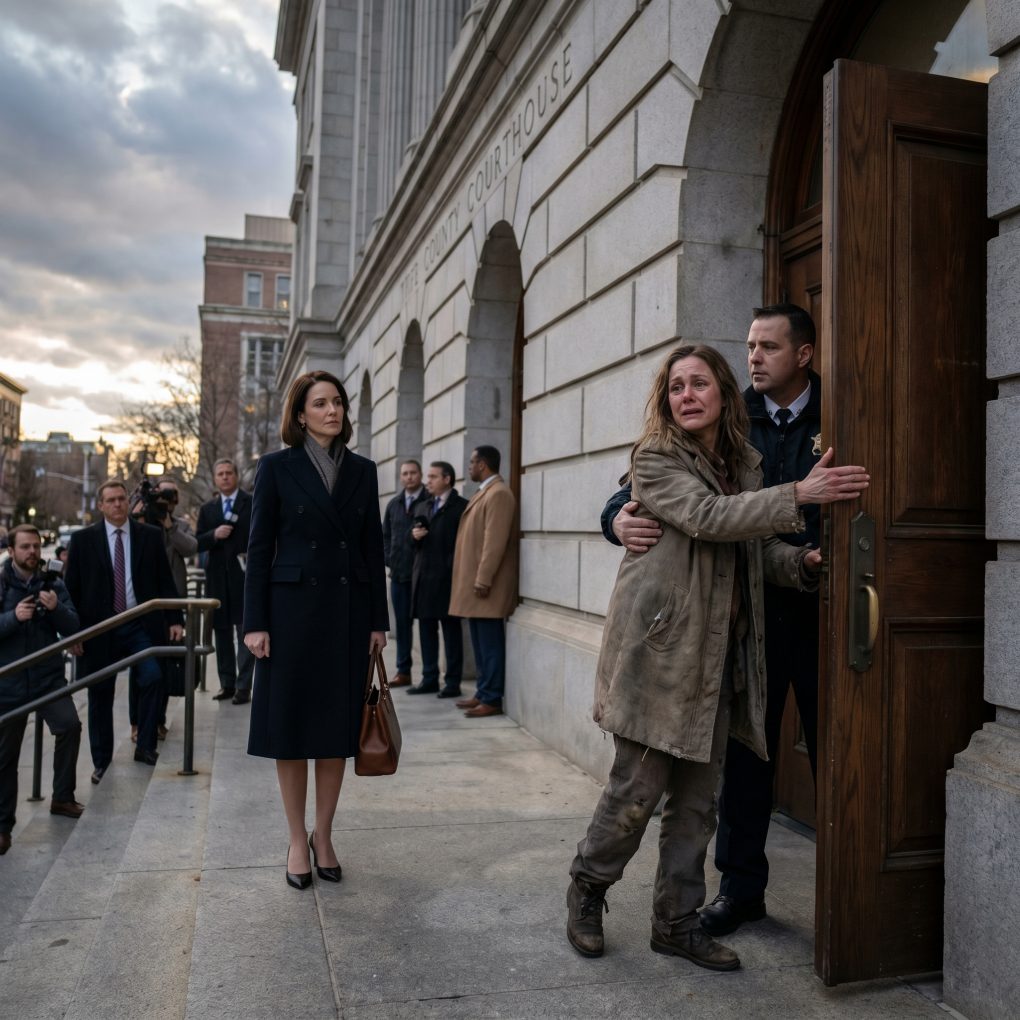
At 8:11 this morning, I walked into the county courthouse holding Sophie’s hand and saw Melissa outside the security doors, crying so hard she could barely breathe, because the judge had finally barred her from entering the room.
At first, I thought the hospital was the worst part—watching a mother choose her vacation over her daughter’s life. I was wrong. The real nightmare started after I took Sophie home, and Melissa decided to turn neglect into war. The rest of the story is below 
The first week Sophie lived in my house, she apologized for everything.
For needing a blanket.
For not finishing soup.
For crying too long in the shower.
For waking me up at 2:00 a.m. because she couldn’t stop shaking and thought if she fell asleep she might not wake up again.
“Sorry,” she whispered so many times that by the fourth day I wanted to throw the word out the window.
“You do not have to apologize for surviving,” I told her once.
She looked at me like I was speaking a language she had never learned.
That told me more than the hospital chart ever could.
The official story, at least at first, was ugly enough: suicide attempt, absent mother, unsafe discharge situation, temporary caregiver authorization signed remotely by an annoyed hospital social worker who clearly hated Melissa before she ever met her. Melissa had refused to cut her trip short. The hospital documented every call. Every delay. Every time she said she was “not in a position to discuss logistics” while her daughter sat under fluorescent lights being asked whether she still wanted to die.
When Melissa got home and called the police on me, the officers did not arrest me. They spoke to Sophie privately, reviewed the discharge paperwork, and left looking disgusted. I thought that would end it.
It didn’t.
Because Melissa didn’t want Sophie back.
Not really.
What she wanted was control of the story.
The next morning, she posted a photo of herself crying in her car with the caption:
When people weaponize your child’s mental health crisis to alienate her from you, the pain is indescribable.
By noon, my phone was full of messages.
Some from mutual friends asking if I was okay.
Others asking why I had “overstepped.”
One woman I hadn’t spoken to in two years wrote, No matter what happened, a child belongs with her mother.
I stared at that text while Sophie sat at my kitchen table trying to force down half a banana and wondered how many terrible mothers got to keep children simply because people found biology easier than courage.
Melissa escalated fast.
She told people I had manipulated the hospital.
She said I had always been jealous of her relationship with Sophie.
She said I was “mentally attaching” to her daughter because I never had children of my own.
That one almost made me laugh from the sheer cruelty of it.
Sophie heard enough to stop checking her phone by day three.
By day five, she started having panic attacks whenever the doorbell rang.
By day six, Melissa sent me a certified letter demanding immediate return of her daughter and threatening civil action for custodial interference.
I showed it to Sophie at the kitchen table because I was done protecting lies from the person they were built to injure.
She read the first page, then folded it once and said, very quietly, “If I go back there, I’ll try again.”
I sat down across from her.
“Then you’re not going back there tonight.”
She looked up sharply. “You can’t stop her.”
“No,” I said. “But a judge might.”
That was when the real process began.
The hospital social worker helped me file for emergency temporary guardianship with Sophie’s consent. The school counselor submitted a statement. The attending psychiatrist documented Melissa’s refusal to return from vacation despite repeated warnings. The discharge notes included the phrase maternal minimization of active suicidality, which remains one of the driest and most devastating things I have ever read.
Melissa showed up to the emergency hearing in a cream blazer and soft makeup, looking like every polished suburban mother who has ever mistaken presentation for innocence.
She cried.
Of course she cried.
She told the court she had been “misinformed” about the severity of the incident. She said she believed Sophie had taken “a few anxiety pills for attention” and that I had used the crisis to “insert myself” into her family. She said Sophie was impressionable, emotionally volatile, and prone to exaggeration. Then she turned to look directly at her daughter and said, “You know how much I love you.”
Sophie flinched so hard the folding chair squealed against the courtroom floor.
The judge noticed.
That helped.
But what helped more was the text thread.
The hospital had preserved it when Melissa tried to argue she “never understood” the emergency. The prosecutor—because by then child welfare had gotten involved and a county attorney was present—read one message aloud:
I’m not flying home because she swallowed pills. She does dramatic stuff when boys ignore her. Stabilize her and bill the insurance.
Melissa stopped crying immediately.
That was the first crack in the performance.
The second came from Sophie herself.
She asked to speak.
I still remember the way her hands shook as she stood.
Not because she looked weak. Because she looked young. Too young to need that much courage.
“My mom knew,” she said.
The whole room went quiet.
“She always knows when I’m bad enough to need help,” Sophie continued, staring at the judge instead of her mother. “She just hates when I need it publicly.”
Melissa whispered, “Sophie—”
The judge shut her down with one glance.
Then Sophie told the court about the bathroom floor two months before the suicide attempt. About cutting and Melissa yelling because blood had stained the grout. About being told, If you want attention that badly, at least don’t ruin the tile.
I felt something cold pass through the room.
Melissa’s attorney tried to object. The judge allowed it.
And then came the twist none of us were prepared for.
Sophie said, “That wasn’t even the worst part.”
She reached into her backpack, pulled out a folded composition notebook, and placed it on the evidence table.
“My mom writes things down,” she said. “When she’s angry. Or when she wants to remember exactly how people fail her.”
The notebook was black-and-white marbled, the kind every school kid has. Ordinary. Cheap. Terrifying.
The judge took a recess to review it in chambers.
When she came back, Melissa was no longer allowed to address Sophie directly.
I found out why later.
The notebook wasn’t a diary in the sentimental sense. It was a ledger of grievance. Names, slights, punishments, strategies. Pages about Sophie’s father, who had vanished when Sophie was five. Pages about coworkers. Pages about me.
And under Sophie’s name, entries like:
Crying jag tonight. Ignore. Rewarding weakness makes it chronic.
If she threatens suicide again, leave her alone long enough to see she doesn’t mean it.
Megan too emotionally involved. Dangerous. Sophie responds to replacement mothers. Break attachment early.
Break attachment early.
That was what the kidnapping accusation had always been about.
Not love. Not fear.
She saw her daughter reach for safety elsewhere, and she wanted to destroy the bridge.
Emergency guardianship was granted that afternoon.
Melissa lost unsupervised access pending a full hearing.
Outside the courthouse, she cornered me near the vending machines and hissed, “You think she loves you? She loves anyone who rescues her for five minutes.”
I looked at her and, for the first time in fourteen years, saw no trace of my friend.
Only appetite.
“She tried to die,” I said.
Melissa rolled her eyes. “She only did it for attention.”
I just stared at her.
That was six months ago.
And I swear that if she had said one more word, I might have forgotten every instruction my lawyer gave me about restraint.
Instead, I walked away and put all my energy where it belonged: into keeping Sophie alive long enough to learn that surviving was not manipulation.
The next months were war.
Therapists. School meetings. Medication stabilization. Home studies. Guardian ad litem interviews. Melissa violated temporary orders twice by showing up at school unannounced and once by sending Sophie a voice note that said, sobbing, If you keep doing this to me, I have nothing left.
That message became evidence too.
The county petition shifted from temporary guardianship to dependency review.
Melissa still thought she could outcharm it.
She had no idea what else was coming.
Because two weeks before the full hearing, Detective Rowan Hill called and asked whether I knew what was in the storage boxes Melissa had moved out of her basement after the emergency order.
I said no.
He said, “You might want to sit down.”
The boxes were full of records.
Not tax files. Not ordinary household junk.
Records.
School counselor notes Melissa had illegally copied from Sophie’s backpack over the years. Prescription printouts. Burned DVDs labeled with dates. Printed emails from teachers. Family court articles. Drafts of statements. Screenshots of Sophie’s texts arranged in neat plastic sleeves with Melissa’s own handwritten notes attached.
USE IF SHE GETS DRAMATIC AGAIN.
Proof she lies when emotional.
Teacher likes her too much — watch this one.
And in the last box, under a folded beach cover-up from Cancún, they found a yellow envelope marked:
COURT — IF SHE TURNS ON ME
Inside was a fully prepared packet designed to destroy Sophie at the full dependency hearing.
False allegations that Sophie had a sexual relationship with an older boy and was suicidal only because I “encouraged rebellion.” Draft affidavits accusing me of drinking around her. A typed narrative claiming Sophie had threatened to accuse “good adults” of abuse when she didn’t get her way.
Melissa had not only ignored her daughter’s suicide attempt.
She had been preparing to bury her afterward.
When Detective Hill laid the copies out on my dining room table, Sophie sat beside me in silence so complete it scared me.
I reached for her hand.
She let me take it, but she didn’t squeeze back.
“I thought maybe…” she began, then stopped.
“What?”
She stared at the papers. “I thought maybe she was just mean because she was overwhelmed.”
The sentence shattered me.
Because even after everything, children still look for smaller reasons. Manageable reasons. They shrink the crime to preserve the mother.
I said the only thing honest enough to be useful.
“She was overwhelmed,” I said. “And cruel. And negligent. And deliberate. Those things can exist together.”
Sophie nodded once, like someone placing a brick onto a stack too tall to carry.
The courtroom hearing was set for the following Monday.
Melissa was ordered not to contact Sophie directly and not to appear outside approved proceedings without counsel. She violated the spirit of that order three days later by waiting outside my driveway in her car at dawn. She didn’t get out. Just sat there staring at the house until a patrol unit rolled past and made her move along.
The judge heard about that too.
By hearing day, Melissa no longer looked polished. She looked frayed. Puffy-eyed. Desperate. Which would have made me pity her once. Not anymore.
The county presented first.
Hospital records. Therapist statements. School documentation. The notebook. The Cancún texts. The yellow envelope with the false packet. The driveway incident. And then Detective Hill testified about the boxes and the evidence that Melissa had been systematically collecting material for years not to help her daughter, but to discredit and control her whenever she feared losing influence.
Melissa’s attorney tried to reframe it as anxious parenting. Meticulous recordkeeping. Fear of a troubled teen. Misunderstood preparation.
Then the county read one note out loud:
If she survives, keep her guilty. Gratitude works better than guilt only when she’s weak.
That ended the anxious-parenting narrative.
Melissa cried again. Talked about stress. Isolation. Single motherhood. Sophie’s volatility. My interference. She said she had “made mistakes under pressure.” She said she never wanted Sophie dead.
I believe that.
Wanting someone dead is not required to destroy them.
Sometimes wanting them dependent is enough.
Then Sophie testified.
Not because I wanted her to. Because she insisted.
She walked to the witness chair in a navy cardigan and the tiny silver necklace I gave her after her first month in my house, the one with a small compass charm because she once told her therapist she had “never felt pointed anywhere safe.”
Her voice shook on the first question.
Then steadied.
“My mom says everything is for attention,” she told the judge. “Crying. Panic attacks. Asking for help. Even trying to die. So after a while, you start thinking maybe the only way to prove you’re really hurting is to get worse.”
Nobody in that courtroom moved.
“I didn’t go with Megan because she kidnapped me,” Sophie said. “I went because I wanted to live.”
Melissa made a sound behind the defense table like she’d been struck.
The judge did not look at her.
By the end of the hearing, the county requested full no-contact suspension pending treatment and long-term review, with my temporary guardianship extended and conversion proceedings opened.
Melissa’s attorney asked for continued visitation.
The judge said no.
Not angry. Not dramatic.
Just no.
And because Melissa had attempted twice to contact Sophie outside orders, submitted materially false documents, and demonstrated a pattern of emotional manipulation severe enough to undermine safety, the judge also barred her from entering the final protective-status review without specific permission.
That was this morning.
That was why Melissa was outside the courtroom, crying against the cinderblock wall near security, while Sophie and I walked past her without stopping.
She looked up at us with mascara all down her face and whispered, “Please. I’m still your mother.”
Sophie kept walking.
So did I.
Six months ago, outside the first hearing, Melissa sneered that Sophie had only tried to kill herself for attention.
This morning, she was the one outside a courtroom she wasn’t allowed to enter, finally learning what it feels like when nobody mistakes your performance for emergency anymore.
The final order gave me continuing guardianship, mandated trauma treatment for Sophie, and suspended Melissa’s direct contact until substantial compliance, review, and Sophie’s consent at a future date.
That last part mattered most.
Sophie’s consent.
Her voice.
Her threshold.
Not mine. Not Melissa’s. Hers.
The first night after the ruling, Sophie sat at my kitchen table in socks and one of my old sweatshirts, eating boxed mac and cheese straight from a bowl too big for her lap.
“Do you think she’ll ever get better?” she asked.
I didn’t lie.
“I think she might get better at understanding what she did,” I said. “I don’t know if that’s the same thing.”
She thought about that for a while.
Then she nodded.
“That’s fair.”
Teenagers say astonishing things when they’ve had to grow up around madness.
She still has hard days. Of course she does. There are nights she panics if I’m ten minutes late from work. Days she folds inward because a teacher uses the phrase seeking attention. Moments when she apologizes for taking up space in her own life.
But she is alive.
She laughs now, sometimes suddenly and with her whole face.
She sleeps with the guest-room door open but not because she’s afraid I’ll lock it. Because she likes hearing someone else moving safely through the house.
She started painting again last month.
And I learned something I wish more adults understood before children pay for it:
Some parents do not break because they are overwhelmed. They become most dangerous when they are being seen clearly for the first time.
My best friend refused to come back from vacation after her daughter tried to take her own life. Then she accused me of kidnapping the girl because I took her home and cared for her.
Six months later, she was crying outside a courtroom she wasn’t allowed to enter.
And inside that courtroom, for the first time in her life, her daughter was believed before her mother was.


.jpg)


0 commentaires:
Enregistrer un commentaire