
After my children put me in a nursing home, I bought the facility and changed their visiting hours from 24/7 to never. When they showed up for their fake weekly visit… they were denied entry.
After my children put me in a nursing home, I bought the facility and changed their visiting hours from 24/7 to never. When they showed up for their fake weekly visit… they were denied entry.
The first time my daughter used the phrase “best for everyone,” she was standing beside a brochure rack full of assisted-living pamphlets and refusing to meet my eyes.
I was seventy-eight, still walking without a cane, still balancing my own checkbook, still driving to church every Sunday and to the library every Wednesday. I had arthritis, yes. High blood pressure, sure. But I was not confused, not helpless, and certainly not ready to be put away like winter china.
My son Matthew smiled through the whole ambush.
“You’ll have people around,” he said. “Activities. Nurses. Structure.”
Structure.
That was their favorite word whenever they wanted control to sound compassionate.
I knew the truth the second my daughter Karen started talking about “safety concerns” that had somehow never been serious enough to mention until the week after I refused to co-sign Matthew’s condo refinance. Suddenly my stairs were dangerous. My kitchen was risky. My independence was “a burden.” They had already toured facilities. Already chosen one. Already put down a deposit using money from the joint account Karen had convinced me to open “for emergencies.”
Mine, apparently.
Three days later, they brought me to Rosebrook Manor with two suitcases, a forced smile, and the kind of tender voices people use when they’re trying not to look like kidnappers.
“Just until things stabilize,” Karen whispered.
That was nine months ago.
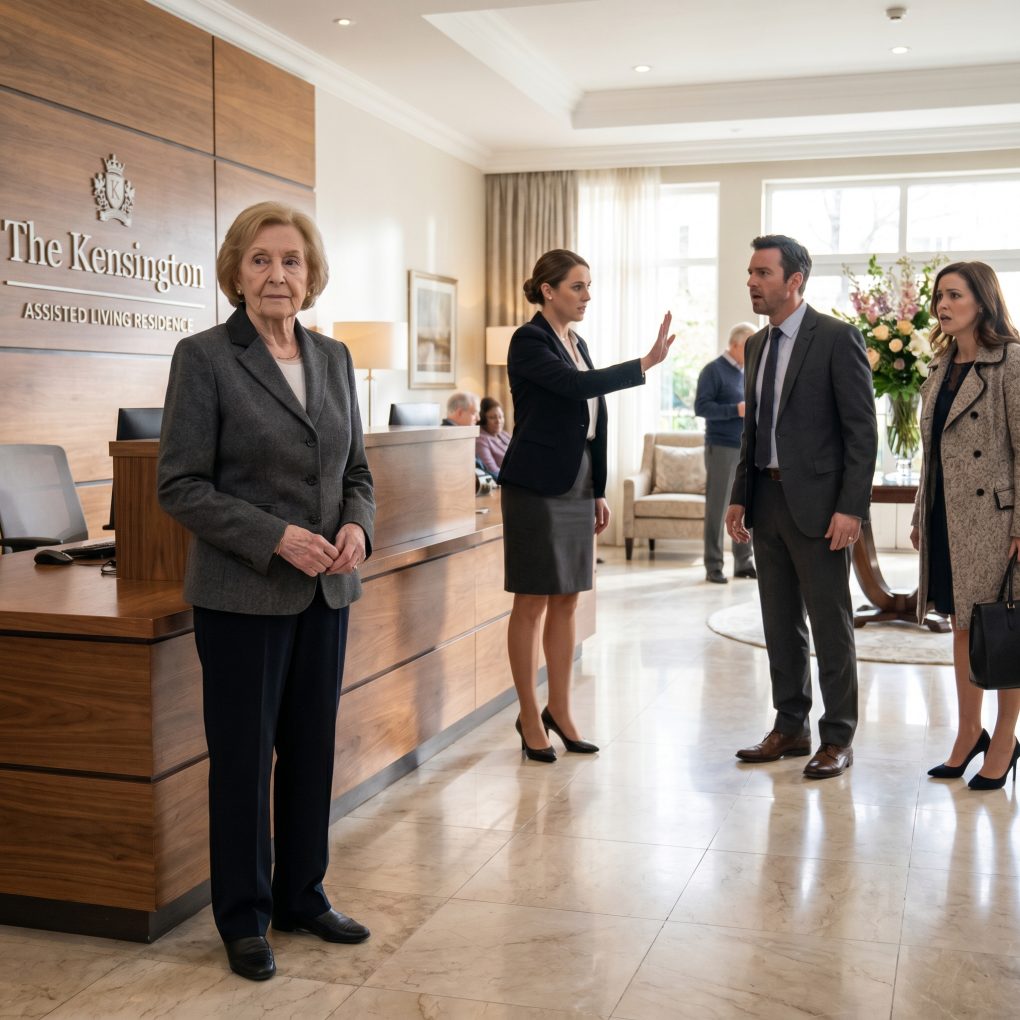
And this morning, at 10:03 sharp, my children walked up to Rosebrook’s front desk carrying store-bought muffins and fake concern for their weekly performance visit.
The receptionist checked the new ownership policy, looked up politely, and said, “I’m sorry. You are both on the permanent no-entry list.”
My daughter laughed first.
Then my son demanded the administrator.
That was when I stepped out of the office, holding the facility master key in one hand, and said, “No need. I’m the one who changed the rules.”
They thought they had parked their mother somewhere quiet until inheritance season. They had no idea what she’d been doing from inside the building—or how much Rosebrook’s owner needed exactly the kind of woman they’d underestimated. The rest of the story is below 
I did not buy Rosebrook Manor out of revenge.
Not at first.
At first, I was just trying not to die of humiliation.
That sounds dramatic until you understand what places like Rosebrook are built to do when families use them badly. Not the building itself. The building was decent enough. Clean. Competent. Kind in the institutional way that still hurts. But it was full of women and men who had been reduced to adjectives by their own children.
Confused.
Stubborn.
Difficult.
Safer here.
I recognized the language because I had heard it used about me before my first week was up.
My daughter Karen told the charge nurse I was “prone to agitation when she discusses finances.” My son Matthew asked whether medication reviews were “standard when older residents become unrealistic about returning home.” Unrealistic. That word landed harder than the move itself.
Because I was not unrealistic.
I knew exactly what they were doing.
Mrs. Alvarez kept calling when she could. Quietly. Guiltily. She told me my son had moved into my downstairs bedroom because “it made more sense.” Karen was “sorting things” from the study into banker’s boxes. My silver was gone. The china cabinet was empty. Two of my late husband’s fishing rods disappeared from the garage. When I asked whether the grand piano was still in the living room, Mrs. Alvarez got silent.
Then she said, “They sold it, Dolores.”
That was the first night I cried in Rosebrook.
Not because of the piano itself, though God knows I loved it. Because my husband Henry bought it with his second-year union bonus and said, “A house needs one unreasonable beautiful thing.” My children knew that story. They sold it anyway.
I stopped crying two days later.
That was when I met Mr. Baines.
Arthur Baines was eighty-four, sharp as broken glass, and in Rosebrook because his nephews had exhausted three lawyers and a county judge proving he was “unsafe alone” after he refused to liquidate the machine shop his father built in 1949. He played chess badly on purpose to make people underestimate him and called every social worker “kid” regardless of age.
On my third week there, he found me in the courtyard staring at the azaleas and said, “You don’t belong here.”
I looked at him. “Neither do you.”
“True,” he said. “But I’ve been rich longer, so I spotted it faster.”
That was how our friendship began.
Arthur knew things. Not gossip-things. Structural things. Who owned Rosebrook. Which wings lost money. Which administrator was kind but overworked. Which investment group had been circling the property for years because elder care is a nice clean way to make cruel money in loafers.
More importantly, Arthur knew I had resources.
Not because I told him.
Because I still held myself like a woman who had once signed checks without asking permission.
My husband Henry had not left me helpless. My children simply mistook politeness for dependency. They knew about the house, yes. They knew about my pension. They even knew about the safer investment account I’d let Karen “help” monitor. They did not know about Henry’s private stock portfolio, the one held under a dormant family trust he told me to touch only “if the kids ever start circling like crows.”
That phrase came back to me the night Arthur asked, over weak tea in the common room, “How much would it take to make this place answer to someone decent?”
I laughed.
Then I stopped laughing.
Because the owner of Rosebrook—a tired local physician named Dr. Mehra—was trying to sell. Not to some evil corporation in secret, but because his wife had cancer, his sons lived in California, and he was too exhausted to fight off private-equity vultures forever.
Arthur told me that.
Then he added, “If they buy it, everyone in this building gets turned into billing codes.”
I went to my room that night and opened the old envelope from Henry I had kept buried in my suitcase lining since the move. Inside were the trust contact numbers and his handwriting on hotel stationery:
Dolly — if the children ever make you feel owned, use what I hid and stop asking whether you’re allowed.
I called the trustee the next morning.
What followed took four months.
Four quiet, delicious months while my children kept visiting every Sunday, playing compassionate heirs, and assuming Rosebrook had dimmed me into compliance.
Meanwhile I reviewed documents.
Met with lawyers.
Studied occupancy rates.
Read staffing reports.
Learned what Medicare audits looked like.
Learned how badly Rosebrook needed someone who cared more about the residents than the margins.
And because life occasionally offers the exact right partner in pettiness, Arthur backed me all the way.
“Buy it,” he said.
“You’re insane,” I said.
“Probably,” he replied. “But more importantly, I’m right.”
He was.
The trust had more than enough.
Henry, in one of his last truly romantic acts, had been quietly brilliant about money.
And Dr. Mehra, when he finally met me in person instead of through counsel, looked at my file, then at me, then said, “You would keep the staff, wouldn’t you?”
“Yes.”
“You’d upgrade hospice wing four?”
“Yes.”
“You’d stop the consultants from turning the recreation room into a premium billing suite?”
“Yes.”
He leaned back in his chair and smiled for the first time that morning. “Then I’d rather sell to a furious woman than a hedge fund.”
That was how I became owner of Rosebrook Manor.
Not overnight. Not with a dramatic gavel slam. Quietly. Professionally. Legally. A month before the paperwork closed, I also changed my own external counsel and had an elder-abuse attorney review what my children had done with my house, my property, and my access to funds.
The results were not flattering.
Unauthorized asset conversion.
Coercive housing manipulation.
Potential exploitation through implied incapacity narratives.
Again: not dramatic crimes with ski masks.
Worse.
Family crimes.
The kind committed in calm voices while saying it’s for your own good.
Then came the second twist.
Karen had not merely redirected my mail.
She had drafted documents.
Temporary healthcare proxy forms.
Property listing worksheets.
A “memory concerns” summary to show a doctor if needed.
All unsigned.
All ready.
Just like Arthur predicted: they had not placed me somewhere safe.
They had staged me somewhere manageable.
When my ownership of Rosebrook officially transferred, the first thing I changed was not the furniture or the menu or the billing structure.
It was visitation policy.
Not for everyone.
Just for two people.
Karen Hale.
Matthew Hale.
Permanent denial of entry pending legal review and resident safety concerns.
I had the front desk print it in clean black ink and place it beside the visitor log.
Then I waited for Sunday.
They arrived carrying muffins.
That part still makes me laugh.
Blueberry for me, I assume. Banana nut for Arthur, because Karen always liked to perform attentiveness through baked goods she didn’t make herself.
Matthew wore his good quarter-zip sweater, the one that made him look like a deacon or a fraud, depending on what you knew. Karen had her sympathy face on already, the one with the softened mouth and slightly pinched eyebrows that said look how hard this is for me to anyone passing by.
They reached the desk at 10:06 a.m.
I was watching on camera from the former administrator’s office.
“Yes, we’re here to see our mother,” Karen said brightly.
The clerk—wonderful Gloria, who had raised three boys and feared nothing in loafers—typed their names, paused, then looked up.
“I’m sorry,” she said. “You are both on the no-entry list.”
Matthew actually laughed. “What?”
“I’m unable to admit you.”
Karen’s face shifted, but only slightly. “There must be some mistake.”
“There isn’t.”
That was when I stepped out.
The hallway did exactly what hallways do in places like Rosebrook: it carried silence faster than sound. Two nurses looked up. Arthur, God bless him, had positioned himself in the dayroom with a newspaper just to watch.
Karen saw me first.
“Mom,” she said, relief flooding in too quickly. “Thank God. They’re confused.”
“No,” I said. “Not anymore.”
Matthew straightened. “What is this?”
“This,” I said, “is what happens when the woman you parked in a nursing home turns out to own the building.”
You should have seen their faces.
Karen actually took one step back. Matthew looked at Gloria, then at me, then down the hall as if maybe reality had a manager he could appeal to.
“That’s not funny,” he said.
“I’m not joking.”
I held up the ownership badge because I wanted that image to live in them forever.
Karen recovered first, because she always did. Tears. Instant tears. “Mom, why are you doing this?”
Interesting question.
Not did we hurt you?
Not how did this happen?
Why are you doing this.
I said, “Because you put me here and started selling my life.”
That landed harder than the ownership did.
Matthew’s voice dropped. “You were safer here.”
“No,” I said. “I was quieter here.”
Arthur actually clapped from the dayroom.
The next twenty minutes were glorious and ugly.
Karen tried guilt.
Matthew tried authority.
Then they both tried public embarrassment, which failed because every staff member in that building already knew what kind of children they were by then. They had asked for sedation consults. Pushed for “compliance support.” Tried to get room inventory records twice. The nurses hated them before I ever signed the final papers.
When Karen realized pleading wasn’t working, she hissed, “You can’t just shut us out.”
I smiled. “I can. I did.”
Then she made the mistake.
She said, “What about my house?”
My house.
Not your home.
Not the place we’ve been staying.
Possession leaks out of bad people when they’re stressed.
I said, “You mean my house.”
Matthew went pale.
Because by then the attorney had already filed notice.
The piano sale.
The furniture.
The redirected mail.
The attempted competency paperwork.
All of it was now in the hands of someone who billed by the hour and didn’t care that they were my children.
I did not call the police immediately, though I could have.
I wanted paper first.
Depositions.
Repayment demands.
Inventory recovery.
The slow respectable unraveling that hurts people like my children much more than handcuffs would.
Karen started sobbing for real then.
“Mom, please. The boys ask about you.”
I almost wavered.
Almost.
Then I remembered my grandson Liam calling three weeks after they moved me in and whispering, “Mom says you’re happier with the old people now.” I remembered Matthew selling my husband’s fishing rods. I remembered Karen telling the nurse I was “sometimes imaginative about finances” while standing in my paid-for cardigan.
So I said the truest thing in the world.
“Then tell them why.”
Security walked them out.
Not roughly.
Not dramatically.
Just firmly enough that they had to feel the finality in their own feet.
Matthew turned once at the door and said, “You’re destroying the family.”
I looked at him and said, “No. I’m just no longer financing the lie.”
That was three months ago.
Karen and the boys live in a rental now.
Matthew is fighting the civil accounting and losing.
I got my piano back, although it needs tuning after the humidity in that storage unit they dumped it in. The fishing rods were recovered from a reseller in Benton. Arthur still cheats at chess. Wing four got its hospice renovation. The mashed potatoes are better. The recreation room is staying exactly where it is.
And every Sunday, right around 10:00, I still feel a small sweet glow in my chest remembering the exact look on my daughter’s face when the receptionist said, “I’m sorry. You are both on the permanent no-entry list.”
After my children put me in a nursing home, I bought the facility and changed their visiting hours from 24/7 to never.
When they showed up for their fake weekly visit, they were denied entry.
Not because I’m cruel.
Because I finally learned the difference between being loved and being managed—and once you know that, the locks change very easily.


.jpg)


0 commentaires:
Enregistrer un commentaire