
The school nurse said I was “just pretending,” but then my heart suddenly stopped right there in the hallway…
“I can’t breathe.”
The words tore out of my throat in the middle of Westfield High’s second-floor hallway, right between a row of blue lockers and the trophy case. My backpack slipped off one shoulder as pain clamped around my chest so hard it felt like invisible hands were crushing my ribs inward.
Students slowed, stared, then kept moving.
“Move,” I gasped to nobody and everybody. “Please—”
My knees buckled.
By the time someone dragged me into the nurse’s office, my fingers were numb, my vision was flickering at the edges, and my heart was pounding so fast it didn’t even feel real anymore. The school nurse, Mrs. Kenner, barely looked up from her computer.
“What happened this time, Lila?”
I grabbed the edge of her desk. “My chest—something’s wrong.”
She sighed like I’d interrupted her lunch. “You were in here three weeks ago because you felt dizzy before a math test.”
“That was different.” I swallowed hard. “Please call 911.”
A few kids had crowded outside the open office door. I could hear whispers.
“She’s doing it again.”
Mrs. Kenner stood and pressed two fingers to my wrist for less than a second. “Your pulse is fine.”
“It’s not fine,” I whispered. My hearing had started to distort, like I was underwater.
She lowered her voice, impatient now. “Lila, pretending to collapse in the hallway is not how you get sent home.”
I stared at her, shocked. “I’m not pretending.”
Then my chest gave one violent, painful thud.
And then—
nothing.
The hallway tilted. The fluorescent lights stretched into white lines. Someone screamed my name from the doorway just as my body hit the floor, and the last thing I saw was Mrs. Kenner’s face changing from annoyance to horror.
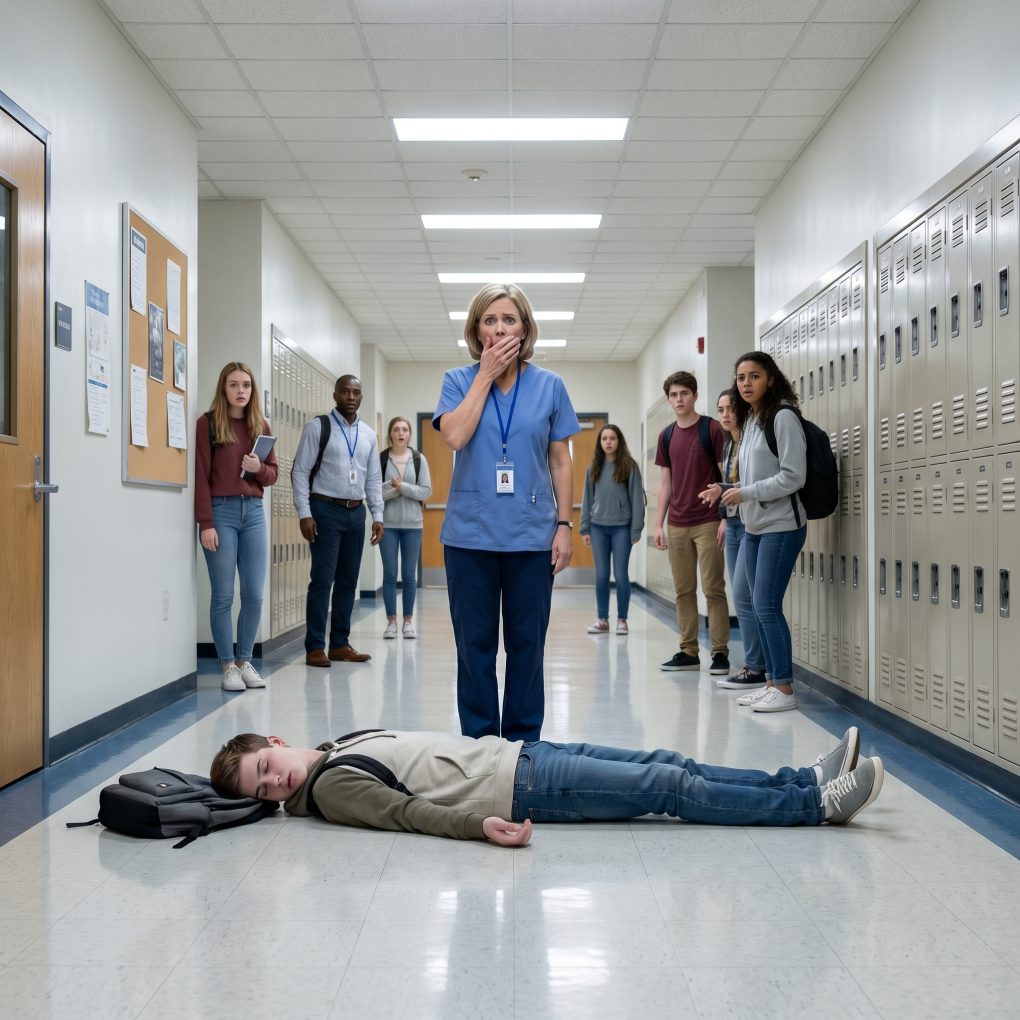
When Lila’s body hit the floor, the hallway exploded into chaos.
Tessa dropped beside her first. “Lila! Lila, wake up!”
Mrs. Kenner was already on her knees now, fingers pressed against Lila’s neck, searching, searching. The color drained from her face so fast it looked unreal.
“I—” Her voice cracked. “Call 911. Now!”
A security aide ran. A teacher started shouting for students to clear the hall. Someone else cried. Tessa couldn’t move. She kept staring at Lila’s face, at the way her eyes were half open but empty, at the terrible stillness of her chest.
Mrs. Kenner yanked open the emergency cabinet with shaking hands. “AED. Where’s the AED?”
“It’s mounted by the gym,” a teacher shouted.
“That’s two halls away!”
Then Coach Ramirez came sprinting around the corner with the red case in his hands like he’d ripped it off the wall himself. Mrs. Kenner snatched it, tore open Lila’s hoodie, and froze for half a second.
There was a small scar just below Lila’s collarbone. Not fresh. Thin, pale, almost hidden.
“What is that?” Tessa whispered.
Mrs. Kenner didn’t answer. She slapped the pads on Lila’s chest and switched on the machine.
A mechanical voice filled the hallway.
Analyzing heart rhythm. Do not touch the patient.
Everyone backed away.
Tessa held her breath.
Shock advised.
Mrs. Kenner flinched like the words had slapped her. “Clear!”
Lila’s body jerked with the shock. Her arms lifted, then dropped. Nothing.
“Start compressions,” Coach Ramirez said.
Mrs. Kenner began CPR, counting out loud with a voice that sounded nothing like hers from five minutes earlier. “One, two, three, four—”
Tessa was crying now. “Please don’t let her die. Please.”
The ambulance arrived in under six minutes, but to Tessa it felt like an hour. Paramedics took over with frightening speed—compressions, airway, IV, monitors, clipped commands. One of them looked at the screen and swore under his breath.
“What?” the other asked.
“She’s sixteen.”
“So?”
“So this rhythm doesn’t make sense.”
They loaded Lila onto the stretcher and pushed her out. Tessa started to follow, but Mrs. Kenner grabbed her wrist.
“You can’t go.”
Tessa ripped free. “You said she was pretending!”
Mrs. Kenner looked like she might throw up. “I know.”
That should have felt good, hearing the nurse admit it. Instead it made everything worse.
By the time Tessa’s mom drove her to St. Andrew’s Medical Center, Lila was in pediatric intensive care, intubated, sedated, and surrounded by machines. Tessa wasn’t allowed in at first. She sat in the waiting room with her knee bouncing uncontrollably while school administrators whispered nearby and tried not to look at her.
Then Lila’s mother arrived.
Janet Monroe looked like she had aged ten years in one car ride. Her hair was half out of its clip, her makeup streaked, her hospital badge from the pharmacy where she worked still hanging around her neck. The second she saw Tessa, she grabbed both her hands.
“What happened?”
Tessa opened her mouth, but what came out was, “She told them. She told them something was wrong.”
Janet closed her eyes.
That tiny reaction—small enough that no one else would have noticed—made Tessa’s stomach twist.
“You knew?” Tessa whispered.
Janet looked at the ICU doors, then back at her. “Not like this.”
“What does that mean?”
Before Janet could answer, a doctor in navy scrubs stepped out. “Mrs. Monroe?”
They went into a consultation room. Tessa sat close enough to hear through the not-quite-shut door.
“Your daughter went into cardiac arrest due to a dangerous arrhythmia,” the doctor said. “We restored circulation, but we need to understand why this happened. Has she ever been diagnosed with a heart condition?”
Silence.
Then Janet said, too quietly, “Not officially.”
Tessa’s head snapped toward the door.
The doctor’s tone sharpened. “Mrs. Monroe, this is not the moment to be vague.”
“When Lila was eleven,” Janet said, voice shaking, “she fainted during soccer practice. We were living in Ohio then. They ran tests. One doctor suspected catecholaminergic polymorphic ventricular tachycardia.”
The doctor swore under his breath. “CPVT?”
“I was told it wasn’t certain.”
“Did you follow up with pediatric cardiology?”
Janet didn’t answer fast enough.
The doctor’s chair scraped. “Mrs. Monroe, CPVT is rare, but it can be fatal if untreated. It causes life-threatening arrhythmias during physical or emotional stress. If that diagnosis was even suspected—”
“I know what it is!” Janet snapped, then broke immediately, her voice collapsing into tears. “I know.”
Tessa felt cold all over.
The doctor lowered his tone. “Was she on beta blockers? Flecainide? Did she have an implanted monitor? Anything?”
Another pause.
“There was medication,” Janet whispered. “For a while.”
“For a while?”
“She hated how it made her feel. Tired. Foggy. Different. And when we changed insurance after the divorce…” Janet’s breath hitched. “I kept meaning to get her back in. She stopped fainting. She looked fine.”
The doctor was silent for two full seconds.
Then: “Fine does not mean safe.”
Tessa pressed a hand over her mouth.
That should have been the whole answer. Hidden medical history. A mother who made a terrible mistake. A school nurse who didn’t listen. Tragedy built from neglect and bad luck.
But it wasn’t.
Because an hour later, after Lila was stabilized enough for more imaging, another doctor came into the room holding a chart and looking confused.
“There’s something else,” he said.
Janet wiped her face. “What?”
“We reviewed her old records from Ohio. The scar on her chest wasn’t from a minor procedure.” He turned the tablet so she could see. “Your daughter has an implanted loop recorder.”
Janet stared at him. “What?”
“It’s a small cardiac monitoring device. It was implanted beneath the skin years ago.”
“That’s impossible.”
“Mrs. Monroe, it’s right there.”
Janet shook her head violently. “No. No one told me that. They talked about maybe implanting something if things got worse. We never did that.”
The doctor frowned. “It’s physically in her body.”
Tessa stepped into the doorway before she could stop herself. “Could someone else have done it?”
Both adults turned toward her.
The doctor answered first. “Not without consent. Not in any normal situation.”
But Janet had gone white again—not grief-white this time, but fear-white.
“What?” Tessa asked. “What aren’t you saying?”
Janet sat down hard. “Lila’s father.”
The room went still.
“He worked for a private medical device company outside Columbus,” Janet said. “Experimental monitoring systems. Clinical trials, pediatric telemetry, remote arrhythmia detection. He was brilliant, and he was obsessed with data. When Lila first started fainting, he stopped acting like her father and started acting like she was… a case.”
The doctor’s expression changed. “What company?”
Janet named one Tessa didn’t recognize.
“He wanted access to her episodes,” Janet continued. “He said hospitals moved too slowly. Said if he could gather enough real-time rhythm data, he could prove the algorithms worked. I left him after that. I thought I stopped him from getting near her.”
Tessa’s mouth went dry. “You think he put that thing in her?”
“I don’t know,” Janet whispered. “But he signed forms behind my back before. He used friends in research. He always said everything he did was to save her life.”
The doctor immediately called hospital legal.
By midnight, things got even stranger.
A technician managed to interrogate the device inside Lila’s chest. It should have contained rhythm data from years ago—episodes, timestamps, maybe clues about what triggered the arrest.
Instead, the device memory had been remotely wiped at 2:14 p.m.
The exact minute Lila collapsed in the hallway.
The technician stared at the screen. “That shouldn’t be possible.”
“Why not?” Tessa asked.
“Because this model isn’t supposed to have active remote wipe capability.”
The doctor leaned in. “Supposed to?”
The technician swallowed. “Unless it’s not a standard model.”
That was the moment everyone in the room understood the same terrifying thing:
Whatever was in Lila’s chest wasn’t just monitoring her.
And someone had been watching.
At 2:40 a.m., while Janet slept sitting upright in a plastic chair and Tessa dozed with her head against the wall, Lila’s monitor alarm suddenly began screaming.
Nurses rushed in.
Her heart rate was climbing again—wild, chaotic, dangerous.
The doctor shouted for medication.
Lila’s eyelids fluttered.
For one impossible second, she seemed to surface through sedation. Her lips moved around the breathing tube, panicked, desperate. Tessa pushed off the wall and stepped closer.
Lila’s eyes found hers.
Then she mouthed two words.
He’s here.
Before anyone could ask what she meant, every monitor in the room cut black at once.
Part 3
For one breathless second, the ICU room became a cave.
The monitors died. The overhead screen went black. The steady mechanical beeping vanished so completely that Tessa could hear Janet’s chair scrape the floor as she jolted awake.
Then backup power slammed on.
Lights flashed. Alarms shrieked from three different directions. Nurses cursed. One machine rebooted. Another didn’t.
“Bag her!” the doctor shouted.
A respiratory therapist tore the ventilator tubing free and started manually forcing air into Lila’s lungs. A nurse checked the IV pumps. Another looked up at the ceiling like she could see the hospital’s electrical system through concrete.
“It wasn’t a building outage,” a tech yelled from the doorway. “Just this room—maybe this hall!”
Tessa’s skin prickled.
Not random.
Targeted.
Lila’s heart was misfiring again on the portable monitor they’d rushed in, but medication finally dragged the rhythm back from the edge. The room settled into controlled panic instead of total chaos. People moved fast, voices sharp and clipped.
Only then did Tessa realize Janet was staring at the hallway with the expression of someone who had just seen a ghost.
“Janet?” Tessa whispered.
“He’s here,” Janet said.
This time it wasn’t a question.
Hospital security arrived within minutes. So did an administrator and two people from legal. The police were called after the technician explained, again, that the device inside Lila’s chest was not behaving like any approved loop recorder he knew.
At first, the officers looked skeptical. Then the cardiologist spoke to them in the kind of flat, furious voice doctors use when they are done being patient.
“A sixteen-year-old almost died today. Her implanted device was wiped remotely the moment she collapsed. Her ICU monitor feed just failed in an isolated event after she mouthed that someone was here. I don’t care how strange this sounds. Treat it seriously.”
They did.
Janet gave the first full statement at dawn.
Lila’s father, Daniel Monroe, had once been a senior engineer at a biotech company called Veylor Dynamics. Officially, the company built predictive cardiac monitoring tools for high-risk patients. Unofficially—at least according to what Janet had pieced together during their marriage—Daniel believed medicine’s future depended on continuous patient surveillance and aggressive intervention long before symptoms appeared.
“He didn’t just want to track disease,” Janet told the officers. “He wanted systems that could control it in real time.”
“Control it how?” one detective asked.
“With implanted devices. Monitors first. Then automated pacing, medication delivery, remote correction. He said someday doctors would prevent sudden death before patients even knew they were in danger.”
The cardiologist folded his arms. “That concept isn’t science fiction. Parts of it already exist.”
Janet nodded shakily. “Yes. But Daniel never accepted limits. Ethics boards slowed him down. Regulators slowed him down. Families saying no slowed him down.”
Tessa sat in the corner listening, sick to her stomach.
“When Lila got sick the first time,” Janet continued, “he said our daughter’s condition was exactly the kind of case his work could solve. I thought he meant he wanted to help her. I didn’t understand at first that he wanted access to her body.”
The younger detective frowned. “Did you ever consent to any experimental procedure?”
“No.”
“Did Lila’s father have legal medical decision-making rights at the time?”
“Yes. Jointly.” Janet swallowed. “And he knew how to make paperwork look routine.”
That opened the door to the nightmare possibility nobody wanted to say aloud: Daniel may have buried an unauthorized research device inside his own daughter under the cover of legitimate care.
By midmorning, the police had a name, an old employer, and enough cause to pull records.
By noon, they had something worse.
Veylor Dynamics no longer existed—not officially. It had been quietly dissolved three years earlier after a sealed civil action involving “unapproved pediatric data collection.” Most of the public details were gone. But one detective returned from a call grim-faced and said, “There were complaints. More than one family.”
Janet covered her mouth.
“Children with arrhythmia risk,” he said. “Children enrolled in observational studies their parents thought were standard monitoring. Devices with firmware that didn’t match regulatory filings.”
Tessa felt dizzy.
“How many?” she asked.
He didn’t answer directly. “Enough.”
That afternoon, surgeons removed the device from Lila’s chest.
The procedure took less than an hour. The emotional damage landed much harder.
The surgeon placed the thing in a sealed evidence container afterward. It was smaller than a thumb drive, sleek and custom-built, with no standard manufacturer markings—just an internal serial tag. The technician who examined it went silent for nearly a full minute before speaking.
“This isn’t only a monitor,” he said.
Everyone in the room turned.
“What is it, then?” the detective asked.
The technician pointed to a component under magnification. “There’s a stimulation module. Primitive by current standards, but deliberate. It could record rhythm. It could transmit. And in theory…” He hesitated. “It could also trigger electrical activity.”
The cardiologist stared at him. “You’re saying it might be able to provoke arrhythmias?”
“In theory,” the technician repeated carefully. “I’m saying this design goes beyond passive observation.”
The room chilled.
Tessa looked at Janet, and Janet looked like she might stop breathing.
“Why would anyone do that?” Tessa asked.
Nobody answered immediately.
Then Janet whispered, “To prove he could stop it.”
That was the truth at the center of everything.
Daniel Monroe had not simply wanted to watch risk. He wanted to build a closed-loop system that could predict, provoke, detect, and correct cardiac events. To him, danger was not always a tragedy. Sometimes danger was data.
And Lila had been his proof of concept.
The biggest mystery remained: if he had built the device years ago, why act now?
The answer came from Lila herself.
She woke that evening, hoarse, weak, and frightened but alive.
Tessa was at her bedside when her eyes opened for real this time. Janet burst into tears the second Lila squeezed her hand.
“Hey,” Tessa whispered, smiling through tears. “You scared everybody.”
Lila blinked slowly, trying to orient herself. Her voice was rough from the tube. “Did he come?”
Janet stiffened. “Lila…”
Lila looked from her mother to Tessa to the police officer waiting by the door. “He was at school yesterday.”
The room went silent.
“What do you mean?” the officer asked gently.
Lila swallowed. “I saw him in the parking lot before lunch. Baseball cap. Gray jacket. He looked older, but it was him.”
“Why didn’t you tell anyone?”
“Because I thought I was wrong.” Her breathing quickened. “And then my phone got a message from a blocked number.”
The officer took out a notebook. “What did it say?”
Lila’s hand tightened around the blanket. “‘I can keep you safe if you stop fighting me.’”
Janet made a broken sound.
“There were messages before that too,” Lila said. “For months. Weird ones. Asking if I’d been feeling palpitations. Telling me to avoid caffeine. To leave class when I felt symptoms. I thought it was some creep or a scam. I blocked them, but they kept coming from different numbers.”
The police requested her phone immediately.
The forensic search uncovered dozens of deleted texts and one email draft saved but never sent—from Daniel Monroe to Lila. It wasn’t loving. It wasn’t apologetic. It read like a manifesto.
Not a father writing to his daughter.
An inventor writing about his invention.
He believed the device had identified a deterioration pattern in her cardiac rhythms. He believed her school stress was increasing the frequency of dangerous episodes. He claimed conventional medicine would be “reactive and blind” while he could “intervene precisely.” He insisted he had tried to warn her mother, but “emotion always obstructed progress.” He wrote that if he re-established connection, he could prevent a fatal event and finally validate the system “under real-world conditions.”
He had been planning to reconnect to the implant.
When Lila collapsed before he could complete whatever he intended, he wiped the device to protect himself.
And when she survived, he came to the hospital.
Not to save her.
To erase the rest.
The police moved fast after that. The hospital’s exterior cameras captured a man in a cap and gray jacket entering through a side door shortly before the ICU blackout. His face was partly obscured, but the timing matched. So did the rental car traced from nearby traffic cameras.
They found Daniel Monroe forty miles outside the city, in a motel off Interstate 70, with a laptop, signal hardware, falsified IDs, and archived data from multiple pediatric cardiac cases.
He was arrested without incident.
The weeks after that were ugly, public, and exhausting. Federal investigators got involved. Old complaints reopened. Families emerged. Lawyers circled. News vans parked outside the hospital and later outside Westfield High. Veylor’s buried history surfaced one horrifying piece at a time.
Mrs. Kenner was placed on leave pending investigation. Whether she lost her job because of negligence or protocol violations, Tessa never learned for sure. But she did show up once at the hospital, pale and trembling, asking if she could speak to Lila.
Lila agreed.
The conversation was private, but afterward Lila said only, “She kept saying she was sorry. I think she means it.”
“Do you forgive her?” Tessa asked.
Lila looked down at the scar that was now gone, replaced by a fresh bandage and a deeper kind of ache. “Not yet.”
That felt honest.
Three months later, Lila stood in a courthouse hallway wearing a navy blazer over the small protective bulge of her new, legal heart monitor. Her doctors had started the right treatment this time. Real specialists. Real oversight. No secrets. No invisible hands controlling the danger.
Janet stood beside her. Tessa on the other side.
Through the courtroom doors, they could hear motion and voices and the machinery of consequences finally turning.
“You okay?” Tessa asked.
Lila let out a slow breath. “No.”
Tessa smiled a little. “Same.”
Lila looked at her mother. “You should’ve told me.”
Janet’s eyes filled. “I know.”
“And you should’ve taken me back.”
“I know.”
For a second, the old anger flashed between them. Then Janet took her daughter’s hand with both of hers.
“I was afraid,” she said. “First of losing you. Then of being wrong. Then of admitting how badly I failed you. None of those are excuses. I should have protected you better.”
Lila stared at her for a long moment.
Then she squeezed back.
“I’m still angry.”
“You get to be.”
“But I’m here.”
Janet nodded, crying openly now. “You’re here.”
That was the miracle no one could take from them.
Not the school that ignored her.
Not the father who used her.
Not the machine that tried to turn her body into evidence.
Lila pushed open the courtroom door.
For the first time in years, the pounding in her chest belonged only to her.


.jpg)


0 commentaires:
Enregistrer un commentaire