
My parents raised us to snitch in order to be loved, turning my siblings into little spies. That night, when I saw with my own eyes what they had done to my little sister, I took her and never looked back. Six months later, they were arrested while trying to adopt more children.
My parents raised us to snitch in order to be loved, turning my siblings into little spies. That night, when I saw with my own eyes what they had done to my little sister, I took her and never looked back. Six months later, they were arrested while trying to adopt more children.
The first thing my little sister whispered when I opened the basement door was, “I didn’t tell this time.”
I stopped breathing.
She was sitting on the concrete floor in the dark with her knees pulled to her chest, wearing yesterday’s school clothes and one pink sock. Her face was blotchy from crying. There was duct tape residue on her wrists. And behind her, hanging from the exposed beam over the old freezer, was the handwritten sign my father liked to use when one of us had “failed the family.”
LIARS LOSE PRIVILEGES.
My little sister, Emma, was nine.
She looked up at me with huge, terrified eyes and said it again, smaller this time, like she thought I hadn’t heard.
“I didn’t tell this time.”
That was the sentence that split my life in half.
In our house, love was a contest built out of betrayal. My parents called it honesty. Loyalty. Character. What it really meant was this: whoever told first got spared. If Luke stole twenty dollars, he’d run to say I cursed at Mom. If Sarah forgot a chore, she’d whisper that Emma had hidden a bad test. Every dinner felt like a surveillance report. Every car ride felt like an interrogation. My parents praised whoever “came clean” first, and punished the sibling who got exposed.
They turned us into little spies before we knew what privacy was.
And Emma—sweet, anxious, desperate Emma—had finally broken the one rule that kept kids alive in that house.
She stopped informing.
I went down the last three stairs and crouched in front of her. “Who did this?”
Her lip shook. “Dad. Mom watched.”
I felt the whole basement tilt.
Upstairs, I could hear laughter from the kitchen. My mother’s laugh. My father’s chair scraping the tile. Like this was a normal Thursday night and not the moment I found out exactly what their system had grown into.
Emma grabbed my sleeve with both hands.
“Please don’t leave me here.”
I didn’t answer.
Because I already knew I wouldn’t.
I also knew that if I took her and ran, my parents would call it kidnapping by morning.
That was six months ago.
At 6:40 this morning, I stood across the street from the county courthouse and watched both my parents get led out in handcuffs while a caseworker carried a file stamped:
EMERGENCY SUSPENSION — ADOPTIVE PLACEMENT REVIEW
I thought I understood how sick my parents were before I opened that basement door. I didn’t. The moment Emma said, “I didn’t tell this time,” I knew I wasn’t escaping alone—and six months later, they were finally being stopped before they got more children. The rest of the story is below 
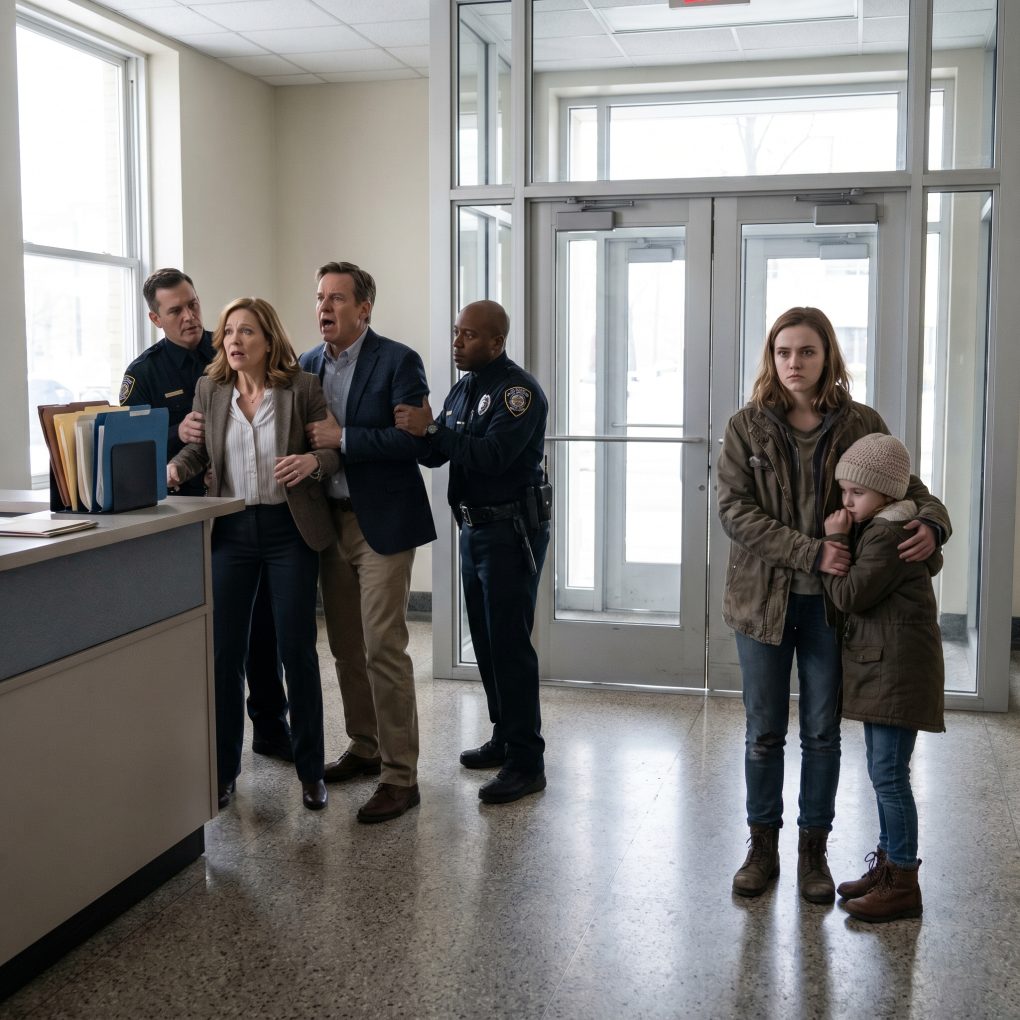
I got Emma out of the basement in less than two minutes.
It felt like a military operation because fear sharpens everything. I peeled the tape residue from her wrists as gently as I could, wrapped my hoodie around her shoulders, and led her up the back stairs while the kitchen noise carried on overhead. My parents were still laughing. My brother Luke was probably at the table too, eager and nervous and pretending not to notice what happened when one of us stepped out of line. Sarah would be in her room listening through the vent, deciding what version to repeat later if it helped her. That was how our house worked: even silence got filed into evidence.
Emma kept stumbling because her legs were half numb. At the mudroom door, she whispered, “What do I say?”
The question gutted me.
Not Where are we going? Not Are we safe? Just What do I say? She was already trying to survive the cross-examination she expected at any minute.
“You don’t say anything,” I told her. “You just come with me.”
I had eighty-three dollars in my checking account, my old Honda with a bad muffler, and no real plan. What I had more than that was certainty. Once you see a child taped up under a punishment sign, you lose the luxury of half-measures.
We made it to the car.
That should have been the hardest part. It wasn’t. The hardest part was deciding where to go, because running from abusive parents is one thing; proving they’re abusive when they know how to smile is another. My parents weren’t sloppy drunks or loud public monsters. They were church volunteers. Foster-parent trainees. Community people. My mother baked casseroles for grieving families. My father coached Little League. They had turned our house into a private intelligence state and wrapped it in Bible verses.
I drove to the only adult who had ever looked at me like she suspected something: Ms. Delgado, my tenth-grade English teacher.
She lived alone in a blue duplex three towns over and opened the door in pajama pants with a paperback still in her hand. The second she saw Emma, she stepped back and said, “Come in.”
No questions first. No demand for explanation. Just space.
That mercy nearly broke me.
Emma fell asleep on Ms. Delgado’s couch with her cheek against a throw pillow within twenty minutes. Pure collapse. I sat at the kitchen table and told the story in one long, shaking line: the spying, the punishments, the food restrictions, the basement, the belt, the sign, the whole rotten system. Ms. Delgado listened without interrupting, then picked up the phone and called a child abuse hotline before I could talk myself out of it.
That single decision saved us.
The caseworker, Janine Mercer, arrived just after midnight with a deputy. I expected skepticism. I expected the same polite doubt adults always carried around our family, the kind that says this sounds awful, but surely not literally. Instead, Janine looked at Emma’s wrists, the split lip, the bruising along her side where the belt had wrapped, and went very still.
Then she asked the question that shifted the whole case.
“Why did they do this?”
Emma was half asleep in the recliner when she answered.
“Because I didn’t tell.”
Janine frowned. “Tell what?”
And there it was.
The family system, stripped down to its horrifying little engine. We all explained it at once—how my parents rewarded whoever reported first, how they used siblings as surveillance, how private thoughts became punishable if another child disclosed them, how they called it “building honesty” and “removing secrets.” Luke tattled to avoid being hit. Sarah tattled to earn food and softness. Lily had learned to hoard anything she loved because if it was seen, it could be taken or used against her. Emma, sweet impossible Emma, had finally refused to betray Lily over stolen crackers, and they’d decided that made her dangerous.
Janine wrote everything down.
By dawn, child services had emergency authority to interview every minor in the house.
By eight, my parents were calling me from unknown numbers, leaving voicemails that changed tone by the hour. First panic: Please bring Emma home, she’s confused. Then grief: You know how overwhelmed we are. Then fury: If you don’t return her, we’ll tell police you kidnapped her.
That was the part they counted on most: that I was only seventeen. That I’d scare easy. That adults would hear “troubled teen took younger sibling” and not look deeper.
But Janine had already looked deeper.
And my parents made the mistake of meeting investigators with their usual confidence.
They said Emma was manipulative. Said I had always been resentful. Said the basement was for “quiet reflection” because one of their church parenting classes recommended de-escalation spaces. Said the sign was an old joke. Said the bruises came from Emma flailing. My father said, with a straight face, “Our children are encouraged to be truthful with us because secrecy breeds dysfunction.”
Janine later told me that sentence made her stomach turn, because by then she’d already interviewed Lily.
Lily told the truth in fragments, the way starved kids eat. Small bites first. Yes, we had to tell on each other. Yes, there were rewards. Yes, Mom would ask who prayed wrong, who complained, who hid snacks, who said mean things in private, who cried after lights-out, who talked about running away. Yes, Dad kept a notebook. Yes, there was a chart.
A chart.
The deputy found it in the desk drawer during the search. Columns for each child. Check marks. Notes. “Confessed first.” “Protected sibling.” “Withheld information.” “Repentant.” “Defiant.” My father had built a management grid for our loyalty.
That chart would have been enough to make me sick even without the rest.
Then they found the pamphlets.
Brochures from an adoption agency. Home-study prep guides. A folder labeled NEW BEGINNINGS FAMILY PROFILE with smiling photos of my parents holding neighborhood babies and a typed statement about their “deep commitment to transparent, truth-based parenting.”
Truth-based parenting.
I laughed when Janine showed me that phrase, and then I cried so hard I had to sit down on the curb.
Because my parents weren’t finished with us. They were preparing to bring more children into that house.
That was the twist that turned my fury into something colder.
They did not see what they’d built as failure.
They saw it as a model.
The county moved fast after that. Emma and Lily were placed with an emergency kinship foster family first, because I was still a minor and couldn’t legally take custody. Luke and Sarah were split temporarily too after both showed clear signs of coercive conditioning. That phrase came from the child psychologist, not me. She called it “attachment distortion through reward-based betrayal training.” Fancy words for the thing I had lived: they taught us to earn love by sacrificing each other.
My parents responded exactly how predators do when their system gets exposed.
They blamed me.
They said I poisoned the younger kids against them. My mother cried to relatives that I always hated family unity. My father told church friends I’d gotten “radicalized by school counselors.” Some people believed them. Some always will.
Then the recordings surfaced.
That was Luke’s doing.
My brother, the best tattler among us, the one who used to report my hidden notebooks and Emma’s nighttime crying and Lily’s food stash without blinking, found me through Ms. Delgado three weeks into the investigation. He showed up on the porch with a trash bag of clothes and a cheap voice recorder.
He looked twelve years old instead of fifteen.
“I have to tell first,” he said.
I almost started crying right there.
The recorder was something our father used during “family conferences,” sessions where he’d make us sit in a circle and repeat what we’d hidden, what others had hidden, and whether we were sorry enough. Luke had stolen it when investigators came. On those recordings, you could hear children bargaining for safety with information. Hear Emma crying that she didn’t want to say what Lily stole. Hear my mother say, “If you protect sin, you share punishment.” Hear my father tell Sarah that if she wanted dessert she needed to be “more useful.”
No jury was ever going to hear that and think parenting.
And one recording mattered more than all the others.
It captured my mother saying, about the upcoming adoption home study, “These new kids will be easier because they won’t have Claire’s influence..
The agency suspended my parents’ adoption approval that afternoon.
Not politely. Not temporarily pending a friendly review. Emergency suspension. Immediate. Complete. The letter used phrases like concealment of coercive disciplinary practices, unsafe home environment, and material misrepresentation in adoption screening.
My mother called Ms. Delgado’s phone seven times in one hour after that letter arrived.
The first three voicemails were sobbing. The next two were furious. The last two were weirdly calm, which was always when she was most dangerous. She said I had ruined “God’s plan” for their family. Said damaged children needed structure. Said I had stolen my siblings for attention.
That accusation might have broken me once.
By then, I was too tired to be gaslit by recycled language.
The criminal case took longer because family abuse cases built on psychology always do. Bruises fade. Fear contradicts itself. Children change stories around the edges because terror is not tidy. But my parents had made one fatal mistake: they documented too much. The chart. The recordings. The basement sign. My father’s notebook. The adoption folder. The home-study lies. They had spent so many years congratulating themselves on being organized that they forgot records can become ropes.
I testified first in juvenile court and later in criminal court.
At seventeen and a half, wearing a borrowed blazer and shoes that pinched, I told a room full of adults that my parents had turned love into a reward for betrayal and called it virtue. I described birthdays where the child who reported the most “dishonesty” got first choice of cake. I described having my bedroom searched after Luke reported I’d hidden scholarship applications. I described the family conferences, the notebook, the sign over Emma’s head in the basement, and the way my mother once told me, “Secrets are what bad children keep, and bad children become dangerous adults.”
Then I looked straight at my father and said, “You made honesty mean hurting whoever you loved first.”
He stared back at me like I had blasphemed.
Good.
The hardest testimony came from Sarah.
She had been the most loyal to my mother and the best at justifying the system. She used to say tattling felt holy because it “kept sin from growing.” That was their language inside her bones. Therapy started loosening it, but slowly. When she finally took the stand, she cried so hard the judge offered a recess. She shook her head and kept talking.
“They said if we loved each other the right way, we would tell,” she whispered. “But really it meant whoever was scared first got to survive.”
That line made the courtroom go silent.
Luke testified too. So did Lily. Emma didn’t have to appear in open court because the forensic interview captured enough, and the judge allowed it to stand. I was grateful for that. She was ten by then and still startled when anyone closed a door too firmly.
My parents’ defense was exactly what you’d expect.
They said the state was criminalizing strict parenting.
Said church culture had been misunderstood.
Said the recordings lacked context.
Said the children had been coached.
Then the prosecutor played the basement audio.
My father’s voice. My mother’s voice. Emma crying. The sign being read aloud. The threat of punishment for “protecting disobedience.” Then my mother, clear as a bell:
“If she won’t report this family’s problems, she isn’t safe to live in it.”
That ended the “context” argument.
The convictions weren’t dramatic in the television sense. No one leapt over a table. No last-minute confession. Just one awful legal translation after another: child abuse, unlawful restraint, coercive control, emotional maltreatment, fraud in adoption screening. My father got more time because the physical punishments were tied more directly to him. My mother got less, but not by much. The judge said their conduct reflected “systematic exploitation of sibling bonds for compliance and self-protection.”
A social worker later told me that sentence would probably end up in training materials.
I hope so.
My siblings’ lives didn’t magically heal after the verdict. I hate stories that pretend justice repairs the nervous system. Luke still apologizes whenever he asks for food. Sarah still over-explains harmless things because she thinks hidden intentions are dangerous. Lily hides candy in dresser drawers. Emma, the bravest of us, still asks sometimes whether she did something wrong by not telling.
I always say no.
Then I say it again, because children raised like we were don’t believe freedom the first time they hear it.
As for me, I turned eighteen in a courthouse hallway while waiting for a status conference.
Ms. Delgado brought cupcakes. The kinship foster mom who had taken Emma and Lily for emergency placement brought paper plates. Luke gave me a folded note instead of speaking because speaking still felt risky to him then.
It said:
I’m sorry I was good at what they wanted.
I still have it.
Six months after I took Emma and ran, my parents were arrested while trying to adopt more children.
That sentence sounds like an ending.
It wasn’t.
The real ending—at least the first true one—came a year later in a small rental house with terrible carpet and too many mismatched dishes, when all four of my siblings were temporarily home for Sunday dinner and no one reported anything.
Lily spilled juice.
Luke swore when he dropped the chicken.
Sarah admitted she hated the mashed potatoes.
Emma whispered after dessert, “Nobody’s going to write this down, right?”
And I looked around that table—at the mess, the noise, the ordinary irritation, the total absence of surveillance—and said, “No. We just live here.”
Emma cried at that.
Quietly. Relieved.
So did I, after they all went to bed.
Because my parents had raised us to snitch in order to be loved, turning us into little spies against each other.
The night I saw what they had done to my little sister, I took her and never looked back.
Six months later, they were arrested before they could teach more children the same system.
That was justice.
But the real miracle was slower:
We learned how to be siblings without witnesses.
We learned that privacy is not proof of guilt.
We learned that love does not ask for evidence.
And once you know that, truly know it, people like my parents never get the last word again.


.jpg)


0 commentaires:
Enregistrer un commentaire