
My daughter pushed me out of her vacation plans — never knowing that I owned the very 5-star resort she was heading to. When hotel security told her to leave at my request… karma hit instantly.
My daughter pushed me out of her vacation plans — never knowing that I owned the very 5-star resort she was heading to. When hotel security told her to leave at my request… karma hit instantly.
My daughter told me I was “too old for this kind of trip” while standing in my own driveway with designer luggage at her feet.
She said it lightly. Almost kindly. That was the cruelest part.
“I just think you’d be more comfortable staying home,” Vanessa said, adjusting her sunglasses like she was discussing weather instead of cutting me out of the vacation I had heard about only by accident.
Behind her, her husband Grant was loading suitcases into the black SUV and pretending not to listen. My granddaughters were already in matching resort hats, giggling over passport covers. Everybody looked polished, excited, ready.
Ready to leave me behind.
I folded my arms. “You planned a two-week Caribbean vacation and never intended to tell me?”
Vanessa sighed. “Mom, please don’t make this dramatic.”
Dramatic.
That word again. The family favorite whenever truth threatened to embarrass them.
I had spent years helping Vanessa rebuild after her divorce. Paid her lawyer when Grant wasn’t in the picture yet. Covered tuition gaps for the girls. Lent her money for the boutique that failed in ten months because she was better at spending than selling. And when she married Grant—a man with polished shoes, a weak handshake, and the kind of smile that always looked borrowed—I kept my opinions quiet for her sake.
Now she stood on my front walk and said, “It’s a couples-and-kids trip. You’d just slow us down.”
That sentence landed clean.
Not because it surprised me.
Because it finally matched what she had been doing for years.
Grant shut the trunk. “We’re already running late.”
Vanessa stepped forward and kissed the air near my cheek. “We’ll bring you something beautiful from Saint Aurelia.”
Saint Aurelia.
I smiled then.
Because neither of them knew one small thing.
The five-star resort they were flying to—the one Grant bragged about booking with “exclusive access” and “special treatment”—belonged to me.
Not partly.
Not through a company he’d recognize.
Mine.
And by the time their plane landed, security would already have my instructions.
She thought leaving her mother behind was just one more clean little humiliation she could explain away later. She had no idea she was flying straight into property her mother owned outright—and karma was already waiting in the lobby. The rest of the story is below 
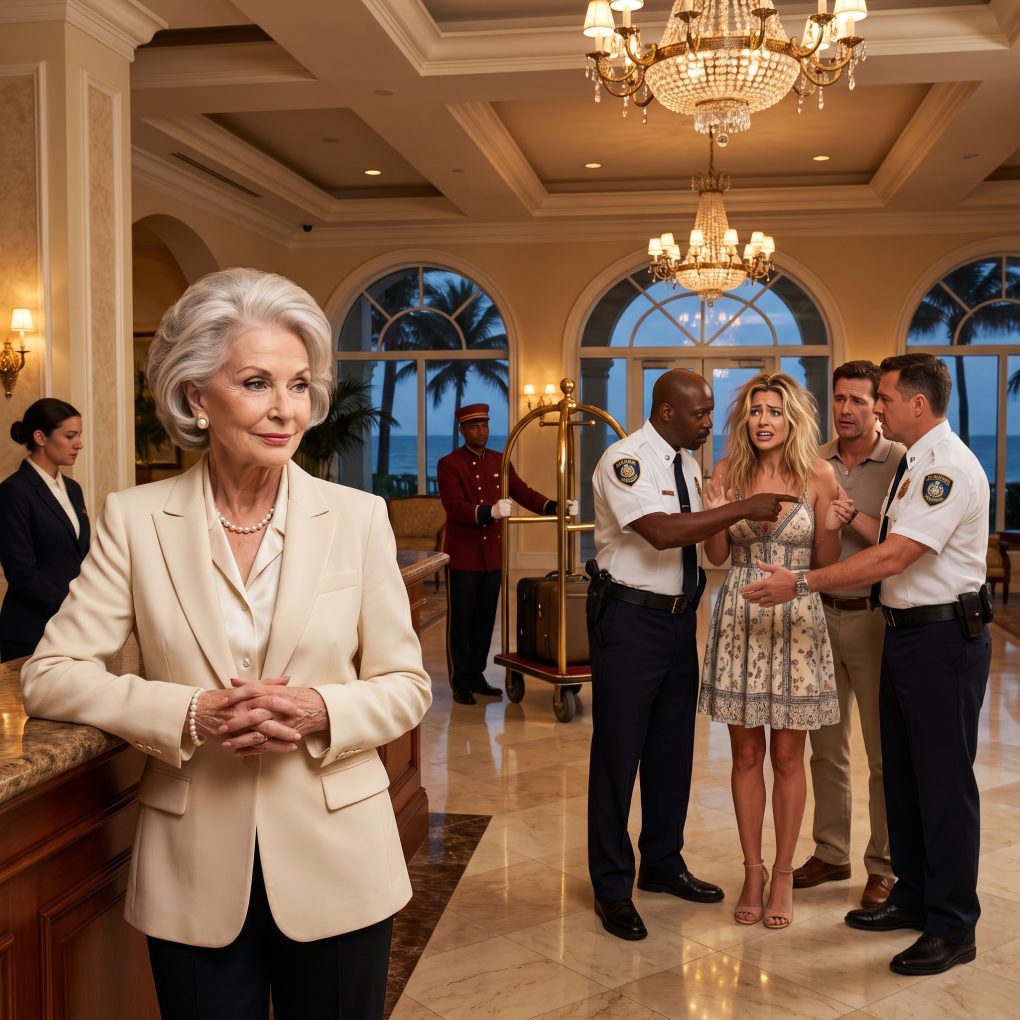
I did not call the airline.
That would have been too easy, too petty, and honestly too messy.
I called Saint Aurelia’s general manager.
His name was Benoit Laurent, and he had been running the resort for six years with the kind of terrifying elegance only very expensive hotels produce. My husband trusted him enough to let him oversee the transition after we moved the resort into our private family holdings, and after my husband died, Benoit became one of the few people in my orbit who still addressed me not as a lonely widow or a useful wallet, but as a principal.
He answered on the second ring.
“Mrs. Hale.”
“Benoit.”
A pause, then warmth. “What may I do for you?”
I looked out through my study window at the fountain my husband built the summer before he got sick, at the house Vanessa once begged me not to sell because “the girls need their grandmother’s home in the family,” and said, very calmly, “My daughter and her family are due to arrive tomorrow under the Grant Mercer reservation. They are not to be admitted.”
Silence.
Not shocked silence.
Operational silence.
Then Benoit asked the right question. “Would you like them redirected or denied?”
Denied.
That word had a certain music to it.
I said, “Denied. Politely. Completely. And if they cause a scene, security is to escort them off property.”
“Understood.”
He did not ask why.
Another reason he stayed employed.
Then I added, “Please prepare the villa for me instead. I may feel like traveling after all.”
That made him laugh softly. “I will have it opened immediately.”
I hung up and sat for a moment in the stillness.
Was it revenge?
Yes.
But not in the way people think.
I wasn’t trying to ruin a vacation.
I was correcting an equation.
Vanessa and Grant had spent years calculating me into their lives as a resource, never as a person. Tuition help? Useful. Emergency legal fees after Grant’s tax trouble? Useful. Holiday gifts, private school extras, bridge funding when Vanessa’s boutique collapsed? Useful. But my actual presence—my age, opinions, memory, inconvenient dignity—that part they wanted smaller, quieter, easier to move around.
The trip simply clarified the pattern.
By evening, my daughter had texted the family group chat from the airport lounge:
Finally unplugging for two weeks 
 No drama, just peace.
That line almost made me admire her.
The audacity was artisanal.
No drama.
When the whole trip had been built on exclusion.
I did not answer.
Instead, I called my attorney.
Not because of the resort.
Because once humiliation gives you clarity, it is wasteful not to use it thoroughly.
My attorney, Miriam Cole, listened while I laid out the last three years in one uninterrupted sweep.
The school trust funds I had created for the girls that Vanessa kept trying to “temporarily borrow against.”
The way Grant pushed for “family streamlining” every time money came up.
The private note I had quietly paid off on their house after Grant’s business nearly drowned under tax liens.
And the newest irritation: Vanessa had begun referring to certain things—my jewelry, the beach property in Maine, even this house—as “what we’ll eventually need to manage.”
Manage.
Such a harmless word for pre-grief scavenging.
Miriam heard enough.
Then she said, “Do you want to revise the inheritance schedule?”
I closed my eyes.
Because there it was.
The real lever.
Not the resort.
Not the vacation.
The future.
My husband had left the bulk of our estate under my control with broad discretionary power. Vanessa had always assumed that meant eventual possession. She never asked directly, of course. She preferred implication. But Grant? Grant asked constantly, just dressed better than greed usually does.
“What would you suggest?” I asked.
Miriam didn’t hesitate. “You’ve been subsidizing dependence while they’ve been escalating entitlement. I would lock down everything now.”
So I did.
Before my daughter’s flight even crossed the Gulf, I changed the educational trusts for the girls into protected independent instruments inaccessible to either parent. The real estate succession shifted to a charitable housing foundation with family board participation only if character benchmarks were met—and I removed Vanessa as primary successor entirely.
Not because she left me out of a trip.
Because she had mistaken a lifetime of generosity for guaranteed reward.
That matters.
One insult does not undo a daughter.
Patterns do.
Then came the twist.
At 11:43 that night, my oldest granddaughter, Lily, texted me privately.
Grandma, are you mad at Mom?
I stared at that message for a long time.
Then came the second one:
She said you don’t like traveling anymore. But I heard you crying after brunch.
Children always know more than adults hope.
I texted back:
I’m not mad at you. I love you very much. Get some sleep.
Then I added, after a pause:
And I do like traveling. I just don’t like being erased.
She didn’t answer right away.
But ten minutes later she sent only:
I thought it was mean too.
That nearly undid me.
Because beneath every adult humiliation, there is often some child quietly learning the wrong lesson about what love looks like.
That, more than my own hurt, made me stay firm.
The next day at 2:16 p.m., the first message came from Saint Aurelia’s guest services.
Mercer party has arrived. Initial denial delivered. Mrs. Mercer requests manager.
I asked Benoit to keep me updated.
At 2:28:
Manager meeting complete. Mrs. Mercer states there must be a misunderstanding. Mr. Mercer has raised his voice. Security notified discreetly.
At 2:31:
You may wish to answer your telephone.
My phone was already ringing.
Vanessa.
I let it ring twice.
Then answered.
At first she sounded confused.
Then offended.
Then, beneath both, frightened.
“Mom?”
“Yes.”
“We’re at the resort.”
“I’m aware.”
“They’re saying our reservation has been canceled.”
“No,” I said. “It’s been denied.”
Silence.
Then Grant’s voice in the background: “Give me the phone.”
Vanessa hissed at him.
Then back to me: “What did you do?”
I looked down at my husband’s old signet ring on my finger and said, “I corrected the guest list.”
That was when she realized.
You can hear realization differently from anger. It sharpens the breathing. Steals a second from the voice.
“Mom,” she whispered, “you own this place?”
“Yes.”
Grant took the phone.
Of course he did.
“You vindictive old woman—”
I hung up.
Three minutes later, Benoit sent the final message:
Security has escorted the Mercer party to transport. No further disturbance. Your villa is prepared should you wish to come.
And that was when the deepest, coldest satisfaction of the entire thing landed.
Not because they were embarrassed.
Because for the first time in years, my daughter and her husband had reached the exact limit of their assumptions about me—and slammed into something solid.
I flew to Saint Aurelia two days later.
That surprised even me.
At first, I had only wanted the correction, not the place itself. But once the resort denied Vanessa and Grant, I found myself thinking about the sea there. About the long white terraces my husband designed with Benoit fifteen years earlier. About the fact that I had let too much of my life become reactive—defined by what needed rescuing, paying, smoothing, fixing.
So I packed linen, called for the jet, and went.
Benoit met me in the open-air lobby with chilled lemon towels and the expression of a man professionally committed to dignity.
“Welcome home, Mrs. Hale.”
Home.
Interesting word.
Because that was the thing I had spent years misunderstanding. Not home as in walls. Not home as in where my daughter might someday return if she softened enough. Home as in the place where no one rearranges your worth to suit their comfort.
The villa was perfect.
Three bedrooms.
Private plunge pool.
Terrace over the Caribbean.
Fresh orchids in the bedroom and a handwritten note from Benoit apologizing for the “unpleasantness” of my daughter’s arrival.
I laughed when I read it.
Unpleasantness.
Such refined language for attempted family theft of atmosphere.
But the real aftermath began not at the resort.
At home.
Because once Vanessa and Grant got forced off that property with hotel staff watching and security walking behind them, the story spread in exactly the way they deserved: incompletely, expensively, and beyond their control.
Grant called me seventeen times the first night.
I answered on the eighteenth.
“You humiliated us in front of our daughters,” he said.
I looked out at the water and said, “You excluded me in front of mine.”
“That was family.”
“No,” I said. “That was management.”
He tried to bluster. Threatened “legal options.” Suggested I was unstable, retaliatory, vengeful. I let him run through the whole little catalog because men like Grant need to hear themselves perform power before they can feel how gone it is.
Then I said, “You should save your energy. Miriam has already removed your wife from direct succession authority.”
The silence that followed was almost spiritual.
“What?”
“You heard me.”
He swore then.
Not elegantly.
I ended the call.
Vanessa was more complicated.
She called the next morning crying.
Real tears, I think.
Not enough to move me, but enough to remind me she was not born cruel. She had learned softness only where it served her, and over the years I had mistaken that selectivity for damage, not choice.
“Mom,” she said, “how could you do this to me?”
Interesting again.
Not why did you feel you had to?
Not I’m sorry.
Not even I was wrong.
How could you do this to me.
I asked her one question.
“When you stood in my driveway and told me I’d just slow you down, did you think I wouldn’t understand what you were really saying?”
She cried harder.
That was her answer.
Then came the final twist.
My younger granddaughter, Sophie, called from the airport hotel where they’d spent the first night after the resort expelled them. She was eleven and angry in the clean way children sometimes are before adults teach them to varnish everything.
“Grandma,” she said, “Mom lied.”
“Yes.”
“She told us you didn’t want to come.”
“I know.”
A pause.
Then: “I told her she was mean.”
That made me smile.
“She didn’t like that.”
“No,” I said. “People rarely do.”
The girls, it turned out, had heard much more than Vanessa and Grant realized. The money conversations. The remarks about me being “emotional.” Grant’s jokes about “waiting out” older people’s indecision. Lily’s text from the night before had only been the smallest opening.
Children notice contempt long before adults admit it exists.
So while Vanessa and Grant spent the next week trying to salvage their pride, I spent mine doing something much more useful.
I set the girls’ trusts in motion in a way that bypassed parental interference almost completely.
I ordered a forensic accounting review of every family reimbursement Vanessa had submitted through the foundation over the last two years.
And I changed my primary residence plan so that my house, after my death, would go not to family control but to a women’s legal aid endowment in my husband’s name.
When Miriam read the final line item back to me over speakerphone, she said, “You’re sure?”
I looked out at the water again.
“Yes.”
Because certainty had finally become less painful than hope.
Vanessa returned from the Caribbean thinner in the face and louder in her victimhood. She told relatives I had “financially attacked” her family over a vacation misunderstanding. Grant went further, implying to anyone with ears that I had become unstable since widowhood and was being manipulated by “outsiders.”
Classic.
But they had two problems.
First, the resort’s internal incident report was clean, polite, and devastating. Denial at ownership request. Security escort due to guest disturbance by Mr. Mercer. Hard to spin that into frail-old-lady confusion when the paperwork is elegant.
Second, the girls started telling the truth.
Not all of it.
Enough.
Enough that Vanessa’s own sister called me and said, “I always thought she was just self-centered. I didn’t realize she was turning into him.”
That phrase sat with me.
Turning into him.
Yes.
That was the tragedy, if there was one.
Not that my daughter married badly.
That she had begun reshaping herself around the worst parts of the man she chose.
Still, tragedy does not erase consequence.
You asked what happened after my daughter pushed me out of her vacation plans, never knowing I owned the very five-star resort she was heading to.
Hotel security told her to leave at my request.
Karma hit instantly.
But the real ending was slower, cleaner, and much more permanent:
I stopped financing the fantasy that blood entitled people to me after they’d stopped treating me like a person.


.jpg)


0 commentaires:
Enregistrer un commentaire