
On Christmas, I had to work a double shift in the ER. My parents and sister told my 16-year-old daughter there was “NO ROOM for her at the table.” She had to drive herself home alone and spend Christmas in an EMPTY HOUSE. I didn’t make a scene. I took action. The next morning, my parents found a letter at their door — and started screaming…
“They said there was no room for me.”
The road blurred.
I pulled onto the shoulder so fast my tires hit gravel.
“What do you mean, no room?”
Avery gave one of those tiny laughs people make when they’re trying not to cry hard enough to choke. “Grandma said they’d already set the table. Aunt Melissa brought extra people. Grandpa said maybe I should’ve told them sooner if I wanted a seat.”
My whole body went cold.
She was sixteen.
She had driven herself to my parents’ house because I was stuck on a double shift and they had insisted—insisted—that of course she should come, of course she wouldn’t be alone on Christmas, of course family took care of family.
Now my daughter was sitting in our empty house by herself because they had looked her in the face and turned her away.
“Who said it?” I asked.
“Grandma first. Then Mom—” She stopped herself. “Then Aunt Melissa said it would be awkward to squeeze me in now.”
I closed my eyes.
“And your aunt Claire?” I asked, because my sister always liked to hide behind the loudest cruelty in the room.
Avery’s voice dropped to a whisper. “She told me to stop making it emotional and just go.”
I just stared through the windshield at the black road and said, very evenly, “Did you eat anything?”
“Crackers.”
That was the moment I stopped feeling hurt.
And started planning.
They thought they’d just humiliated a teenage girl for one night and I’d swallow it to keep the peace. They forgot who they were dealing with. By morning, their front porch had become the starting line of their worst Christmas yet. The rest of the story is below 
I made Avery hot chocolate first.
That is the detail people always miss when I tell this story later—when they jump straight to the letter, the family meltdown, the public exposure, the beautiful little collapse of the lie they had built around themselves.
Before any of that, I made my daughter hot chocolate.
I took off her coat.
Heated milk.
Put extra marshmallows in because she liked them even though she always pretended they were childish.
Then I sat with her on the couch under the Christmas tree while she told me everything in the exact order it happened.
That mattered.
Not because I doubted her. Never for a second.
Because I know how families work after they do something ugly. They rewrite fast. They shave the edges off what they said, move words around, recast tone, pretend you misunderstood. If you don’t capture the truth while it’s still warm, they start embalming it almost immediately.
So I wrote it all down in my notebook.
7:03 p.m. — Grandma opened the door, seemed annoyed.
7:05 p.m. — Said table was already full.
7:07 p.m. — Grandpa suggested the den.
7:08 p.m. — Aunt Claire said stop making it emotional.
7:10 p.m. — Aunt Melissa said she should go home because it would be awkward now.
7:12 p.m. — No one walked her to the car.
7:48 p.m. — Avery arrived home alone.
Then I asked the second set of questions.
Did anyone hug you?
No.
Did anyone offer to drive you?
No.
Did anyone call me?
No.
Did anyone ask if you were scared driving home in the dark?
No.
When I got to that last one, Avery started crying again, quietly this time, and said, “Grandma said sixteen is old enough to stop expecting the world to bend for me.”
That sentence went into the notebook too.
By 1:30 a.m., after Avery was finally asleep upstairs, I was sitting at the kitchen table in scrubs that still smelled like the hospital, writing the letter.
Not texting.
Not emailing.
A letter.
Because texts can be screenshotted and spun. Emails can be forwarded with commentary. A letter on a doorstep at dawn feels different. It sits there like judgment waiting to be opened with cold fingers.
I wrote it in longhand first, then typed it, printed three copies, and signed my full name.
One for my parents.
One for my sister Claire.
One for my aunt Melissa, because she had children of her own and still looked at mine like a scheduling problem.
The letter was not dramatic.
That was important.
It did not threaten.
It did not rant.
It did not beg.
It simply documented what they had done.
That on December 25, while I was working a double shift in the ER, they invited my sixteen-year-old daughter to Christmas dinner, turned her away at the door, left her to drive home alone at night, and made no effort to ensure she was fed, accompanied, or emotionally safe.
Then I added the part that turned the knife.
I informed them that, effective immediately, none of them would have unsupervised access to Avery again. They were no longer emergency contacts. They were no longer authorized for school pickup, medical decisions, holiday plans, or any role requiring trust. I also informed them I had already contacted the school to update her records and had documented the incident in case “future misrepresentations” became necessary to address.
Future misrepresentations.
That line was for my mother.
Because I knew her.
By 7:00 a.m., she’d be on the phone telling cousins I was overreacting. By 8:00, she’d be telling church friends Avery had been “moody” and chosen to leave. By noon, she’d have turned a humiliated teenager into a difficult one.
Unless I got there first.
So before I drove the letters over, I did one more thing.
I posted.
Not a screaming Facebook rant.
Not names in all caps.
Just a calm, factual paragraph to the private family group thread and the larger extended-family holiday chat my aunt loved to use for recipes and prayer requests.
I wrote:
Since there may be confusion later, here is what happened tonight: while I was working a Christmas double shift in the ER, Mom, Dad, Claire, and Melissa told Avery there was “no room” for her at Christmas dinner and sent her home alone. She spent Christmas night by herself in an empty house. Please do not contact Avery directly to explain this away.
Then I attached a photo of the untouched place setting Avery had helped me wrap for Grandma the day before—still sitting in our kitchen because she never even got to bring it inside.
I hit send.
Then I drove.
The sky was still dark blue when I pulled up to my parents’ house.
Christmas lights still on.
Wreath still on the door.
Nativity scene in the lawn.
Everything outside still trying to look holy.
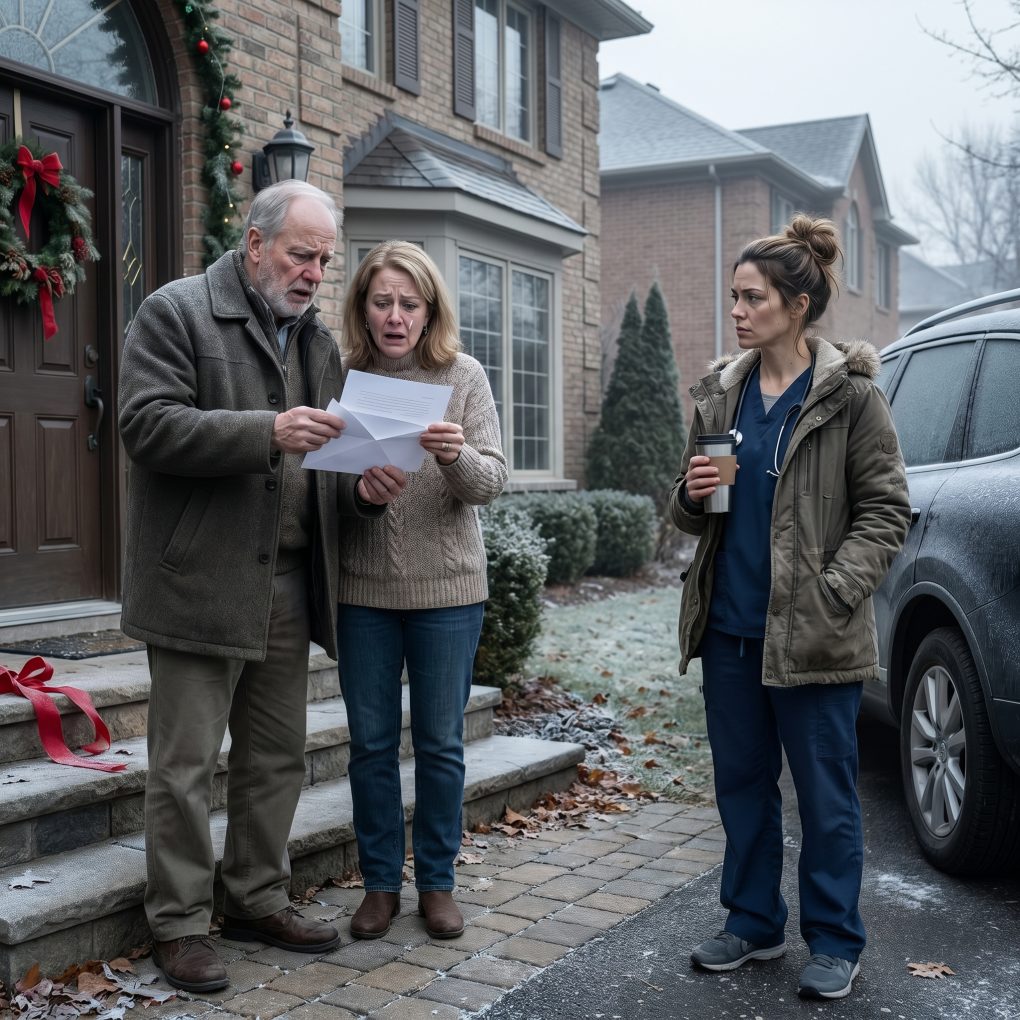
I put the letters in separate envelopes and left them on the porch with their names written in thick black ink.
Then I sat in my car across the street and waited.
At 7:18, my father opened the door in pajama pants and a robe.
He saw the envelopes.
Picked them up.
Opened his first.
Even from across the street, I could see the shift in his face.
Then my mother appeared behind him, still in her red chenille robe, coffee mug in hand. He handed her the pages.
She read the first paragraph.
Then looked up sharply.
Then started yelling.
Actually yelling.
Not because she was guilty.
Because she had already checked her phone and seen the family thread.
My aunt Denise had replied first: You sent Avery home alone on Christmas??
Then Cousin Rachel: Please tell me this isn’t true.
Then my mother’s own sister: Carol, answer me right now.
That was the screaming.
Not conscience.
Consequence.
By 7:25, Claire had arrived in leggings and no makeup, clutching her own envelope like it had bitten her. Melissa called from her driveway because she was too much of a coward to come to the porch at first. By 7:30, all three of them were outside under the Christmas wreath, shouting over each other while my father stood there looking like somebody had finally removed the wallpaper from his life.
I should have driven away then.
But I stayed.
Because then my mother said the stupidest thing she could have said:
“She’s making this sound worse than it was!”
And my father answered, furious for once not at me, but at the situation itself:
“She sent that to everyone.”
Exactly.
That was the point.
The next two days were chaos.
My mother called fourteen times.
Claire texted that Avery “misread the atmosphere.”
Melissa wrote a six-paragraph email about how “holiday logistics got unfairly personalized.”
My father left one voicemail that was somehow both apologetic and defensive, which is his special talent.
Avery listened to none of it.
I didn’t make her.
I blocked them all from her phone first.
Then came the twist I didn’t expect.
My oldest brother, Jason—the one who lived in North Carolina and only showed up for funerals and fantasy football—called me on December 27.
He was quiet for a long moment after I answered.
Then he said, “They did that to you too, didn’t they?”
I sat down.
Because yes.
Not exactly like this. But close enough.
The Christmas I was fourteen and got sent upstairs because Claire’s boyfriend came and “space got tight.”
The Thanksgiving I ate in the den because grown-ups needed the table.
The Easter brunch where my mother told me not to be sensitive when she gave my seat to a visiting pastor’s son.
I had forgotten some of it.
Or thought I had.
Jason hadn’t.
He said, “I should’ve said something back then.”
And that was when I realized the letter hadn’t only blown up this Christmas.
It had cracked open every old one too
Three days after the letters, my mother tried to pick Avery up from school.
That was her first real mistake.
Not because the school let her—they didn’t. I had already changed every emergency contact, added password protections, and spoken directly to the principal, the counselor, and the front office. But my mother still walked in at 2:47 p.m. with her church coat on and that same injured expression she wore whenever she wanted authority figures to confuse emotion with innocence.
She told the secretary there had been a “family misunderstanding” and she was there to “rescue” her granddaughter from unnecessary drama.
The secretary called me immediately.
Then the principal.
Then security walked my mother back outside while she cried loudly enough for the entire office to hear that I was weaponizing a child against her.
That got documented too.
Good.
By then the family had split.
Not in half exactly. Families like mine rarely split cleanly. It was more like layers peeling back.
A few people apologized right away.
My aunt Denise called Avery herself and left a voicemail saying, “I should’ve protected you better from grown-up nonsense.” That mattered.
Jason mailed Avery a gift card and a handwritten note that said, No kid should ever be made to feel extra on Christmas. That mattered too.
But my mother, Claire, and Melissa dug in deeper.
They shifted stories three times in one week.
First: there really wasn’t room.
Then: Avery was offered the den and “dramatically refused.”
Then: she had wanted to go home early anyway.
Each version got thinner.
Especially because my youngest cousin, ten-year-old Noah, accidentally torched them in the family group chat when he typed:
Grandma said Avery could go because dessert was more important than squeezing another chair.
Children are marvelous that way. They tell the truth with zero respect for adult strategy.
My mother deleted the message two minutes later.
Too late.
I had screenshotted it.
That should have been enough to shame her into stopping.
Instead, she escalated.
She mailed Avery a wrapped present with a note that said:
When your mother calms down, Grandma’s table will still be here for you.
I opened it first, of course.
Inside was the pearl bracelet I wore to prom.
Mine.
Not hers to gift.
Not hers to turn into a symbol.
Just one more attempt to rewrite reality through sentiment.
I sent it back with no note.
Then Melissa did something even uglier.
She told two relatives that I was “unstable from hospital trauma” and probably taking out work stress on the family. That got back to me through my cousin Rachel, who was outraged enough to repeat it word for word.
That was when I stopped treating the situation like a painful family rupture and started treating it like reputation warfare.
I work in an ER. I know exactly how ugly people get when they’re cornered and can’t admit fault.
So I made one final move.
I wrote a longer statement—private, still, but precise—and sent it directly to the relatives who mattered most, the ones likely to become targets of my mother’s narrative first. I attached timestamps, the school documentation from her failed pickup attempt, and screenshots of her voicemail and Melissa’s messages.
I wrote:
I am not asking anyone to take sides. I am stating facts. My daughter was invited, rejected, and sent home alone on Christmas while I was saving other people’s lives at work. When I addressed it privately and directly, the response was denial, manipulation, and an unauthorized attempt to access my child at school. This is why contact remains closed.
That ended the gossip war.
Not because everyone agreed with me.
Because nobody could out-document me.
And my father?
He came by in person a week later.
No robe this time.
No Christmas lights.
Just a tired man on my porch holding his hat in both hands.
I almost didn’t let him in.
But Avery was at a friend’s house, and I wanted to hear what he sounded like without my mother standing behind him arranging his sentences.
He sat at my kitchen table and looked around like the house itself accused him.
Then he said, “Your mother didn’t think it would hurt her like this.”
I stared at him.
“Not Avery,” I said. “Herself.”
He flinched.
That was answer enough.
He admitted what I already knew: my mother thought Avery was old enough to “understand holidays are complicated.” Claire didn’t want to add a chair. Melissa complained about the food. He let the women decide. Then once Avery’s face fell, everyone got embarrassed and doubled down instead of fixing it.
That was the whole story.
Cowardice.
Convenience.
Cruelty in the language of practicality.
“I’m sorry,” he said quietly.
It was the first real apology I got.
Not enough.
But real.
I asked him one question.
“When she stood at that school and tried to get my daughter after what happened, did you know?”
He closed his eyes.
“No.”
I believed him.
That made me angrier in a different way.
Because it meant he was still doing what he had always done: standing close enough to the damage to benefit from it, far enough to say he didn’t swing the weapon himself.
I told him he could have limited contact with Avery one day, maybe, if he learned how to be loyal without being obedient.
He cried at that.
I did not.
You asked about the next morning.
About the letter.
About the screaming.
The truth is, the letter was never really the revenge.
The revenge was precision.
I didn’t make a scene on Christmas night.
I didn’t race over in my scrubs and pound on the front door.
I didn’t give them the gift of calling me hysterical.
I documented.
I wrote.
I sent it to the right people.
I cut off access.
I protected my daughter.
And I made sure they could never again pretend what happened was a misunderstanding over seating.
It was a test of whether my child mattered as much as appearances.
They failed it.
On Christmas, I worked a double shift in the ER while my parents and sister told my sixteen-year-old daughter there was “no room” for her at the table. She drove herself home alone and spent Christmas in an empty house.
The next morning, my parents found a letter at their door and started screaming.
Not because I lied.
Because I told the truth before they could get to it.
And some people can survive guilt.


.jpg)


0 commentaires:
Enregistrer un commentaire