
My stepmother blocked me from entering my father’s hospital room. “Family members only. You’re not his real child,” she said. I had driven eight hours to see my father. Security escorted me out. What she didn’t know was that I was listed as his medical proxy. One call to hospital administration changed everything.
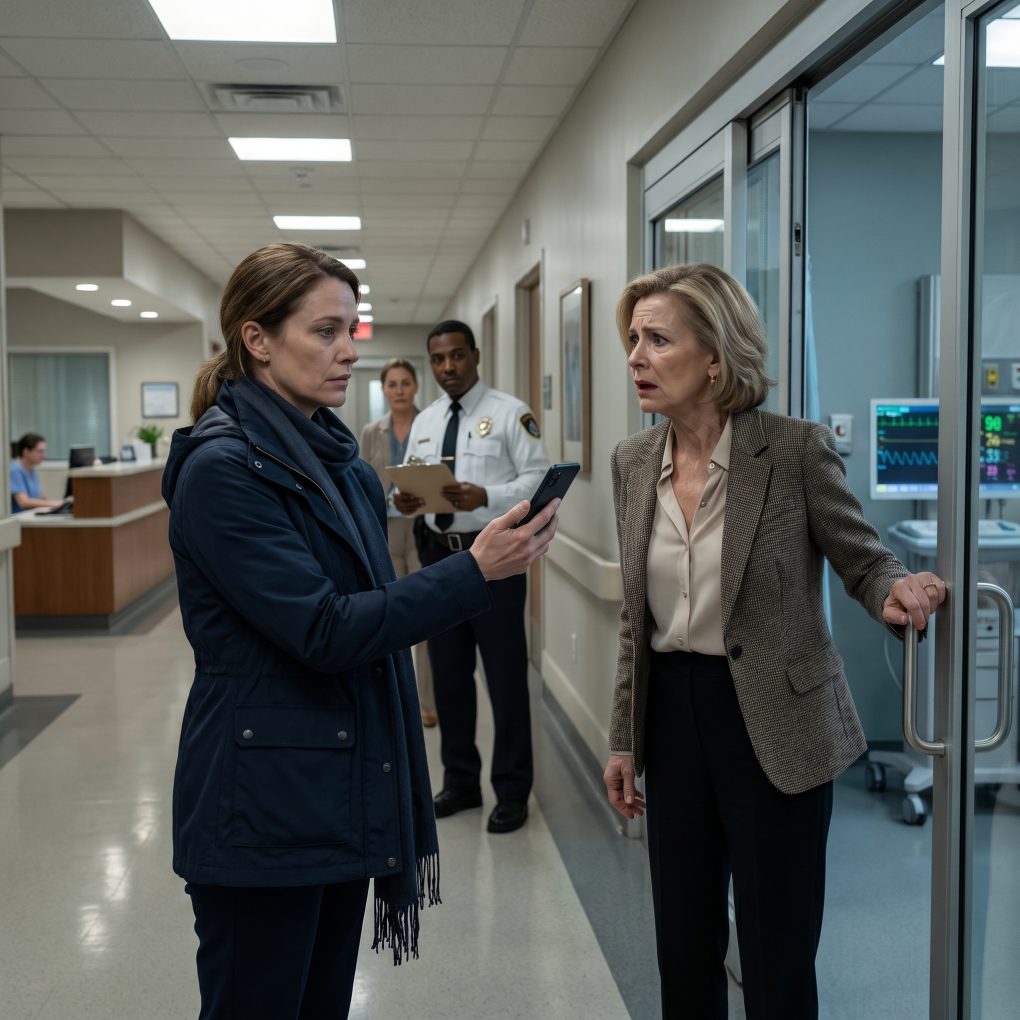
My stepmother said it in front of the nurses’ station like she was announcing a policy, not a cruelty.
“Family members only. You’re not his real child.”
Then she folded her arms and looked at me as if eight hours of driving, no sleep, and a duffel bag still on my shoulder somehow made me less of a daughter than the woman who married my father twelve years after my mother died.
My name is Claire Bennett. I was thirty-three years old, standing on the cardiac floor of St. Anne’s Regional Hospital in Knoxville, Tennessee, staring at the closed door to my father’s room after driving through the night from Richmond because my cousin texted me at 1:14 a.m. that Dad had suffered a massive stroke.
I had not even stopped for coffee after the state line.
My father, Thomas Bennett, was sixty-eight. Stubborn, sharp, difficult in the ordinary ways older men become difficult when they think routine will save them from mortality. We weren’t one of those soft, openly affectionate father-daughter pairs people post about online. But we were real. He called me every Sunday. I handled his insurance forms because he hated paperwork. I knew which shoulder hurt when it rained, what kind of pie he pretended not to like, and which old songs he only played when he was scared.
My stepmother blocked me from entering my father’s hospital room. “Family members only. You’re not his real child,” she said. I had driven eight hours to see my father. Security escorted me out. What she didn’t know was that I was listed as his medical proxy. One call to hospital administration changed everything.
My stepmother said it in front of the nurses’ station like she was announcing a policy, not a cruelty.
“Family members only. You’re not his real child.”
Then she folded her arms and looked at me as if eight hours of driving, no sleep, and a duffel bag still on my shoulder somehow made me less of a daughter than the woman who married my father twelve years after my mother died.
My name is Claire Bennett. I was thirty-three years old, standing on the cardiac floor of St. Anne’s Regional Hospital in Knoxville, Tennessee, staring at the closed door to my father’s room after driving through the night from Richmond because my cousin texted me at 1:14 a.m. that Dad had suffered a massive stroke.
I had not even stopped for coffee after the state line.
My father, Thomas Bennett, was sixty-eight. Stubborn, sharp, difficult in the ordinary ways older men become difficult when they think routine will save them from mortality. We weren’t one of those soft, openly affectionate father-daughter pairs people post about online. But we were real. He called me every Sunday. I handled his insurance forms because he hated paperwork. I knew which shoulder hurt when it rained, what kind of pie he pretended not to like, and which old songs he only played when he was scared.
My stepmother, Linda, knew something else.
She knew he trusted me.
That was why she was panicking.
When I arrived at the hospital just after 8:00 a.m., she was already in the hallway with her sister, both of them positioned like decorative guards in front of room 614. Linda wore cream slacks, a pale pink sweater, and the expression of a woman who believed enough certainty could become law.
“I’m here to see my father,” I said.
She smiled tightly. “He’s resting.”
“I drove eight hours.”
“And now you can drive back.”
I thought she was being monstrous, but temporary. Grief makes people territorial. Fear makes them stupid. So I stepped toward the door anyway.
That was when she raised her voice.
“Security.”
I actually stopped walking out of pure disbelief.
Two guards came over. Linda’s voice sharpened into performance. “This woman is causing distress to immediate family during a critical medical situation.”
Immediate family.
I laughed once, because the alternative was losing my mind in public.
“I’m his daughter.”
Linda turned to the guards and said, “Not legally. Not really. She’s from before.”
From before.
As if I were an outdated part of his life instead of the one person he called when things got serious.
Security asked me to step away from the room.
I did, but only because I was too stunned to understand what level of ugliness I was seeing. Linda stepped closer to the door and said quietly, for me alone this time, “You’re not his real child. You don’t get to show up now and act important.”
That sentence almost broke me.
Because she had timed it perfectly. Exhaustion, worry, public humiliation, the door closing between me and a father who might die before I touched his hand. For one poisonous minute, it worked. Security escorted me to the elevator bank while Linda stood there composed, victorious, and absolutely certain she had just won.
What she didn’t know was this:
Three years earlier, after a bad surgery scare, my father named me his medical proxy.
And from the lobby, with one phone call to hospital administration, I destroyed the fantasy she had built around that room.
had built around that room.
The first person I called was not Linda.
That was the difference between us.
She believed in scenes. I believed in paper.
I sat in a quiet corner of the hospital lobby beside a vending machine humming like a bad memory, took three breaths, and called the number my father had drilled into me years earlier.
“St. Anne’s patient administration,” the woman answered.
“My name is Claire Bennett,” I said. “My father is Thomas Bennett in cardiac ICU. I am his designated medical proxy, and I have just been denied access by a spouse who is not the named decision-maker.”
The woman went silent for exactly one beat.
Then: “Can you verify your identity and hold?”
I could.
Because my father had not just told me he was naming me. He had mailed me a copy, then made me scan it, then called to make sure I stored it somewhere “your stepmother can’t get theatrical near.” That was his exact phrase. At the time, I laughed. Sitting in that hospital lobby, I stopped laughing.
I emailed the signed proxy, the advance directive, and the durable medical power of attorney from my phone in under two minutes.
Four minutes later, patient administration called back with a different voice on the line.
Risk management.
That got my full attention.
“Ms. Bennett,” the man said carefully, “we have your documents. You are, in fact, the active medical proxy on file.”
I looked up toward the elevators and said, “Then my father’s spouse just falsely represented access authority and had me removed from his floor.”
Another short silence.
Then, colder now: “Please remain where you are. We are addressing this immediately.”
Those are beautiful words when spoken by the right institution.
I didn’t have to go looking for Linda again.
The hospital came to her.
Within ten minutes, the cardiac floor nurse manager, a hospital administrator, and one of the same security guards who had escorted me out were standing by room 614 while I came off the elevator with an orange visitor sticker and a copy of the proxy in my hand.
Linda’s face when she saw me coming was something I will remember until I die.
Not guilt. Not even fear at first. Offense. The pure outrage of a person discovering that authority cannot, in fact, be improvised out of confidence and a wedding ring.
“What is she doing back here?” she demanded.
The administrator answered before I could.
“Ms. Bennett is Mr. Thomas Bennett’s designated medical proxy.”
Linda blinked. “That’s impossible.”
“No,” I said. “It’s documented.”
Her sister looked down at the floor immediately. Smart woman.
The administrator kept going. “You may not block proxy access. You may not misrepresent next-of-kin authority. And you may not instruct security to remove a legally designated decision-maker from patient care areas.”
The security guard who had escorted me out earlier looked miserable enough that I almost felt sorry for him. Almost.
Linda tried recovering fast. “I was only trying to protect my husband.”
“No,” I said. “You were trying to control him.”
That landed.
Because it was true in more ways than one. My father had married Linda when I was twenty-one. She liked order, social optics, and the type of loyalty that always seemed to flow in one direction. Over the years, she had slowly tried to edit me out of family language. Not with open war—she was too polished for that—but through tiny revisions. Dad’s birthday dinner became “our family’s tradition,” excluding me. Financial decisions became “something spouses handle.” My mother’s photograph moved from the piano to the upstairs hall. Every act small enough to deny. Every pattern obvious enough to feel.
But the proxy? That one was my father’s answer to all of it.
Linda looked at me and asked, very quietly now, “What did he tell them?”
I met her eyes. “The truth.”
Then the administrator opened the door to room 614 and said the words she had driven eight years of pettiness toward and still failed to stop:
“You may go in, Ms. Bennett.”
That was the moment everything changed.
My father looked smaller than I had ever seen him.
Machines make even strong men look borrowed. He lay propped against white pillows, one side of his face slack from the stroke, oxygen at his nose, bruising along one forearm where IVs had gone in. For one terrible second I was twelve again, standing at the edge of my mother’s funeral, learning what fear does to the body when it realizes loss is not theoretical.
Then his eyes opened.
And when he saw me, they filled.
That nearly undid me.
I took his hand carefully and said, “Hey, Dad.”
He tried to speak but couldn’t form more than breath and sound. I told him not to force it. That I was there. That I had come. That nobody was keeping me out anymore.
His fingers tightened weakly around mine.
You cannot fake that kind of relief.
The doctor came in twenty minutes later and, for the first time all day, spoke to the correct person. Prognosis. swelling. clot response. monitoring. rehab possibilities if he stabilized through the next thirty-six hours. Linda stood in the doorway for part of that conversation, listening with the brittle stillness of someone realizing she had not only lost control but publicly exposed the fact that she had tried to seize it without permission.
She asked to come in once the doctor left.
I let her.
That surprised her more than the proxy.
She stepped to the foot of the bed and looked at my father, then at me, then back at him. There are apologies people offer because they are sorry, and apologies people offer because events have turned against them too cleanly to maintain the old script. Hers was the second kind.
“I was stressed,” she said. “I didn’t handle this well.”
I almost laughed.
Not because it was funny.
Because some people can watch their own cruelty reflected back at them and still reach for phrasing like didn’t handle this well as if the issue were bad hosting instead of moral failure.
My father made a sound then—rough, low, angry enough that we both turned toward him. He lifted his left hand, the stronger one, and pointed weakly toward the door.
Linda went still.
He did it again.
The message was clear enough.
Leave.
She did.
That was the end of the sentimental version.
The practical ending came faster. Hospital administration documented the incident. Security updated the floor access list. Risk management asked whether I intended to file a formal complaint over the misrepresentation and removal. I said yes. Not because I wanted revenge against frightened staff, but because what happened to me should not happen to anyone whose parent happens to marry a woman with enough nerve and not enough conscience.
Over the next two days, I handled the calls, the rehab consults, the insurance clarifications, the decisions my father had trusted me with all along. Linda was allowed to visit, but she was no longer the center of the room. Her sister stopped coming entirely. The nurses, who had initially been distant after the hallway scene, became quietly protective once they understood the truth. One of them squeezed my shoulder on the third morning and said, “He knew exactly who he wanted.”
Yes.
He did.
My stepmother blocked me from entering my father’s hospital room. “Family members only. You’re not his real child,” she said. I had driven eight hours to see my father. Security escorted me out.
What she didn’t know was that I was listed as his medical proxy.
One call to hospital administration changed everything.
Not because I won some dramatic argument.
Because the paper my father signed years earlier said what his weakened voice could not:
I was family enough to matter when it counted.


0 commentaires:
Enregistrer un commentaire