
My sister locked me in the garage after I refused to sign over my father’s company. “No one knows you’re here.” For 36 hours, I endured the cold. Then I used the radio in the truck to contact the one person who destroyed everything…
My sister locked me in the garage at 8:14 on a freezing Thursday night and smiled through the narrow gap before the door slammed shut.
No one knows you’re here,” she said.
Then the deadbolt clicked.
My name is Daniel Mercer. I was thirty-nine years old, standing in the dark garage of my late father’s estate outside Lexington, Kentucky, with concrete under my shoes, cold air leaking through the side seams, and the full weight of betrayal settling into my chest one hard inch at a time.
The argument started over papers.
It always does when a family has spent years pretending greed is grief. My father had owned Mercer Tool & Die, a midsized manufacturing company he built from one machine and a rented warehouse into a regional business worth millions. He died three weeks earlier of a sudden aneurysm, leaving behind a house too big for peace, a law firm full of polished condolences, and one final surprise no one in my family was prepared to accept.
He left the company to me.
Not to my older sister, Vanessa, who had already begun introducing herself to vendors as “the future of Mercer.” Not to my mother, who believed widowhood automatically converted into authority. And certainly not to my brother-in-law, Todd, who had been circling the company for years like a man measuring curtains in a house he didn’t own yet.
To me.
Because while they all performed family around holidays and funerals, I had spent fourteen years actually working beside my father. I knew the clients, the books, the machinery, the debt schedule, the safety issues, the payroll risks, and the two ugly lawsuits no one else had even heard about yet. My father trusted Vanessa to host a fundraiser. He trusted me to keep the lights on.
She hated that.
So when the family attorney gathered us in the library that evening to review transition documents, Vanessa tried one final push. She slid a prepared transfer agreement across the table and said, in a sugar-sweet voice, that I should “do the right thing” and sign the company over to a sibling partnership.
I said no.
Todd called me selfish. My mother said grief had made me paranoid. Vanessa accused me of manipulating our father in his final months. Then, when I stood up to leave and take the signed will copy to my truck, Todd blocked the hallway and Vanessa said we should “cool off in the garage and talk like adults.”
I was stupid enough to follow her three steps in.
She shoved me hard, Todd slammed the side door, and the deadbolt snapped before I even turned around.
At first I shouted. Then pounded. Then listened while their footsteps faded.
My phone had fallen somewhere in the dark during the struggle. The garage windows were painted over from the inside. The service door handle had been removed years ago after a break-in. There was one old pickup truck in the center bay, no house landline, no food, no coat, and night temperature dropping below freezing.
For thirty-six hours, I endured the cold.
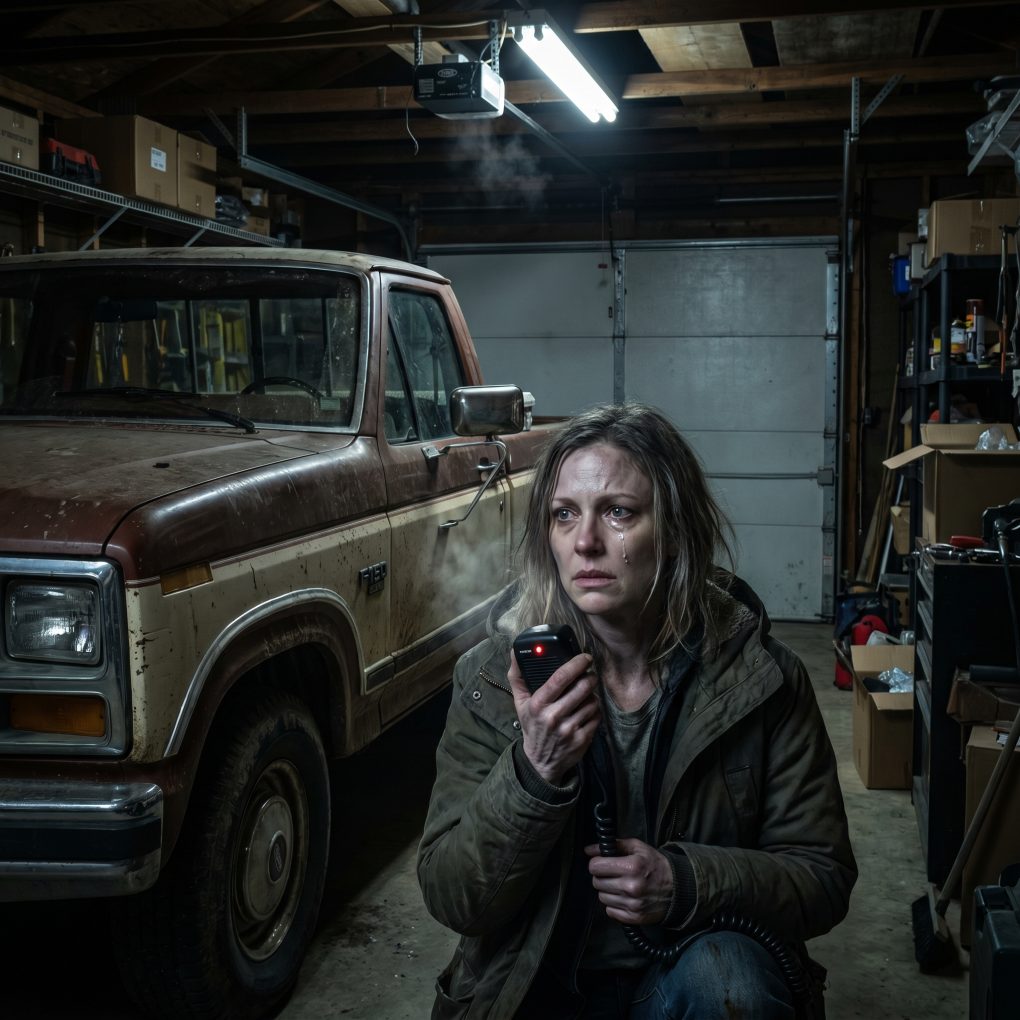
Then I turned the ignition in that truck, grabbed the old CB radio mic, and contacted the one person in Kentucky who could destroy my sister’s life before sunset.
The first night was the worst.
Cold changes time. Minutes stop behaving properly. I spent the first hour searching for my phone by the weak flashlight on the garage wall until the battery died. I checked every shelf, every workbench drawer, every cabinet my father had not locked years ago. Nothing useful. No pry bar small enough to leverage the side door. No ladder tall enough to reach the rafters where the vent opening sat. Just paint cans, rusted tools, old hunting gear, and the pickup truck my father used to drive around the yard when he wanted to inspect the fencing himself.
By midnight my hands had gone numb enough that thinking became harder than anger.
I climbed into the truck cab, wrapped myself in an old canvas tarp from behind the seat, and tried to conserve heat. That was when the shape of what Vanessa had done became clear. This was not a bad fight. Not a dramatic family overstep. She and Todd had locked me in a detached building in December, knowing no one was due at the house until the lawyer returned Friday afternoon. They had not just trapped me. They had calculated the gap.
At some point in the dark, I laughed.
Not because anything was funny. Because once you understand your sister is willing to leave you in a freezing garage to gain control of a company, normal emotional language stops working.
By morning, the truck battery was still alive.
That mattered.
My father kept old things in working order even when no one remembered why. The pickup had fuel, a functioning heater if I dared use the engine sparingly, and most importantly, a CB radio mounted under the dash like a relic from 1989. I nearly ignored it. Then memory kicked in. My father used that truck during storm outages when cell towers went down, and he kept the CB tuned to a local channel some emergency contractors, tow drivers, and county crews still monitored.
I turned the key halfway.
Static exploded through the cab.
I adjusted the dial with shaking fingers and got nothing at first but weather chatter, truck stop nonsense, and one man in Frankfort complaining about diesel prices. Then, around noon on the second day, I heard a call sign I recognized.
Bluegrass Seven.
That belonged to Russell Kane.
Russell was not law enforcement. He was worse for Vanessa. He had been my father’s operations chief for twenty years, the man who knew every vendor, every foreman, every bank officer, and every buried weakness in Mercer Tool & Die. More importantly, he hated Todd with a personal purity I had always admired.
I grabbed the mic and said, “Bluegrass Seven, this is Daniel Mercer. If you hear this, I am trapped in the garage at the Mercer estate. This is not a joke.”
Static.
Then silence.
Then Russell’s voice, sharp as a blade: “Say that again.”
So I did.
I told him enough. Locked in. House empty. Suspected corporate coercion. Need police and the company attorney. Come now.
He did not ask unnecessary questions. “Stay on frequency,” he said. “I’m fifteen out.”
That was when hope became dangerous.
Because once you believe rescue is possible, every sound becomes a test. Every minute becomes personal. I sat in that freezing cab listening to the engine tick, rationing heat, and thinking about what Russell would do when he got there. He would not just break a lock. He would bring witnesses. And Russell, unlike my mother, did not confuse family embarrassment with something worth preventing.
Three hours later, I heard it.
Not footsteps.
Sirens.
They opened the garage at 8:27 Saturday morning.
The deadbolt gave first, then the outer latch, then a flood of cold white winter light hit the floor in one long blade. I stood too fast, stumbled against the truck door, and caught myself just as Russell Kane stepped into the doorway with two sheriff’s deputies behind him, the company attorney beside them, and a look on his face that told me Vanessa’s week had already become far worse than mine.
“Jesus Christ,” Russell said when he saw me.
I wish I could say I walked out strong and silent like some movie version of myself. The truth was uglier. My legs shook. My lips were split from dehydration. My shoulder hurt from the first shove. I smelled like gasoline, dust, and fear cooked down into endurance.
The deputies got me into the house first. Warmth. Water. An ambulance check I tried to refuse and Russell overruled with one look. Then the sheriff asked the obvious question:
“Who locked you in there?”
“Vanessa Mercer Holt,” I said. “And Todd Holt.”
Russell handed the deputy the transfer papers Todd had tried filing at the company office that morning.
That part surprised me.
Apparently Vanessa didn’t just lock me away and wait. She used the thirty-six hours to start moving. Todd had shown up at Mercer Tool & Die Friday afternoon with a forged management resolution, claiming I was medically unstable, unreachable, and willing to step aside temporarily. He demanded access to accounts, signature authority, and payroll approval.
Unfortunately for him, Russell Kane had spent too many years around thieves wearing family names to be impressed by paper alone.
So he stalled. Then he tried my phone. Then he drove to the estate Friday night, saw my truck still there, saw the house dark, heard nothing, and came back at dawn with the county, the attorney, and enough fury to level a building.
By the time I made it to the hospital for fluids and a doctor’s clearance, Vanessa had already been picked up for questioning.
Todd lasted two extra hours.
That’s how long it took for the forged company resolution to be compared against the original will package, the garage door camera to reveal them forcing me toward the side entrance, and the county prosecutor to decide this was no longer a “domestic inheritance matter.”
It was unlawful imprisonment, coercion, attempted corporate fraud, and forgery.
Russell came to see me that evening with coffee and one sheet of paper.
Emergency board action.
While I was in the garage, Todd and Vanessa had accidentally triggered every protective clause my father built into the company charter. Any attempt to seize control through coercion or fraud resulted in permanent exclusion from ownership, managerial participation, and dividend rights by involved family members. My father had not trusted my sister nearly as much as she thought. He just never believed she’d be stupid enough to prove him right in a way that left paperwork.
“She destroyed herself,” Russell said.
“No,” I told him. “She just finally stopped pretending.”
The arraignment was Monday.
Vanessa cried in court. Todd blamed grief. My mother sat in the second row looking twenty years older and still somehow offended that consequences had shown up in public. The judge did not care. Bail conditions were set. Contact orders were entered. And Mercer Tool & Die moved into my control cleanly, legally, and without a single Holt hand left on the wheel.
My sister locked me in the garage after I refused to sign over my father’s company. “No one knows you’re here.” For thirty-six hours, I endured the cold.
Then I used the radio in the truck to contact the one person who destroyed everything.
Not because he took revenge for me.
Because he brought the truth into daylight before my family could rewrite it.
And once that happened, the company was never really the thing my sister lost.
What she lost was the illusion that blood could still protect her from what she had done in the dark.


.jpg)


0 commentaires:
Enregistrer un commentaire