
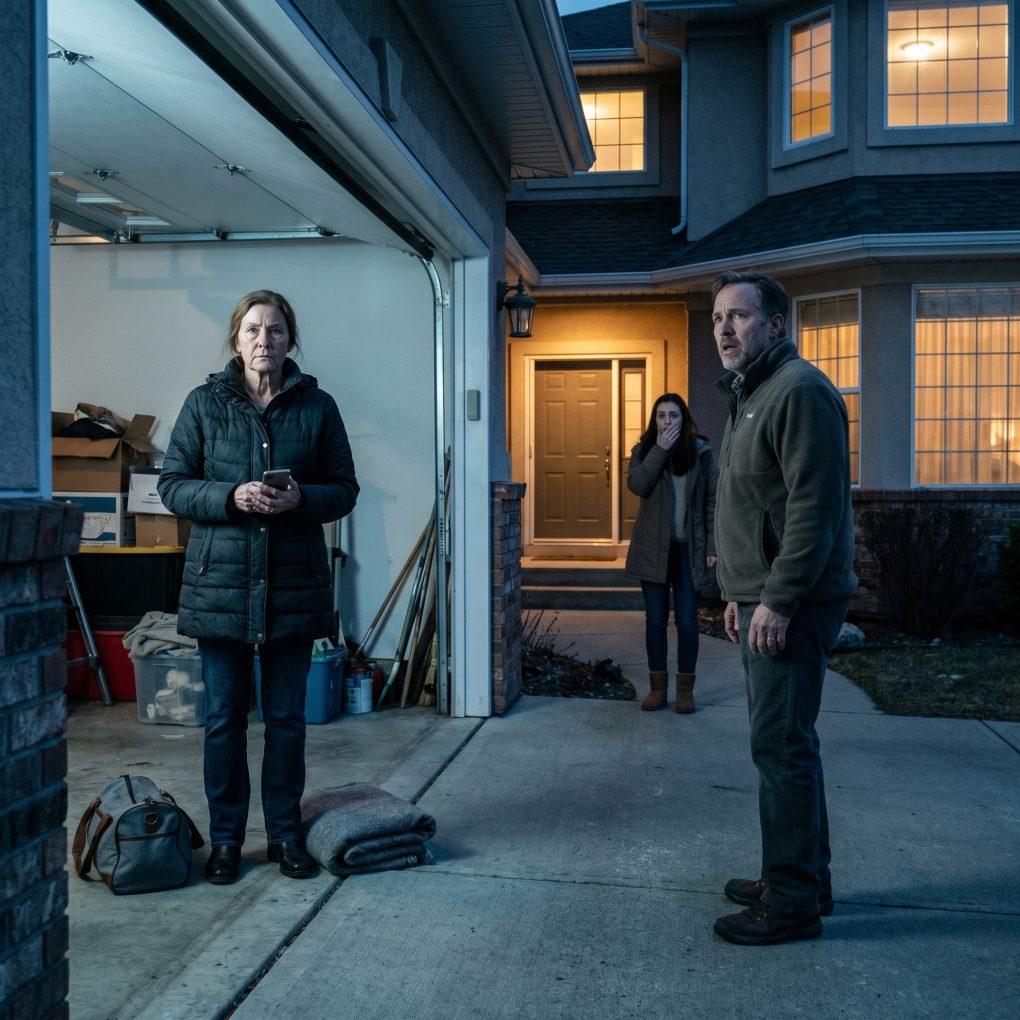
I gave my daughter the family home, believing she would cherish it forever. But her husband “repaid” my kindness by making me sleep in the garage. He thought I had nowhere else to go — until I made one phone call.
I gave my daughter the family home, believing she would cherish it forever. But her husband “repaid” my kindness by making me sleep in the garage. He thought I had nowhere else to go — until I made one phone call.
The first thing my son-in-law said when he handed me the blanket was, “Don’t make this harder than it needs to be.”
Then he pointed to the garage.
Not the guest room.
Not the couch.
Not even some air mattress in the den.
The garage.
I stood there in my own slippers, holding my medicine case and staring past him at the side door hanging half open to the cold. Behind him, through the warm yellow light of the kitchen, I could see the family home I had signed over to my daughter six months earlier—the same house my husband built room by room with his own hands, the same house where I had rocked my daughter through fevers and prom heartbreak and the night she came home from college crying because she thought she’d ruined her life with student debt.
I gave her that house because I loved her.
I thought she would cherish it.
Her husband, Brent, apparently thought it came with the old woman to
“Are you serious?” I asked.
He folded his arms. “You’ve been undermining me since we moved in.”
Undermining.
That was his word for asking why he had drained my late husband’s workshop into storage, painted over the walnut dining room trim, and started calling the front parlor “the media room” like the last forty years of my life were just ugly wallpaper he was waiting to strip off.
My daughter, Alicia, stood at the end of the hall in tears and said nothing.
That hurt more than his voice did.
Brent lifted the garage remote. “You can stay out there tonight and think about whether you still want to keep disrespecting me in my own house.”
My own house.
That phrase turned something in me to ice.
I looked at Alicia one last time, waiting for her to stop this.
She lowered her eyes.
So I took the blanket.
I walked to the garage.
And once the door shut behind me, I sat down on an old paint bucket, pulled out my phone, and made one call.
By sunrise, Brent was the one standing in the driveway realizing I had somewhere else to go.
And he had just lost his.
He thought humiliating an old woman in her own former home would break her into obedience. He forgot two things: who originally owned that house, and who still remembered every paper ever signed inside it. The rest of the story is below 
The person I called was not the police.
That would have been too simple, and worse, too easy for Brent to turn against me.
He was good at that.
Good at taking ugly things and dressing them up in practical clothes until even my own daughter stopped recognizing them for what they were.
He never shouted in public.
Never cursed in front of company.
Never did anything dramatic enough for neighbors to name.
He preferred quieter weapons.
Like changing the Wi-Fi password and “forgetting” to give it to me.
Like moving my late husband’s things into boxes labeled miscellaneous.
Like telling Alicia I was “having trouble adjusting” whenever I objected to something that had once mattered in this house.
And so when he made me sleep in the garage, I knew exactly what he thought would happen next.
That I would cry.
Get cold.
Maybe get dizzy from my blood pressure.
Then come inside in the morning softer, smaller, grateful for reentry.
Instead, I called Raymond Pike.
Raymond had been my husband’s attorney for thirty-two years, and after the funeral he became the quiet keeper of every paper my grief-bruised mind couldn’t bear to sort through. My husband, Walter, trusted almost nobody by the end—not because he was paranoid, but because he had built enough things in his life to know exactly how quickly people start reaching once they smell inheritance.
Raymond answered on the second ring, voice thick with sleep.
“Margaret?”
“I need the house file.”
He was awake instantly. “What happened?”
I looked around the garage.
The old Christmas bins stacked by the freezer.
Walter’s rusted tackle box.
A cot Brent must have dragged out recently, as if he had planned this before tonight and wanted the humiliation prepared in advance.
Then I said, very clearly, “My son-in-law put me out in the garage and thinks I can’t do anything about it.”
Raymond was silent for one long beat.
Then he said, “Do not leave. I’ll meet you there in forty minutes.”
That should have frightened me more than it did. But what I felt, sitting there wrapped in an old wool blanket while the November cold crept under the garage door, was not fear.
It was recognition.
Because this wasn’t the first time Brent had tried to make me feel like a guest in my own life.
The pattern started almost the moment they moved in. At first it was little things. He replaced the locks “for security” and didn’t give me a full set for three days. He moved Walter’s portrait from the front room to the upstairs landing because it made the house feel “heavy.” He told repairmen to bill Alicia directly now, even though the plumbing, roof, and old furnace maintenance were still being paid from the account Walter had left specifically for house upkeep.
And Alicia?
My poor girl.
She kept smoothing.
“Brent doesn’t mean it like that.”
“He’s just trying to make things organized.”
“You know how strong personalities clash.”
Strong personalities.
As if one of us was not an intruder in a house built before he was born and the other was not the woman who bled into every floorboard of it.
Raymond arrived at 1:07 a.m. in his old Buick, wearing a camel overcoat over flannel pajamas and carrying a file box.
I opened the side door before he knocked because Brent had apparently gone to bed believing the garage solved me.
“Lord,” Raymond said softly when he saw the cot. “Walter would’ve killed him.”
“Walter always said your version of revenge was more effective.”
That got the faintest smile out of him.
We sat on upturned paint cans under the bare bulb while he opened the file.
The deed transfer had been real.
Legal.
Clean.
On the surface.
That was Brent’s problem. He only understood the surfaces of things. He had rushed Alicia into accepting the gift because it made him feel established, successful, landed. But Walter never signed anything important without two extra layers underneath it.
Raymond slid the relevant page free and tapped a paragraph I had barely understood the day I signed it.
The house had transferred to Alicia in a life estate structure with occupancy protections, not absolute unrestricted ownership. Walter had insisted on it after his first stroke. The property remained hers so long as two conditions were met:
One, I retained permanent residential rights in the downstairs suite and common areas for as long as I wished.
Two, any act of coercion, dispossession, or forced removal against me triggered reversion review under trust authority.
I stared at the words.
Then at Raymond.
“Reversion review?”
He nodded. “Walter set it up so if anyone ever tried to push you out, the trust could claw the property back before full vesting.”
For one second, I forgot how cold I was.
Then I started laughing.
Not because it was funny.
Because my husband, dead two years and buried under the sycamore at Oak Hill, had apparently seen this exact shape of betrayal coming long before I did.
Raymond handed me a second document.
A letter from Walter.
Of course.
He had written it the week before the transfer and instructed Raymond to hold it unless “Brent ever starts measuring the rooms.”
That was Walter to the bone. Dry even in prophecy.
I opened the letter with shaking fingers.
Maggie, if you’re reading this, then our daughter married a man who thinks access equals ownership. I’m sorry I guessed right. Don’t protect his pride at the expense of your dignity. The house was always for Alicia, but never for the kind of husband who would use it to shrink you. If he crosses that line, take it back.
My eyes filled immediately.
I read the last sentence twice.
Take it back.
Raymond let me cry for exactly thirty seconds before sliding over the third paper.
Notice of immediate trust review and occupancy violation.
Prepared already.
Unsigned.
Waiting.
That was the twist.
Walter hadn’t just created a safeguard.
He had left the weapon loaded.
All I had to do was sign.
I did.
At 1:24 a.m., in the freezing garage my son-in-law thought would teach me obedience, I signed the document that started taking the house back.
At 1:31, Raymond emailed the trustee, the county recorder, and Alicia’s title insurer.
At 1:39, he called the emergency number for the trust administrator because, as he put it, “some things improve with dramatic timing.”
At 1:52, he sent Brent and Alicia a formal notice of occupancy breach and suspended beneficial transfer rights pending investigation.
Then came the second twist of the night.
Brent wasn’t just cruel.
He was stupid.
When Raymond asked if the house account had changed recently, I mentioned the contractor bills Brent had started rerouting. Raymond frowned, made one call, and discovered Brent had already tried to use the property as collateral for a business equipment loan.
Without my knowledge.
Without Alicia fully understanding what she signed.
And without realizing the title restrictions made the whole application fraudulent if my protected residence rights were not disclosed.
Raymond looked up from his phone and said, very quietly, “He may have just solved the rest of this for us.”
That was the moment I stopped seeing the garage as humiliation and started seeing it as the place Brent’s life split in two.
Brent opened the garage door at 7:13 the next morning with coffee in one hand and triumph already arranged on his face.
I think he expected to find me chastened.
Cold.
Ready to apologize for whatever imaginary stress he’d accused me of causing.
Instead, he found me dressed, calm, and sitting at the little folding table by the freezer with Raymond Pike beside me and a stack of papers laid out between us.
The look on his face fed me for weeks.
“What is this?” he asked.
Raymond stood first. “Good morning, Brent.”
Brent actually flinched. He knew Raymond. Everybody in town with money problems or inheritance expectations knew Raymond.
Then Alicia appeared behind him in yesterday’s sweater, pale and frightened already. She looked from me to the papers and whispered, “Mom?”
I stood up slowly.
“You put me in the garage.”
Brent lifted his chin. “You were upsetting my wife.”
“No,” I said. “I was existing in a house you decided felt more comfortable without me.”
Raymond handed him the notice.
Brent read the first paragraph, then the second, and the blood drained out of his face by the third.
Occupancy violation.
Protected residential rights.
Trust review.
Immediate reversion suspension.
“What the hell is this?” he snapped.
“This,” Raymond said mildly, “is the part where you learn the deed you were so proud of came with conditions you never bothered to understand.”
Alicia took the notice from Brent’s hand and read it herself.
I watched her get to the sentence about coercion and forced removal.
Watched her mouth part.
Watched the whole ugly architecture of the last six months finally shift from marital tension to what it really was.
Brent reached for the old favorite first: denial.
“This is ridiculous. She slept out here by choice.”
I laughed once.
That sound made Alicia look at me.
Then at the cot.
The blanket.
The pillow Brent had carried out himself.
He saw it too late—that the stage he built for my humiliation was now evidence.
Raymond, who had the soul of a man built specifically to ruin people like Brent, simply lifted a second file and said, “Would you like to discuss the undisclosed collateral application next?”
That landed harder.
Because cruel men can often talk their way around family abuse if everyone is invested in appearances.
Banks are much less sentimental about fraud.
Brent stared at him. “What application?”
Raymond didn’t smile. “The one you submitted last month using this house as security for a contracting equipment loan without disclosing Mrs. Holloway’s protected occupancy interest.”
Alicia looked like she’d been struck.
“You used the house for a loan?”
Brent turned on her too fast. “It wasn’t finalized.”
It didn’t need to be finalized.
That was another thing he failed to understand.
Intent has a paper trail.
Raymond laid out the application printouts, the signed disclosure pages, and the flagged note from the lender questioning title irregularities. Then he said the sentence that broke the room apart:
“Between the forced removal and the fraudulent collateral use, the trust is now within its rights to revoke the transfer entirely.”
Alicia sat down on the edge of the workbench because her knees had given up.
My daughter looked at me with tears already building and said, “You’re taking the house back?”
I wanted to say no.
Wanted, in some old deep mother place, to protect her from the full force of the consequence.
Then I remembered her standing in the hallway while her husband pointed me toward the garage and said nothing.
So I answered truthfully.
“Yes.”
Brent exploded.
Shouted that I had planned this.
Called Raymond a vulture.
Called me manipulative, vindictive, senile, poisonous.
Senile was a mistake.
Raymond visibly enjoyed that one.
“You may want to be cautious using competency language,” he said. “It tends to complicate matters when you’ve also been trying to borrow against an elder’s residence.”
Alicia looked from him to Brent, and for the first time since she married him, I saw her stop trying to smooth and start trying to see.
That was the real surprise.
Not the papers.
Not even the reversion.
The seeing.
She whispered, “Did you really think you could put my mother in the garage and keep the house?”
Brent said nothing.
Because yes.
He had.
He thought power was a mood and ownership was just whoever acted certain first.
By noon, the locks were scheduled to be changed.
By three, the trust administrator had formally frozen the transfer.
By five, Brent’s lender had withdrawn the application and flagged him internally for material nondisclosure.
He didn’t leave that night.
Alicia did.
Not forever.
Not heroically.
Just enough.
She took an overnight bag and sat in my downstairs suite while the man she’d been defending paced upstairs in a house that was already slipping back out of his reach.
We spoke until nearly midnight.
Not perfectly.
Not cleanly.
There were tears, accusations, long silences, pieces of history neither of us had looked at straight in years.
She admitted she saw more than she ever said.
Admitted Brent always pushed hardest when property, money, or status were involved.
Admitted she had started feeling like a guest in her own marriage but kept telling herself pregnancy hormones, stress, timing, anything but the truth.
Then she said the sentence that hurt most.
“I thought if I kept quiet, he’d stop picking targets.”
I closed my eyes when she said that.
Because every woman learns that lie from somewhere.
The house returned fully to the trust within two weeks.
Brent fought, blustered, threatened lawsuit, then backed down once the loan paperwork, the garage incident, and the title terms all got placed in one neat stack by men who bill by the hour. There are many things bullies enjoy. Document review is rarely one of them.
Alicia filed for separation two months later.
Not because of me, though he told everyone that.
Because once a woman sees a man measure her mother against square footage and still choose the square footage, it gets hard to unsee the rest of him too.
I still live in the house.
The walnut trim is being restored.
Walter’s workshop is open again.
The front parlor is the front parlor.
Alicia comes every Sunday now, sometimes with swollen eyes, sometimes with hope, sometimes just to eat soup in the kitchen and let silence be something gentle for a while. We’re not healed exactly. But we’re honest, which is rarer and better.
You asked what happened after my son-in-law made me sleep in the garage.
Here it is:
I gave my daughter the family home, believing she would cherish it forever.
Her husband repaid that kindness by trying to make me small enough to disappear inside it.
He thought I had nowhere else to go.
He forgot the dead sometimes prepare more carefully than the living—and that one phone call to the right lawyer can sound an awful lot like a house taking itself back.


.jpg)


0 commentaires:
Enregistrer un commentaire