
At my sister’s engagement party, my father told her wealthy future in-laws that I was just a meal delivery worker. They smiled at my plain dress. Then federal security agents walked in, and a cabinet-level official came straight toward me. The entire room fell silent.
At my sister’s engagement party, my father introduced me like I was a stain he hoped expensive people wouldn’t notice
My name is Elena Ward. I was thirty-two years old, standing in the ballroom of the Ashcroft Hotel in Washington, D.C., wearing a simple navy dress and low heels while my younger sister, Rachel, posed beneath white roses with her diamond ring held toward a room full of people who believed money and breeding were the same thing. The party was lavish in the way my father always reserved for her. Crystal chandeliers. String quartet. Imported champagne. A custom dessert table taller than some children. My father had spent years calling Rachel “our family’s future.” I was usually just “Elena.”
The future in question that night was Rachel’s fiancé, Bennett Hale III, the son of a powerful old-money family with political donors, private schools, and the kind of confidence that gets passed down like silverware. His parents, Charles and Victoria Hale, had arrived with polished smiles and quiet eyes that assessed everything. They were cordial to me at first, but then my father made his move.
He guided them toward me just as I was setting down my champagne flute and said, in the falsely casual tone he used when he wanted to sound humble while being cruel, “This is my older daughter, Elena. She’s just a meal delivery worker. Never cared much for ambitious things.”
Rachel laughed softly.
Not a shocked laugh. Not an embarrassed one
.At my sister’s engagement party, my father told her wealthy future in-laws that I was just a meal delivery worker. They smiled at my plain dress. Then federal security agents walked in, and a cabinet-level official came straight toward me. The entire room fell silent.
At my sister’s engagement party, my father introduced me like I was a stain he hoped expensive people wouldn’t notice.
My name is Elena Ward. I was thirty-two years old, standing in the ballroom of the Ashcroft Hotel in Washington, D.C., wearing a simple navy dress and low heels while my younger sister, Rachel, posed beneath white roses with her diamond ring held toward a room full of people who believed money and breeding were the same thing. The party was lavish in the way my father always reserved for her. Crystal chandeliers. String quartet. Imported champagne. A custom dessert table taller than some children. My father had spent years calling Rachel “our family’s future.” I was usually just “Elena.”
The future in question that night was Rachel’s fiancé, Bennett Hale III, the son of a powerful old-money family with political donors, private schools, and the kind of confidence that gets passed down like silverware. His parents, Charles and Victoria Hale, had arrived with polished smiles and quiet eyes that assessed everything. They were cordial to me at first, but then my father made his move.
He guided them toward me just as I was setting down my champagne flute and said, in the falsely casual tone he used when he wanted to sound humble while being cruel, “This is my older daughter, Elena. She’s just a meal delivery worker. Never cared much for ambitious things.”
Rachel laughed softly.
Not a shocked laugh. Not an embarrassed one.
An agreeing laugh.
Victoria Hale’s eyes flicked over my dress, my shoes, my lack of diamonds. Charles gave me the sympathetic little smile rich men use when they think they’re being kind to someone beneath the table but near enough to smell the food.
“How nice,” Victoria said. “It’s important that every family has grounded people.
”My father smiled like the line pleased him.
I stood there, calm on the outside, feeling something old and ugly settle into place. This was not new. My father had spent years reducing me in front of the right audience. When I worked overseas, he told relatives I was “wandering.” When I missed holidays for confidential assignments, he called me unreliable. When I refused to discuss my work because I legally could not, he translated silence into mediocrity.
And I let him.
Because defending yourself against someone committed to misreading you becomes exhausting after enough years. So I learned to keep my own counsel. It was easier. Safer. Cleaner.
Rachel squeezed Bennett’s arm and said, “Elena always preferred being in the background.”
I looked at her and almost smiled.
Because that part, at least, was true.
Then the ballroom doors opened.
Two federal security agents in dark suits entered first, scanning the room with practiced stillness. Conversation faltered. The quartet broke rhythm. A few guests turned, expecting perhaps some dignitary had arrived for the Hales. Then a third figure stepped in behind them—a cabinet-level official everyone in that room recognized instantly.
He did not look at my sister.
He did not look at the Hales.
He looked straight at me and started walking.
And that was when the entire room fell silent.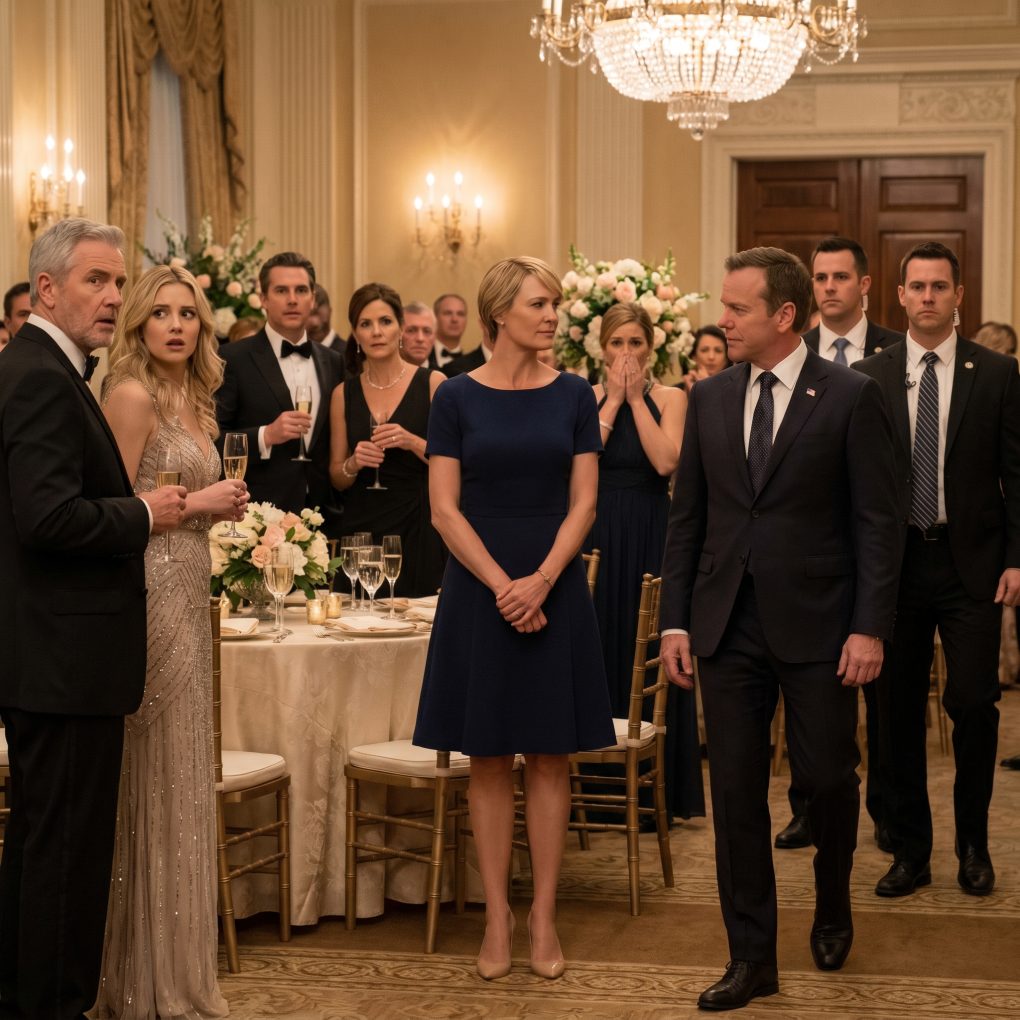
For a few seconds, no one in that ballroom moved.
Not the servers. Not the quartet. Not my father, whose hand was still resting proudly on the back of Rachel’s chair. The only sound was the soft click of the official’s shoes crossing the marble floor while two federal agents followed at a respectful distance.
It was Secretary Adrian Cole, the current Secretary of State.
Every person in that room knew his face.
Half of them had probably donated money to men who hoped to stand near him one day.
He came directly toward me.
I watched my father’s expression change in stages. First confusion. Then disbelief. Then the first hint of panic, because there are only so many reasons a cabinet-level official crosses a crowded engagement party and bypasses three hundred wealthy, well-connected people to approach the daughter you just called a meal delivery worker.
Secretary Cole stopped in front of me and smiled.
Not a vague public smile. A real one.
“Ms. Ward,” he said, extending his hand. “I had hoped I’d catch you before you disappeared again.”
I took his hand. “Mr. Secretary.”
The silence in the room deepened.
Behind me, I could feel Rachel staring. Bennett’s mother actually set down her champagne glass too hard. One of the Hales’ business associates muttered, “What on earth—”
Secretary Cole glanced briefly at the room, then back at me. “I apologize for the intrusion, but I was informed you were here, and I’m leaving for Brussels before dawn. I didn’t want to miss the chance to thank you personally.”
My father found his voice first.
“Mr. Secretary,” he said quickly, stepping forward, “I’m Elena’s father. There must be some misunderstanding.”
Secretary Cole turned his head just enough to acknowledge him, and in that small movement my father somehow became visibly smaller.
“There is no misunderstanding,” Cole said.
Then he looked at me again. “The evacuation corridor in Skopje would not have held without your intervention. Three embassy families are home because of you.”
No one breathed.
Rachel whispered, “Skopje?”
I didn’t answer.
I had spent the last eight years serving in a federal diplomatic security role that required discretion so strict it often looked like emptiness from the outside. I did not correct people because I was not allowed to discuss the details, and because part of me had long ago stopped expecting fairness from my family. My father took my silence and used it however it benefited him socially. Apparently tonight, he decided it would help to make me look ordinary in front of his future in-laws.
Secretary Cole kept going.
“You also saved one of my deputy chiefs from an extraction failure last spring,” he said. “I have not forgotten that.”
The room shifted around us. Not dramatically. Social rooms never explode first. They recalculate. I could almost hear the mental arithmetic beginning—the Hales reconsidering me, my father, the lie they had just been handed so casually.
Victoria Hale looked at my father with something close to contempt now. Charles had gone rigid. Bennett stared at Rachel as if seeing, for the first time, what kind of family he was really marrying into.
My father laughed once, weakly. “Elena has always been very private.”
That almost made me laugh.
Private.
Such a graceful word for all the years he’d spent diminishing what he could not control.
Secretary Cole’s expression cooled. “Private service is often the most important kind.”
Then he reached into his inside pocket and handed me a sealed envelope embossed with the department’s crest.
“The commendation should have reached you formally next week,” he said. “But after what I heard in the hallway, I thought tonight might be a good moment to make sure your work was named correctly.”
That was the sentence that finished my father.
Because it meant he hadn’t just been wrong in private.
He had been overheard.
And for the first time in my life, my silence was no longer protecting his version of me.
The problem with lies told in elite rooms is that they survive only as long as no one more powerful corrects them.
My father understood that immediately.
You could see it in his face as he stood there trapped between two social realities: the one he had built all evening, where I was the embarrassing daughter with a small life, and the one now standing in front of him in the shape of the Secretary of State thanking me for work important enough to keep families alive overseas.
Rachel broke first.
“What does he mean, extraction failure?” she asked me, but her voice was thin now, stripped of that bright little superiority she had worn all night.
I looked at her calmly. “Exactly what it sounds like.”
Bennett took one step away from her.
That tiny movement did more damage than any accusation could have. Because this was not really about my job anymore. It was about deception. My father had lied to impress them. Rachel had participated. And the Hale family, who valued status above almost everything, had just learned they had been manipulated at their own future in-laws’ event.
Victoria Hale turned to my father with deadly politeness. “You said your elder daughter lacked ambition.”
My father’s mouth opened, then closed.
Charles Hale said, “Interesting choice of presentation.”
There are some men who can survive public humiliation if they still control the next sentence. My father had no next sentence. Every possible explanation made him look worse. If he claimed ignorance, then he had belittled his own daughter without even knowing who she was. If he admitted he knew, then he had lied intentionally to impress his daughter’s wealthy future in-laws.
Rachel tried to recover.
“Dad was only joking,” she said.
Secretary Cole looked at her, then at me, and his expression told me he had spent enough years in Washington to recognize cowardice disguised as social smoothing.
“No,” he said. “He wasn’t.”
That landed harder than anything else.
Because it came from a man no one in that room could dismiss.
The quartet never resumed. Guests drifted into clusters, whispering. A few people came to speak to the Secretary, but only after I had finished with him, and even then they approached cautiously, as if proximity to him might further expose whatever foolish thing they had laughed at earlier. Before leaving, he shook my hand again and said quietly, “You’ve been underestimated by the wrong people for too long.”
“I’m used to it,” I said.
He smiled faintly. “Then let them get used to being wrong.”
And he left.
That should have been the end of it.
But the real collapse happened after.
Bennett asked Rachel, in a voice that carried farther than he intended, “What else has your family lied about?”
No one answered him.
Victoria requested her car.
Charles followed.
The Hales did not make a scene. Families like that never do when dignity can still be salvaged by speed and silence. But by the time they left, the engagement party had become a crime scene of class embarrassment. Rachel was crying. My father was trying to corner people into private explanations. My mother sat in a chair near the cake table looking as if someone had pulled the floor out from under her pearls.
I picked up my clutch, the sealed commendation envelope, and my untouched champagne.
My father intercepted me near the ballroom doors.
“Elena,” he hissed, “you could have said something.”
There it was. Not apology. Not shame. Just accusation that I had failed to rescue him from the consequences of his own contempt.
I looked him in the eye.
“You could have asked.”
Then I walked out.
At my sister’s engagement party, my father told her wealthy future in-laws that I was just a meal delivery worker. They smiled at my plain dress.
Then federal security agents walked in, and a cabinet-level official came straight toward me. The entire room fell silent.
Not because I suddenly became important.
Because for the first time, the truth entered before my family could edit it.


.jpg)


0 commentaires:
Enregistrer un commentaire