
After my husband died, my son called me and said, “I sold your car, so from now on you’ll be taking the bus to work every day.” But he had no idea what was inside the glove compartment..
My son sold my car three days after my husband’s funeral.
He didn’t ask.
He didn’t warn me.
He called me at 7:12 on a Monday morning while I was standing in my kitchen in my nursing scrubs, trying to force down half a cup of coffee before my shift at the rehab center.
“Mom,” he said, in the same clipped voice he used when speaking to customer service workers and people he thought owed him obedience, “I sold your car, so from now on you’ll be taking the bus to work every day.”
I laughed because the sentence made no sense.
“What?”
“The Buick,” he said. “You don’t need it.”
I stared out the window at the empty driveway.
My husband had been dead for eight days.
Eight.
Frank drove that car only on Sundays after his heart got bad. The rest of the time it was mine. Mine to get to work. Mine to buy groceries. Mine to drive to the cemetery when I needed to cry where no one could hear me. And now the driveway was bare.
“You sold my car?” I said.
“You’re welcome,” he snapped. “I got a decent price before it depreciated more. You should be thanking me for thinking ahead, since you clearly aren’t.”
My whole body went cold.
“I need that car.”
“No, you don’t. You’re sixty-eight, not thirty. The bus stops two blocks away.”
He said it like he was assigning chores.
Then he added, almost lazily, “I moved the money into my account for safekeeping. You’re not exactly in a good state to manage things.”
For one second, I couldn’t speak.
Because grief is one thing.
But hearing your own child start circling your life like an estate sale before the flowers on your husband’s grave have even wilted—that rearranges something in you.
I should have screamed.
Instead, I said, very quietly, “Who bought it?”
He gave me the name.
And the second I heard it, I smiled.
Because my son had no idea what was still inside the glove compartment.
He thought he’d taken her independence and moved one step closer to controlling everything. He forgot one small thing his father never left behind by accident—and the man who bought the car was about to open the wrong compartment. The rest of the story is below 
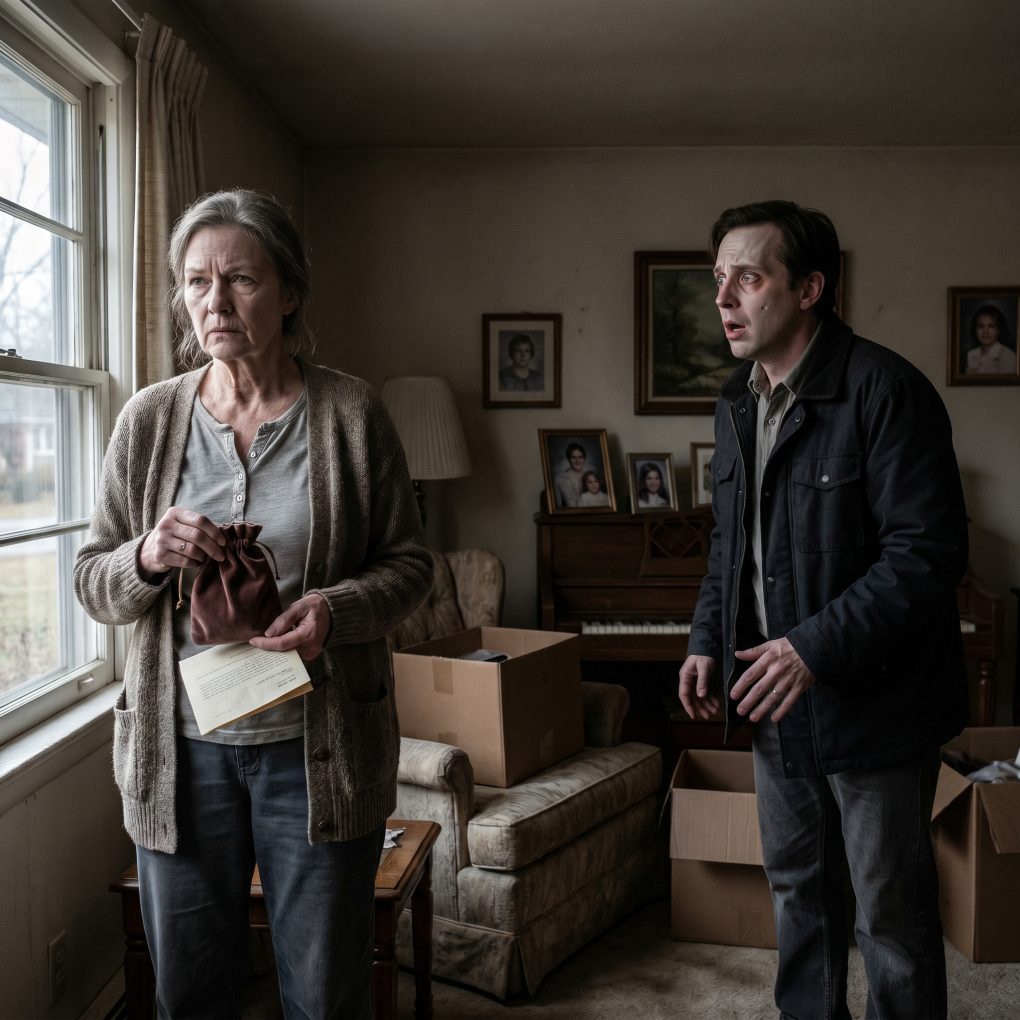
The buyer’s name was Walter Greer.
That mattered instantly.
Because Walter Greer was not some stranger from a classified ad. He owned Greer Auto & Salvage fifteen miles outside town, and more importantly, he had been my husband’s closest friend for forty years. Walter drank coffee at our kitchen table every deer season, carried Frank’s casket with the other pallbearers, and cried at the burial hard enough that I had to hand him my last clean handkerchief.
My son clearly didn’t know any of that.
Or maybe he did and was arrogant enough to think it didn’t matter.
Either way, he made the sale before calling me, which meant he had acted fast—too fast for paperwork to be clean, too fast for decency, and definitely too fast to remember what Frank used to keep in the glove compartment “for insurance against stupidity.”
That was Frank’s phrase.
Not stupidity in the mechanical sense.
In the human sense.
I didn’t wait for the bus.
I took the spare truck key off the hook, the one to Frank’s old farm pickup my son had apparently forgotten existed because it was ugly, rust-flecked, and therefore beneath his interest. The engine coughed twice, then turned over.
I drove straight to Walter’s lot.
He was standing beside my Buick when I pulled in, one hand on the roof, paperwork clipboard tucked under his arm. He took one look at my face and said, “Well. I guess he didn’t ask you.”
I got out and shut the truck door behind me. “No.”
Walter swore under his breath.
The Buick was parked by the service bay, still warm from the drive over. My husband’s old seat cushion was still on the driver’s side. The rosary from my sister-in-law still hung from the mirror. And in that moment, seeing the car whole and ordinary almost made me cry harder than the funeral had.
Walter saw it and softened instantly.
“Come inside,” he said. “I haven’t finished the transfer.”
That one sentence saved me.
Not finished the transfer.
My son had signed a bill of sale, yes. He had forged confidence, probably forged a signature too. But Walter was old-school. He checked titles against names. And the title was not in my son’s name.
It was in mine.
Inside the office, Walter laid the papers out flat on the desk and tapped the seller line with one thick finger.
“He signed as executor.”
“There is no executor yet,” I said.
Walter nodded once, already grim. “That’s what I figured after I saw the registration.”
I closed my eyes for one second.
My son wasn’t just cruel.
He was sloppy.
Then I said, “Open the glove compartment.”
Walter looked at me sharply.
“Still in there?”
“If he didn’t go through the car first.”
Walter grabbed the ring of keys off the hook and went back outside with me behind him. He opened the passenger side, reached in, pressed the latch—
And the compartment dropped open.
Inside were the owner’s manual, a flashlight, a pack of napkins, and a sealed manila envelope with one sentence written across the front in Frank’s blocky handwriting:
For Ellen, if Michael ever starts acting like my death makes him your keeper.
Walter actually barked out one disbelieving laugh.
“Oh, Frank,” he muttered.
My hands were shaking as I took the envelope.
Inside was a letter, a folded bank document, and a notarized power directive.
I read the first line standing in the gravel lot with the morning wind cutting through my coat.
Ellen, if you’re opening this, then our son has mistaken grief for opportunity. Don’t waste time hoping he’ll correct himself. Use this.
That was Frank all over. No soft lead-in. No dramatic poetry. Straight to the wound.
The letter explained everything.
Frank had seen changes in Michael over the past two years. The little comments about whether I “really needed” to keep working. The pressure to “simplify” my finances. The overinterest in what was paid off and what wasn’t. The way he kept referring to my house as “the family house” and my savings as “what’s left for all of us.”
Frank, unlike me, had not confused politeness for innocence.
So he planned.
The bank document gave me sole access to a separate account I didn’t know existed—seeded with enough money to cover my mortgage, living costs, and legal fees for years if necessary.
The notarized directive was even better: a statement of intent, signed by Frank and witnessed by his attorney, confirming that my car, home, pension supplements, and all liquid personal assets were to remain under my exclusive control, and that any attempt by Michael to interfere before formal estate settlement should be treated as hostile financial manipulation.
Hostile.
Financial.
Manipulation.
Frank had apparently sat in some lawyer’s office and named our son correctly while I was still trying to believe he was merely selfish.
I didn’t realize I was crying until Walter handed me a clean shop rag.
Then I turned to the bank page.
And there was the twist.
Frank hadn’t only protected me from Michael.
He had already caught him once.
Three months before Frank died, Michael had tried to convince him to refinance the house and “streamline the title structure” so everything would “avoid probate confusion.” Frank had refused. Later, he discovered Michael had called the bank himself pretending to clarify account authority after “cognitive changes in the older homeowners.”
My stomach dropped.
Cognitive changes.
He had already started building the narrative.
The frail old parents.
The confused mother.
The practical son stepping in.
Frank wrote, in one sentence that still scorches me:
He is not grieving me now. He is timing you.
Walter read that part over my shoulder and said, “Do you want me to call my brother?”
His brother was Sheriff Greer.
I said yes.
That was when the day stopped being about my car.
And became about my son.
Sheriff Greer came out an hour later, read the forged sale paperwork, looked at the title, looked at Frank’s directive, and said, “Well. That boy’s about to have a terrible afternoon.”
I should tell you I felt guilty.
I didn’t.
I felt clear.
For once in my life, heartbreak and clarity arrived holding hands.
Michael had not snapped under grief.
He had accelerated under opportunity.
And once I accepted that, every little thing from the last week changed shape.
The way he insisted I let him “sort” Frank’s desk.
The way he asked for my online banking password “in case bills got confusing.”
The way he referred to my job at the library as “cute” and said I should retire now that there was “no point pretending independence.”
No point.
He said it three times in four days.
As if widowhood were the natural ending of my authority.
Sheriff Greer took copies of everything and asked the question I had been avoiding.
“Do you want to press this?”
I looked at my Buick, then at Frank’s handwriting in my lap.
Then I said, “I want him to understand he can never try this again.”
The sheriff nodded. “That sounds like yes.”
Michael was waiting on my porch when I got home.
Pacing. Jacket open. Phone in hand. Angry in the way guilty people get when they think they’re still entitled to the upper ground.
The second he saw Walter’s truck behind me and the sheriff’s cruiser turning in at the end of the drive, his face changed.
That gave me more peace than it should have.
He came down the steps fast. “Mom, what the hell are you doing?”
I got out of the truck slowly because I wanted him to see every second of it. Not the broken widow. Not the soft target. Just a woman stepping down under her own power with a manila envelope in her hand and the law two vehicles behind her.
“What am I doing?” I said. “Undoing what you thought was already done.”
He looked at the Buick behind Walter’s truck, then at the sheriff.
Then back at me.
“You called the police over a car?”
“No,” I said. “Over fraud.”
That landed.
Not because he suddenly understood morality.
Because he finally understood risk.
Sheriff Greer came up the walk without hurrying. “Michael Bell?”
Michael straightened. “This is a family misunderstanding.”
The sheriff held up the forged bill of sale. “You sold property you did not own, using authority you did not have.”
Michael looked at me, not the sheriff. “You’re really doing this?”
I laughed once.
“You sold my car before your father’s obituary was even out of the paper.”
He flinched. Good.
Then he made his second mistake.
He said, “Dad would’ve wanted me to handle things.”
I took Frank’s letter out of the envelope and handed it to the sheriff.
“Would he?”
The sheriff read just the first paragraph, then looked at Michael like a man examining rot in a support beam.
“Son,” he said, “your father specifically documented concern that you would do exactly this.”
That broke something in Michael’s expression.
Not remorse.
Exposure.
He knew then that this wasn’t my emotional reaction against his practicality. Frank had seen him. Named him. Planned for him.
And he hated that more than the cruiser in the driveway.
The next hour was ugly in a very ordinary way. No dramatic handcuffs on the lawn. No neighbors filming from behind curtains. Sheriff Greer gave him the clean version first: return everything, sit down, say nothing stupid, understand that a formal report was being filed and that whether charges stuck would now depend on how cooperative he became.
Michael did not become cooperative.
He became insulting.
Said I was being manipulated by old men.
Said Walter had always hated him.
Said I was too emotional to know what was best.
And finally, in a burst of temper that finished whatever mercy I still had left, said:
“You’re seventy and alone. Somebody has to take over.”
I remember going very still.
Because there it was.
The true belief underneath all the helpfulness, all the management, all the planning.
Not love.
Not concern.
Succession.
I said, “No. Somebody doesn’t.”
He realized too late that Sheriff Greer had heard every word.
That helped.
By evening, the report was filed, the forged sale was voided, and Michael had left my property under direct instruction not to return without written permission. Walter changed the Buick’s locks for free. Sheriff Greer advised me to change the house locks too.
I did.
Then I called Frank’s attorney.
That conversation lasted two hours.
By the end of it, my will was being rewritten, my accounts were being restructured, and Michael’s “future expectations” were being reduced to something so thin it could barely cast a shadow.
Not from revenge.
From reality.
You cannot let a man try to administratively erase you and still reward him with control later for trying.
The biggest shock came two days later when Frank’s attorney pulled the archived file.
Frank hadn’t only written the glove compartment letter and set aside the private account.
He had also executed a trust amendment six months before he died, quietly removing Michael as successor decision-maker on everything. Health directives. Financial authority. Property oversight. All of it.
In his place?
Me alone first.
And if I was ever truly incapacitated, our niece Caroline—a CPA in Nashville who once told Michael to his face that he had “repo man energy in a banker’s haircut.”
I laughed so hard when I heard that I had to sit down.
Frank really had seen it all.
He didn’t confront Michael while alive because, I think, he still hoped time might turn arrogance into maturity. But he had built the rails anyway. He knew hope was not a plan.
Michael called every day for a week.
The first two days, furious.
The next three, pleading.
Then indignant.
Then falsely tender.
“Mom, I was only trying to help.”
“Mom, you know I panicked.”
“Mom, don’t let outsiders turn us against each other.”
“Mom, please, I’m still your son.”
Yes.
That was the saddest part.
He was.
And because he was, I knew exactly how much of this was choice.
A stranger stealing from me would have hurt less.
My son tried to strip away my movement, my work, my finances, and my dignity in one efficient gesture because widowhood had made him think I was entering a stage of life where consent became optional.
I did not answer any of those calls.
I sent one message only:
Your father left clear instructions. I am following them. Do not contact me again unless it is through an attorney.
Then I blocked him.
Three months later, I still drive the Buick to work.
I park it in the back lot at the library, carry my lunch in the same blue tote, and touch the glove compartment every now and then like a pulse point. Not because I need the money—though thank God for it. Not because I enjoy the memory.
Because it reminds me of something women my age are trained to forget:
being old does not make you available for confiscation.
After my husband died, my son called me and said, “I sold your car, so from now on you’ll be taking the bus to work every day.”
But he had no idea what was inside the glove compartment.
Neither, for that matter, did I.
Turns out my husband left me exactly what I needed:
the truth,
a warning,
and enough leverage to make sure our son never mistook my grief for surrender again.


.jpg)


0 commentaires:
Enregistrer un commentaire