
My brother’s wife slapped me right in the middle of the baptism. “Stay away from my family, you junkie.” Everyone gasped, but not a single person defended me. I had been clean for three years. Then my sponsor stepped out of the crowd. He was a federal judge. He looked at her and said nine words that changed everything.
The slap echoed off the stone walls of Saint Matthew’s before the baby even started crying.
My name is Daniel Reyes. I was thirty-seven years old, standing in the middle of my nephew’s baptism in a navy suit I had borrowed from my sponsor because my own still hung too loose on my frame, and my brother’s wife had just hit me across the face hard enough to turn half the church toward us in one shocked movement.
“Stay away from my family, you junkie,” she snapped.
The word landed harder than the slap.
Maybe because of where we were. Maybe because the priest had just raised the silver shell for the first blessing. Maybe because my nephew, six months old and dressed in white, blinked from his mother’s arms while the whole room inhaled and nobody—nobody—said a word in my defense.
I had been clean for three years.
Three years, two months, and eleven days, if anyone had cared enough to ask. I knew the number because I earned it every morning. I earned it in meetings, in apologies no one trusted at first, in working construction all day and still showing up to sponsor calls at night. I earned it every time I passed the corner where I used to score and kept driving. I earned it every holiday where my family watched me like a lit match in a dry room.
My brother, Mateo, didn’t move. He just stood beside the baptismal font, one hand on his son’s blanket, the other hanging useless at his side. That hurt worse than anything.
His wife, Sabrina, had hated me from the day they got engaged. She met me in my last bad year, when my life was all tremor and lies and disappearing acts. To her, I would always be that man. Recovery didn’t interest her. Accountability didn’t impress her. She liked moral certainty too much. Being able to point at me made her feel cleaner than she really was.
And my family let her.
That was the ugliest part.
My mother gasped and whispered my name, but she didn’t step forward. My father looked at the floor. My aunt crossed herself. Two cousins stared at me with that same tired mix of pity and embarrassment I had seen for years, as if my very existence kept ruining their nice occasions by reminding them of a chapter they preferred closed and buried.
I touched my cheek and said, quietly, “I’m here for the baby.”
Sabrina let out a short laugh. “No. You’re here to poison everything like you always do.”
The priest cleared his throat, but he didn’t intervene. Churches are full of mercy until someone makes it inconvenient.
I should have left then.
I almost did.
I had already started turning toward the aisle when a figure near the back pew stood up and stepped into the silence. He had been sitting among the guests in a dark gray suit, hands folded, unnoticed by almost everyone there.
My sponsor.
Judge Elias Whitmore.
He walked forward slowly, stopped beside me, looked at Sabrina, and said nine words that changed the whole church in an instant.
“You should pray the court never sees that temper.”
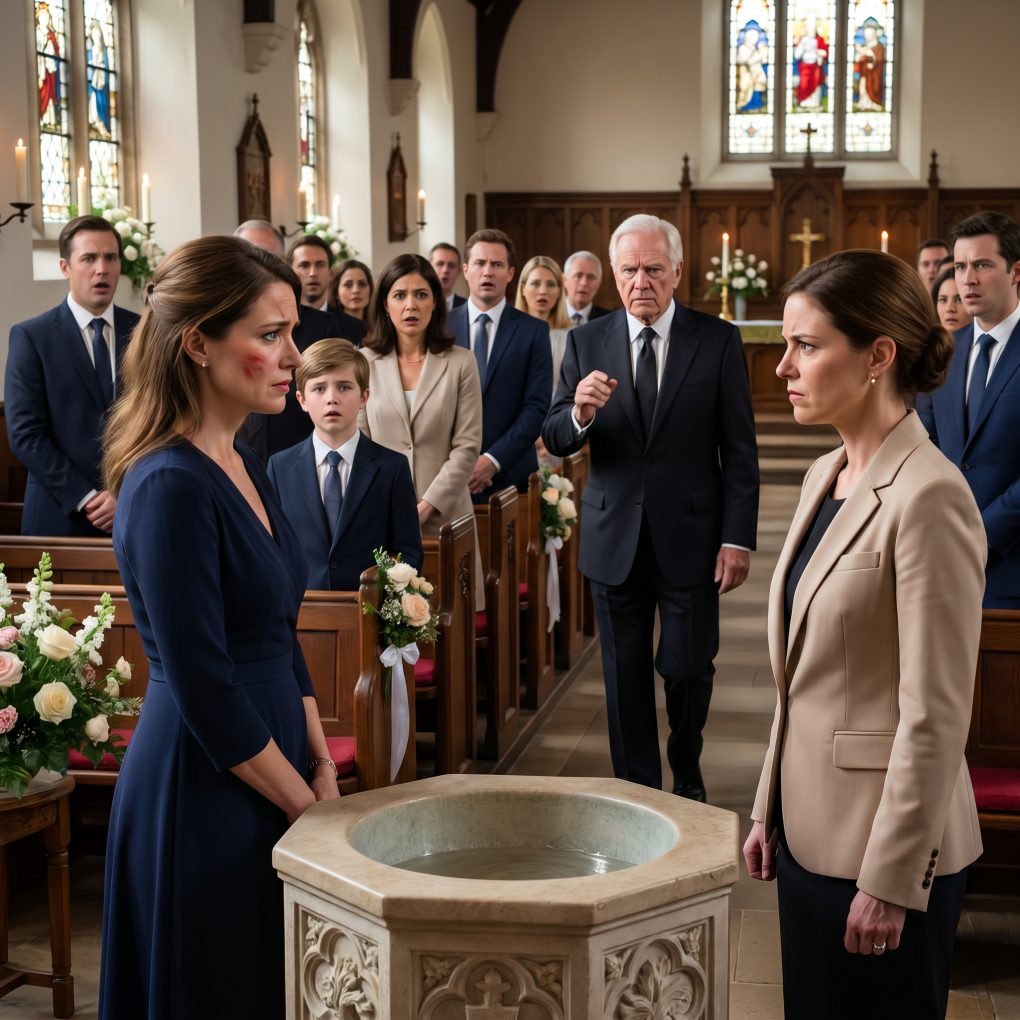
At first, Sabrina didn’t understand who had spoken.
She looked at Judge Whitmore the way people look at older men in churches—mild annoyance, quick dismissal, the assumption that age and calm mean softness. Then she really saw him. The silver hair. The posture. The face she had probably passed on local news clips without ever expecting it to be standing three feet away from her after she slapped her husband’s brother during a sacrament.
The room changed.
Not all at once. That would have been merciful. It changed in layers. My mother recognized him first. Her hand flew to her mouth. Then my uncle whispered, “That’s Whitmore,” like the name itself explained why the air had suddenly gone thin. Then my brother looked from the judge to me with the expression of a man realizing he had not only failed someone publicly but failed to understand him privately for years.
Judge Whitmore did not raise his voice.
That was what made it so devastating.
He stood beside me, one hand resting lightly on the pew rail, and repeated himself more clearly.
“You should pray the court never sees that temper.”
Sabrina’s face lost color. “I—this is a family matter.”
“No,” he said. “A woman striking a recovering addict in public and using his illness as a weapon is a character matter. Family is just where you chose to display it.”
A few people shifted uncomfortably. My father finally looked up. The priest took one step back from the font as if legal authority had somehow become a liturgical problem. My nephew started fussing softly in the tension, and my brother bounced him automatically, still saying nothing.
Still.
That silence from Mateo was digging under my ribs.
Judge Whitmore turned toward me then, not as a judge, not even as a sponsor, but as the one person in that room who had watched every ugly step of my recovery and never once mistaken shame for permanent identity.
“Daniel,” he said, “how long clean?”
I swallowed. “Three years.”
“Louder.”
I lifted my head. “Three years, two months, and eleven days.”
He nodded once. “And how many meetings this week?”
“Four.”
“How many people have you sponsored through detox?”
“Two.”
“How many times have you shown up for this family when they called?”
That one hit me strangely. I looked at my mother, my father, my brother holding his son, Sabrina clutching the baptismal towel like she was still the one under attack.
“Every time,” I said.
Judge Whitmore let the silence sit.
Then he looked at the church and said, “Then let the record of this man be spoken clearly, since none of you seem interested in speaking it yourselves.”
He wasn’t literally making a record, of course. But that’s what it felt like. Like the room had shifted into some higher chamber where facts finally mattered more than family mythology.
He started naming things.
Not dramatically. Precisely.
That I had completed treatment with no violations. That I worked full-time and had for over two years. That I had testified at youth recovery panels, quietly, without payment. That I had driven my father to cardiology appointments when Mateo couldn’t. That I had paid my mother’s overdue electric bill last winter and asked her not to tell anyone because “she already felt ashamed enough.”
My mother began crying then.
Not loudly. Just enough for everyone to hear the first crack.
Because she knew it was true. They all did. They had accepted my labor, my rides, my repairs, my money, my quiet presence at the edges of family life—but none of them had stood up fast enough to defend my dignity when it mattered.
Sabrina’s eyes darted to Mateo. “Say something.”
He opened his mouth, closed it, and for one second I thought he would choose her. Publicly. Again.
Then he looked at me and said, hoarsely, “I should have stopped her.”
That wasn’t enough. Not nearly. But it was the first honest thing he had said all morning.
Sabrina stared at him like she had been struck herself. “You’re taking his side?”
Mateo’s voice shook. “There shouldn’t have been sides.”
That was when the priest finally found his backbone and murmured that perhaps the family needed a private conversation before continuing. But no one moved. Nobody wanted privacy anymore. Privacy was what let lies grow fat in our family. Public truth, ugly as it was, had become the only clean thing in that church.
Then Sabrina made her final mistake.
She laughed once, brittle and furious, and said, “Oh please. He’s still an addict.”
Judge Whitmore looked at her for a long moment.
“Recovery is not a stain,” he said. “Cruelty is.”
And just like that, her certainty started collapsing.
What broke the room was not the slap.
Not even the word junkie.
It was what came after—the unbearable realization, laid out in front of God, a priest, and forty family members, that the only person who had defended me was the one man there who owed me nothing by blood.
My mother walked toward me first.
She was crying openly now, hands shaking, lipstick trembling in the way it used to when I came home strung out at three in the morning and she didn’t know whether to hug me or lock her purse away. Only this time, she stopped two feet short, like she no longer trusted herself to touch the son she had watched get humiliated without speaking quickly enough.
“I’m sorry,” she whispered.
I believed she meant it.
I also knew that wasn’t the same as forgiveness.
My father came next, slower, shoulders bent with the weight of being the kind of man who let silence do his cowardice for him. He didn’t apologize right away. Men like him need one extra second to recognize that shame is not fatal. Then he put a hand on my shoulder and said, “I failed you.”
That one landed.
Because it was true in a larger way than the morning. He failed me the first year I got clean when he called it “too early to trust.” He failed me every holiday he let people watch my hands too closely during dinner. He failed me every time he accepted my help but introduced me as “doing better now” in that thin, temporary voice, as if I were a weather system instead of a son.
Mateo handed the baby to the godmother and came down from the font. He looked wrecked. That was good. He should have. He stopped in front of me and said, “I didn’t know she was going to do that.”
I looked him in the eye. “You knew she thought it.”
That shut him up.
Because there it was again: family doesn’t usually collapse from one dramatic act. It collapses from the hundred tolerated attitudes that make the dramatic act possible. Sabrina had not invented that contempt by herself. She had been permitted it. Fed it. Protected by it.
She was still standing near the first pew, face pale, jaw tight, realizing the room no longer belonged to her performance. A few minutes earlier, she had been the righteous wife defending her child’s sacred day from the embarrassing uncle. Now she was the woman who slapped a sober man in church while a federal judge listed his good works one by one.
And yes, she knew exactly who Judge Whitmore was by then.
Everybody did.
He never once pulled rank in some vulgar way. He didn’t threaten charges, or mention his court in any specific sense, or turn the baptism into a legal spectacle. That would have been beneath him. What he did was worse for her. He made moral facts impossible to dodge.
Before the ceremony resumed, he leaned slightly toward Sabrina and said in a voice only the front rows were meant to hear, “If you ever force that child to learn contempt from your mouth again, the wrong people will notice.”
She didn’t answer.
She couldn’t.
The baptism went on, though no one could pretend innocence afterward. The baby cried through half of it. My mother held my hand during the final blessing. Mateo asked me to stand in the family photographs, and for once, Sabrina did not object. She didn’t speak to me at all. She kept her eyes on the floor or the baby or anywhere else. Her face had that hollow look people get when pride survives but confidence doesn’t.
Outside the church, under a pale afternoon sun, Judge Whitmore adjusted his cuffs and prepared to leave. I stopped him near the steps.
“You didn’t have to do that,” I said.
He gave me the look he used at meetings when I tried to minimize my own worth.
“Yes,” he said. “I did.”
I laughed, and this time it came out clean.
Then he put one hand briefly on my shoulder and said, “The world will always offer you people who remember your worst season. Build your life with the ones who can recognize your harvest.”
My family heard him.
I think that mattered too.
My brother’s wife slapped me in the middle of the baptism and called me a junkie. Everyone gasped, but not a single person defended me. I had been clean for three years. Then my sponsor stepped out of the crowd. He was a federal judge. He looked at her and said nine words that changed everything.
“You should pray the court never sees that temper.”
But the real change wasn’t fear.
It was the silence afterward—the kind that only comes when truth finally enters a family loud enough that nobody can pretend not to hear it anymore.


.jpg)


0 commentaires:
Enregistrer un commentaire