
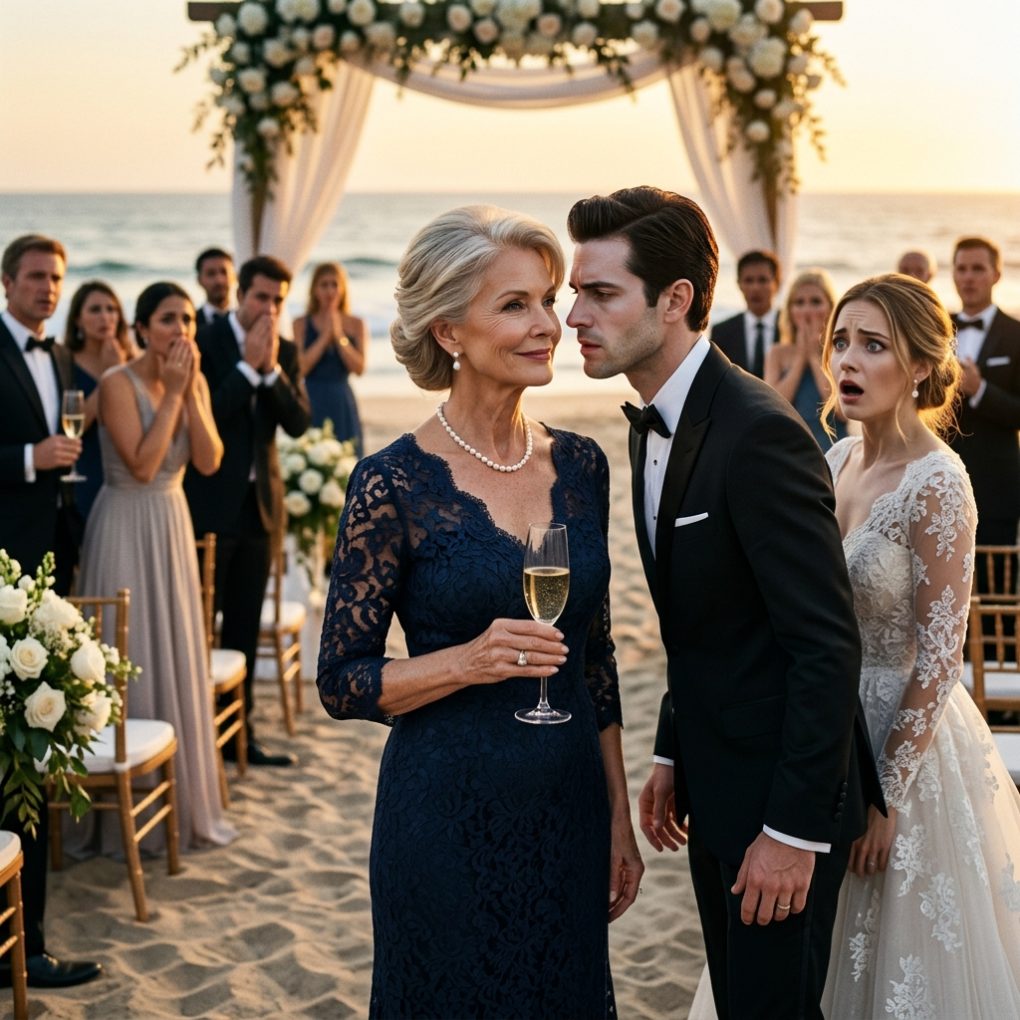
At my daughter’s beach wedding, her fiancé smirked and said, “Pay $50,000 for this luxury and stay in our lives—or disappear forever.” Then my daughter looked at me coldly and added, “Otherwise, enjoy growing old alone in a nursing home.” I took a sip of champagne, smiled calmly, and whispered, “You forgot one thing.” Their faces drained of color… and seconds later, everything fell apart without me having to do a thing.
At my daughter’s beach wedding, her fiancé lifted his champagne glass, looked me straight in the eye, and said, “Pay $50,000 for this luxury and stay in our lives—or disappear forever.”
Then my daughter smiled.
Not nervously. Not apologetically.
Coldly.
“Otherwise,” she said, adjusting the lace at her wrist as if she were discussing weather, “enjoy growing old alone in a nursing home.”
I took a sip of champagne.
Smiled calmly.
And whispered, “You forgot one thing.”
The color drained from both their faces.
Seconds later, everything around them began to collapse without me having to raise my voice, plead, or make a single scene.
But to understand why, you need to know what kind of daughter says that to her mother on her wedding day.
Her name is Vanessa.
She was my only child. I raised her mostly alone after my husband died when she was eleven. I worked through migraines, double shifts, rent scares, and every private humiliation that comes with being a widow too young and a mother too determined. I paid for violin lessons she quit, braces she complained about, a private university she swore would launch her into a “different kind of life.” I sold my wedding jewelry during her sophomore year when a scholarship fell through and never told her exactly why I suddenly “preferred simpler things.”
I did all of that gladly.
That is the ugly power of love when placed in the wrong hands: it teaches selfish people to confuse sacrifice with supply.
Vanessa met Grant two years before the wedding.
He was polished in a way that fools people fast. Expensive watch, calm voice, family money wrapped in startup language. He talked about branding, exclusivity, circles, standards. He treated waiters politely enough to impress the weak-minded and cruelly enough in private to reveal himself to anyone paying attention.
I paid attention.
So did he.
He saw very quickly that I was the only person in Vanessa’s life who ever told her no.
That made me inconvenient.
The wedding itself was pure theater. A private resort on the Florida coast. White orchids flown in from somewhere ridiculous. A string quartet on a bluff above the sand. Custom welcome baskets in each guest suite. Drone photography. Imported champagne. The kind of event designed less for marriage than for evidence.
Evidence of status.
Evidence of arrival.
Evidence that my daughter had become the kind of woman who no longer needed to remember where she came from.
Three months before the ceremony, Vanessa called and told me, with unsettling casualness, that the budget had “shifted unexpectedly” and there was “a family contribution gap.” I assumed she was asking for something symbolic. Maybe ten thousand at most, which would still have been absurd, but at least within the realm of selfishness rather than extortion.
No.
She wanted fifty.
Fifty thousand dollars.
Not for survival.
Not for a medical emergency.
Not because she and Grant were drowning.
For “the standard of experience.”
I laughed when she first said it because I honestly thought she was joking.
She wasn’t.
Then came the pressure campaign. Calls. Guilt. Silence. Grant saying families “invest in legacy moments.” Vanessa saying if I really loved her, I would want her wedding to “match the level of her future.” I said no. Repeatedly. Calmly. Absolutely.
That should have been the end of it.
Instead, the demand grew teeth.
When I arrived at the beach resort the day before the ceremony, I realized they had seated me at the very edge of the rehearsal dinner, placed me in the least desirable guest bungalow farthest from the main house, and removed my name from the family brunch itinerary entirely. It was all deniable. Small enough to call accidental. Obvious enough to communicate intent.
Then, one hour before the sunset ceremony, Grant asked me to meet them privately on the reception terrace.
That was where he made the offer.
Ocean behind him.
Champagne tower glowing beside him.
My daughter standing at his shoulder in silk and diamonds that my money had once helped teach her to admire.
“Here’s where we are,” Grant said smoothly. “We can still fix the tension.”
Vanessa crossed her arms. “If you transfer the fifty tonight, we move on. You stay in our lives. Holidays, future grandchildren, everything. If not…” She gave a tiny shrug. “You’ve made your choice.”
Grant smiled. “Pay for the luxury and stay in the family—or disappear forever.”
Then my daughter delivered the final line, looking me dead in the face:
“Otherwise, enjoy growing old alone in a nursing home.”
There are sentences that do not wound.
They clarify.
I lifted my glass, took one slow sip of champagne, and said, “You forgot one thing.”
Grant’s smile faltered first.
Vanessa’s followed.
“What?” she asked.
I held her gaze and said softly, “The resort isn’t yours.”
And that was when the first member of the hotel’s executive staff started walking toward us with security.
 Part 2: The One Thing They Didn’t Know
 Part 2: The One Thing They Didn’t Know
They had forgotten who paid attention.
That was their first mistake.
Their second was assuming age makes women passive instead of strategic.
The resort where Vanessa planned her perfect coastal spectacle was called Halcyon Dunes. To most guests, it was just another exclusive property for people who enjoy spending the cost of a down payment on flowers and imported linens. To me, it was something else.
Three years earlier, I had quietly invested in the hospitality group that acquired it.
Not because I am secretly wealthy in the cartoon sense. I’m not. But after my husband died, I handled the insurance payout with far more caution than anyone in my family realized. Later, after selling a commercial parcel my husband’s brother once mocked as “worthless marshland,” I diversified carefully. Real estate trusts. regional developments. quiet equity placements. I told almost no one. Not because I was hiding. Because I had spent decades learning that people become reckless around women they believe have no power.
One of those placements turned into a minority but meaningful ownership position in the holding company behind Halcyon Dunes.
Not enough to control the property day to day.
Enough to be taken very seriously when fraud, extortion, or reputational catastrophe threatened a flagship site.
And three days before the wedding, I had placed one discreet call.
Not to sabotage the event.
To ask a simple question: were there any outstanding billing irregularities connected to the Lancaster-Brooks wedding account?
There were.
A great many.
Grant had not merely built a wedding beyond budget. He had been moving vendor deposits through temporary private accounts, promising post-event settlements, and using my name in at least two communications as a “family guarantor” for unresolved balances.
Without my consent.
That part interested the resort’s legal team very much.
So when he and Vanessa cornered me on the terrace and delivered their polished little ultimatum, they did so without knowing three things.
First, the resort’s risk director had already flagged their account.
Second, copies of Grant’s emails naming me as a guarantor had been forwarded to me by a furious events controller.
Third, I had formally denied all liability in writing two hours earlier.
That was why I smiled.
Not because I enjoy revenge. Because certainty is very calming.
After I said, “The resort isn’t yours,” Grant laughed, but badly.
“What is that supposed to mean?”
Vanessa narrowed her eyes. “Mom, don’t do something dramatic.”
I almost pitied her then. She had inherited my cheekbones and none of my patience.
Before I could answer, Marianne Holt—the resort’s general manager, elegant as a knife in cream linen—stepped onto the terrace flanked by head security and a man from corporate finance.
“Mr. Mercer,” she said to Grant, “we need a word immediately.”
He blinked. “I’m in the middle of a private family conversation.”
“I’m aware,” she said. “It concerns unauthorized financial representations made in this family’s name and several unpaid accounts currently associated with this event.”
Vanessa turned toward me so fast the veil comb in her hair shifted.
“What did you do?”
“Nothing,” I said. “That’s the problem. I didn’t authorize any of it.”
Grant’s face changed.
Not to guilt.
To math.
He was calculating distances now—money owed, guests nearby, how fast a polished evening could become an administrative disaster if the wrong people started speaking too loudly.
Marianne continued in that same terrifyingly level voice. “Also, because you attempted to leverage a named investor associated with the holding group without disclosure, corporate counsel has instructed us to suspend bar expansion, vendor release, and final event execution until these questions are resolved.”
That was the moment the wedding began to die.
Not romantically.
Operationally.
The lighting coordinator stopped mid-adjustment because nobody had approved the overtime release. The live band’s manager, hearing the words unpaid accounts, walked over from the edge of the lawn. Two catering supervisors began speaking rapidly into headsets. Somewhere behind us, I saw one of the florists physically turn toward the ballroom as if calculating what could still be removed before sunset without legal trouble.
Vanessa’s face emptied.
“You can’t do this today.”
Marianne said, “This was done before today.”
Beautiful line. I admired her for it.
Grant took a sharp breath and tried a new tone—the rich man’s favorite, wounded professionalism.
“There has clearly been a misunderstanding.”
“No,” I said. “There’s been a habit.”
He looked at me with real hatred then.
Good.
Let him finally feel honest.
Vanessa grabbed my wrist. “Tell them this is a family issue.”
I looked down at her hand on me and saw, all at once, every year of this. Every sacrifice translated into expectation. Every kindness converted into access. Every boundary treated as betrayal.
“No,” I said. “This is a legal one.”
That was when the groom’s father, two bridesmaids, and half the front lawn noticed something was wrong.
And once wealthy weddings begin smelling like money trouble, all elegance goes feral fast.
Part 3: The Collapse No One Could Stop
It unraveled in under twelve minutes.
That is the true answer when people later ask how long it took for the whole thing to fall apart.
Twelve minutes from the moment Marianne stepped onto the terrace to the moment Vanessa was sobbing in the bridal suite and Grant was shouting at a lawyer on speakerphone while guests pretended not to listen.
First came the vendors.
The band refused to perform without payment release.
The floral team halted setup of the arch because the secondary transfer had bounced.
The cake designer, who had been fed promises about “family money clearing at midnight,” requested immediate written confirmation and got none.
The champagne tower was quietly dismantled before anyone could take photos in front of it.
Then came the guests.
Rich guests are the same as poor guests in one important way: once they sense social blood in the water, they stop caring about dignity and start caring about proximity. Were they close enough to the scandal to matter? Far enough from it to deny involvement? I watched people rearrange themselves by instinct, drifting away from Grant and Vanessa in little elegant arcs.
My former in-laws-to-be—Vanessa’s future family—were less subtle.
Grant’s mother cornered him near the dunes and hissed something fierce enough that even from a distance I could see his shoulders tighten. His father, who had spent the weekend performing old-money ease, was suddenly all business posture and cold eyes. He asked one question loud enough for me to hear:
“Did you use her name?”
Grant didn’t answer quickly enough.
That silence cost him more than any accusation could have.
Then the resort’s corporate counsel arrived by video call.
That was when the phrase fraud exposure entered the evening.
You could almost hear the social oxygen leave the lawn.
Vanessa came at me once more then, heels sinking into the grass, mascara already beginning to break at the corners.
“How could you do this to me?”
That was the line. Not mother, please. Not what happened. Not were you telling the truth about the guarantees. Just: how could you do this to me?
I answered honestly.
“I didn’t.”
She stared.
“You built a wedding on money that wasn’t yours and affection you thought would never stop paying out.”
She slapped me.
Not hard. Not cinematic. More desperate than violent.
It was enough.
Security moved at once. Not because of the slap itself, but because by then everything involving her and Grant had become a liability management exercise. Marianne stepped between us and told Vanessa, with exquisite professionalism, that any further aggression would trigger complete event cancellation under the resort conduct clause.
Grant then did the most self-destructive thing of the night.
He shouted, “This old woman promised support for the family!”
Too many people heard him.
Not promised legally. Not authorized formally. Promised support.
A phrase that turned his careful financial “misunderstanding” into what it really was: extortion dressed as kinship.
One of the attorneys on the video call asked him to repeat himself.
He did not.
Coward.
By then, the officiant had quietly left.
The photographer had switched from artistic discretion to full invoice-protection mode.
And Grant’s father, realizing exactly what his son had attached himself to, said something to Vanessa I suspect will echo in her nightmares for years:
“If this is how you enter a family, you may leave ours before sunset.”
She collapsed into a chair after that.
As for me, I did not yell. I did not threaten. I did not gloat. I sat in a wicker chair overlooking the water, finished my champagne, and watched consequence do what it does best when enough truth enters a room.
It requires no performance.
By nightfall, the ceremony had been “postponed.”
By morning, it was over.
Not romantically, perhaps. They may still crawl back toward each other out of vanity, stubbornness, or mutual ruin. But the wedding itself was dead.
Vanessa called me two days later from a private number.
She sounded smaller. Not wiser. Just smaller.
“You humiliated me.”
“No,” I said. “I interrupted you.”
She cried then, finally, and asked the question she should have asked before any of this began.
“Did you ever even want to help?”
“Yes,” I said. “Until you turned love into a bill.”
That was the heart of it.
I would have given her joy.
I would have given her beauty within reason.
I would have given her dignity all day long.
But I would not pay ransom for a place in my own daughter’s future.
So yes—at my daughter’s beach wedding, her fiancé smirked and said, “Pay $50,000 for this luxury and stay in our lives—or disappear forever.” Then my daughter looked at me coldly and added, “Otherwise, enjoy growing old alone in a nursing home.”
I took a sip of champagne, smiled calmly, and whispered, “You forgot one thing.”
Their faces drained of color because the one thing they forgot was simple:
I was not the desperate one in that conversation.
They were.
And seconds later, everything fell apart without me having to do a thing because once the lies touched the money, even love’s illusion could no longer protect them.
Tell me honestly—what ruined them more: the unpaid wedding, or the moment they realized I would not buy my way back into being their mother?


.jpg)


0 commentaires:
Enregistrer un commentaire