
At the airport, my sister slapped me in front of all the passengers just before our flight to Hawaii. My parents immediately blamed me — because she had always been the spoiled favorite. What they didn’t know was that I had paid for the entire trip. So I quietly canceled all their tickets and walked away. What happened next left everyone completely stunned…
The slap landed so hard it turned my head and sent my sunglasses skidding across the polished airport floor.
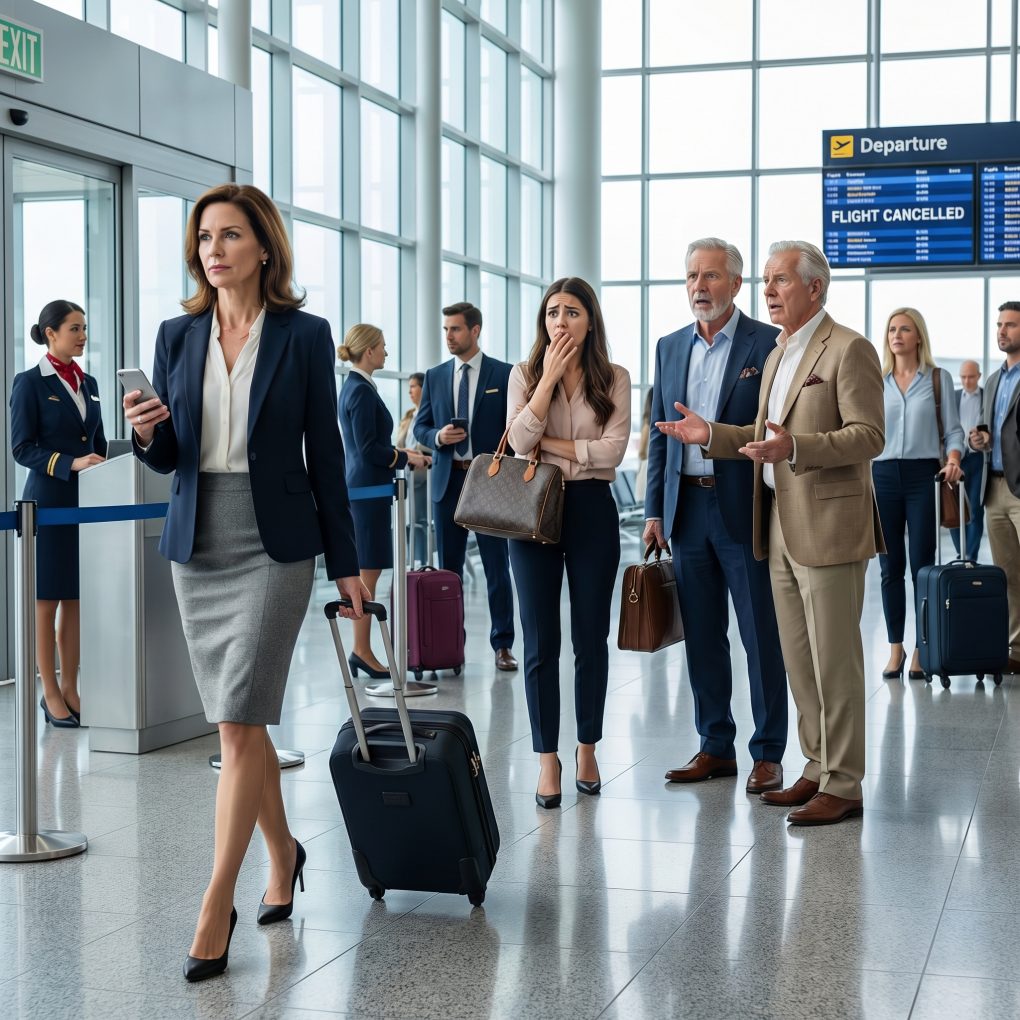
For a second, everything in Terminal B seemed to stop. Conversations cut off. A child near the gate stared openly. A woman holding a boarding pass lowered her coffee cup halfway to her mouth and forgot to drink it. Even the airline agent at the counter looked up in frozen disbelief.
My sister, Vanessa, stood in front of me breathing hard, one hand still raised, her face twisted with the kind of rage only spoiled people feel when the world refuses to rearrange itself fast enough for them.
“Don’t you ever embarrass me like that again,” she snapped.
I touched my burning cheek and tasted blood where my teeth had caught the inside of my mouth. Around us, rolling suitcases and airport announcements kept moving, but it all sounded far away. We were less than twenty minutes from boarding our flight to Honolulu, and I had just been slapped in public by my thirty-two-year-old sister because I told her she was old enough to carry her own Louis Vuitton bag.
That was it. That was the crime.
My name is Claire Monroe, I was twenty-nine, and this family vacation to Hawaii had been supposed to celebrate my father’s retirement. My parents had spent weeks bragging to relatives about the ocean-view resort, the first-class upgrades, the private snorkeling excursion, the fancy dinner cruise. What they did not tell anyone—because they did not know—was that I had paid for all of it.
Every ticket. Every reservation. Every upgrade.
My father thought he had “handled the package” through a travel agent friend. In reality, after his business had taken a bad turn the year before and my mother had quietly started borrowing money from me “just to stay afloat,” I stepped in and booked the entire trip myself using my bonus from a pharmaceutical sales deal I had closed in March. I did it because I was tired of hearing them say they had never had one real luxury vacation together. I did it because despite everything, I still wanted one peaceful week where we could act like a normal family.
That was my first mistake.
My second mistake was expecting Vanessa not to behave exactly like Vanessa.
She had always been the favorite. Prettier, louder, more fragile when it was useful. When she wrecked my mother’s car at nineteen, my parents called it stress. When she stole money from my wallet in college, they said sisters should not keep score. When she screamed at waiters, ruined birthdays, flirted with men I dated, and turned every gathering into a hostage situation, everyone bent around her like human furniture because “that’s just how Vanessa is.”
So when she slapped me, my parents reacted the same way they always did.
My mother rushed to her side instead of mine. “Claire, what did you say to her?”
My father looked furious—but at me. “For God’s sake, can’t you go one day without provoking your sister?”
I stared at all three of them, my cheek still throbbing.
Vanessa gave me a smug little smile then, the kind she always wore when she knew the verdict had already gone her way.
And that was the exact moment I stopped being generous.
I bent down, picked up my sunglasses, walked to a quiet corner by the gate windows, opened the airline app on my phone, and began canceling three tickets.
My parents’ first.
Then Vanessa’s.
Then the hotel suite that had been booked in all their names under my card.
By the time boarding was called, only one confirmed passenger remained on the reservation.
Me.
I did not say a word while I canceled everything.
That was the part I still remember most clearly—not the anger, not the humiliation, but the calm. My hands were steady. My breathing slowed. Years of resentment aligned into one clean line of action, and for the first time in my life, I was not reacting to my family. I was deciding.
The airline app made it almost insultingly easy.
Three taps to cancel my mother’s ticket.
Three more for my father’s.
Then Vanessa’s.
The resort reservation took a little longer because it had multiple linked services attached: airport transfer, ocean-view suite, dinner package, and activity credits. I called the hotel directly, identified myself as the paying guest, and removed every name except my own from the booking. The woman on the phone was polite, efficient, and completely unsurprised. Money, unlike family, recognizes authority immediately.
When I hung up, I slipped the phone back into my purse and walked toward the gate.
Behind me, I could hear Vanessa still complaining. “She’s so dramatic. She always ruins everything.”
My mother made soothing noises. My father muttered something about boarding soon. None of them had checked their emails yet. None of them had looked at their updated itineraries. They still believed I was the family mule—hurt, maybe, but still harnessed.
Then the gate agent smiled at me. “Welcome, Ms. Monroe. You’re all set.”
I handed over my passport.
That was when my father finally noticed something was wrong.
He stepped up behind me and frowned at his phone. “Why am I getting a cancellation notice?”
My mother pulled out her phone too. “What does this mean, ticket voided?”
Vanessa’s voice went shrill. “Why does mine say inactive reservation?”
The gate agent looked from them to me with sudden caution.
I turned slowly.
Three faces stared back at me—annoyed first, then confused, then beginning to understand.
My father said, “Claire, what did you do?”
I held his gaze. “I canceled the tickets.”
Vanessa laughed once, a disbelieving bark. “No, seriously.”
“I’m serious.”
My mother stepped forward, already offended. “You can’t cancel our tickets.”
“I already did.”
The color drained from my father’s face. “How?”
“Because I paid for them.”
Silence.
Not just from my family. From the people nearby too. A businessman two feet away actually stopped typing on his laptop. An older couple at the gate turned fully toward us. The gate agent straightened like she had just realized she was watching a very expensive family collapse in public.
Vanessa blinked. “What are you talking about?”
I almost smiled.
“I’m talking about the fact that Dad didn’t pay for this trip. I did. The flights, the hotel, the upgrades, the excursions. All of it. You slapped me in front of half the terminal, Mom blamed me, Dad blamed me, and the three of you can figure out your own vacation now.”
My mother’s mouth fell open. “You said this was Dad’s retirement gift package.”
“No,” I said. “You assumed that because none of you ever ask where things come from as long as they appear when you want them.”
My father recovered with anger, because that was his only surviving option. “You vindictive little—”
“Don’t,” I said.
He stopped.
Not because I raised my voice. Because I never did. And people who have relied on your silence for years always notice when it hardens.
Vanessa stepped toward me. “You humiliating psycho, reactivate my ticket right now.”
I looked at her red manicure, the same hand that had slapped me ten minutes earlier, and said, “No.”
That was when she tried to lunge for my phone.
The gate agent moved first. “Ma’am, step back.”
Vanessa froze, stunned that a stranger had interrupted her momentum. She looked around as if expecting the terminal to return to its proper order, the one where she erupted and everyone else managed the fallout. But people were watching now with open disgust. One woman near the stanchions actually said, under her breath but not quietly enough, “Good for her.”
My mother grabbed my wrist. “Claire, stop this nonsense. Families fight. You do not strand your parents at an airport.”
I pulled my hand free. “You let your daughter hit me and asked what I did wrong.”
My father said, “We can discuss that in Hawaii.”
“No,” I said. “You can discuss it here.”
Boarding for first class was announced then.
The gate agent looked at me. “Ms. Monroe?”
I nodded.
Vanessa’s face twisted into panic for the first time. “You’re actually going?”
“Yes.”
My mother’s voice broke. “You would leave us?”
I picked up my carry-on.
“You left me first,” I said.
Then I handed over my boarding pass, stepped onto the jet bridge, and walked away while my family remained behind the ropes, shouting my name to no effect at all.
By the time the plane lifted over the Pacific, I had blocked all three of their numbers.
Not forever, I told myself at first. Just long enough to have one uninterrupted breath in a life that had felt crowded by obligation for years. But somewhere between the second glass of champagne and the dark blue stretch of ocean under the wing, I understood that this trip had already become something else. It was no longer a vacation I had paid for.
It was an exit.
I arrived in Honolulu just after sunset. Warm air hit my face the moment I stepped out of the terminal, carrying salt, flowers, and the strange sweetness of a place untouched by my family’s noise. The driver I had originally booked for four was now waiting with a sedan instead of a van. He took my suitcase without a question and drove me to the resort while palm trees flashed in the dark like quiet applause.
At check-in, they upgraded me again. Complimentary, the manager said, because the larger suite had become awkward for one guest and they happened to have a private bungalow available near the water.
I stood alone on that lanai an hour later, barefoot, looking out at moonlight on the ocean, and realized I had never once in my adult life been alone somewhere beautiful without guilt attached to it.
The messages started the next morning after I unblocked email but not their calls.
First my father:
You made your point. Rebook the flights home and stop acting childish.
Then my mother:
We had to spend the night at an airport hotel because everything was booked. Your sister is hysterical. I hope you’re happy.
Then Vanessa:
I swear to God I will never forgive you. Everyone knows what you did. You’re disgusting.
I read all three while sitting beside an infinity pool with Kona coffee in my hand and a plate of papaya I had not prepared for anyone else.
For once, their outrage looked exactly like what it was: inconvenience mistaken for injury.
What happened after that stunned more than just them.
Two days into my stay, my father’s older brother, Uncle James, emailed me privately. Then my cousin Melissa. Then my grandmother’s sister in Arizona. Word had traveled fast through the family, but not in the direction my parents expected. Apparently, when forced to explain why they were suddenly not in Hawaii, they told a version that kept changing. First it was a “booking glitch.” Then I had “overreacted to a misunderstanding.” Then Vanessa admitted there had been a slap but claimed I had “baited her.” The problem with lies inside families is that everyone already has previous evidence. Enough people had seen Vanessa’s behavior for years. Enough people knew I was the one paying emergency dental bills, replacing broken appliances, and quietly wiring money whenever my parents came up short.
For the first time, the story did not land on me as proof of my cruelty.
It landed on them as proof of their dependence.
Uncle James wrote only one line that mattered:
I always wondered who was funding your parents’ “comfort.” Now I know. Stop.
So I did.
When I got back to Ohio a week later, I canceled the automatic payment I had been sending monthly to help my parents with their condo fees. I removed my mother from my backup credit card. I closed the shared family streaming bundle, the cell phone plan, and the grocery delivery account Vanessa had somehow ended up using more than I did. I also pulled my offer to co-sign the refinance my father had been begging me to help with.
Within ten days, real panic began.
Not vacation panic. Life panic.
My mother showed up at my apartment crying. My father called from a new number and shouted that I was tearing the family apart. Vanessa sent a message through a cousin saying I had “changed since getting money.” That one almost made me laugh. I had not changed because I had money. I had changed because, at Gate 22 in front of strangers, I finally saw what I had been buying all these years: not love, not gratitude, not family peace.
Access.
Convenience.
Silence.
The final conversation happened a month later at my parents’ condo. I went only because my aunt insisted there should be one honest meeting before I cut contact completely.
Vanessa was there, arms folded, still angry enough to think she was the victim. My mother looked older. My father looked tired in a way pride does not age well. They wanted explanations. They wanted proportionality. They wanted the old version of me back, the one who could be slapped and then made to apologize for the tension.
Instead, I told them this:
“I did not cancel your tickets because of one slap. I canceled them because that slap was the clearest, most public version of what this family has done to me my whole life. Vanessa hurts me, you excuse it, and then you expect me to pay for the privilege of staying.”
No one answered.
Because there was no answer.
I left them sitting there in the quiet.
People later asked whether I felt guilty spending that week in Hawaii alone.
No.
I felt expensive.
Not in the glamorous sense. In the truthful one.
It took me twenty-nine years to understand that I had been paying far too much for people who only noticed my value when I withdrew it.
At the airport, my sister slapped me in front of everyone.
But what left them completely stunned was not what happened in the terminal.
It was what happened after they learned I was no longer coming back as their wallet.


.jpg)


0 commentaires:
Enregistrer un commentaire