.jpg)
My wife called from the hospital, sobbing, “Please, the doctor refuses to operate on our son. He says our boy’s condition is too critical.” I asked, “Who’s in charge?” She told me the name. I replied quietly, “Stay on the line. Five minutes.” I didn’t call an ambulance. I called the hospital director. After that, everything changed.
The call came at 2:13 in the morning, just as I was locking my office and preparing to drive home after seventeen straight hours of work
.My name is Daniel Mercer. I was forty-two, a corporate litigation attorney in Houston, Texas, and until that moment I believed the worst part of my week had already happened. I was wrong. My phone lit up with my wife’s name, and the second I answered, I heard her crying so hard she could barely breathe.
“Please,” she sobbed. “The doctor refuses to operate on our son. He says our boy’s condition is too critical.”
For one second, everything inside me stopped.
Our son, Ethan, was nine years old. Bright, stubborn, obsessed with astronomy, and the only child I had ever known who could make an entire room rearrange itself around his smile. He had been admitted that evening after what we thought was severe abdominal pain turned into something much worse. By midnight, the scans showed a ruptured vascular malformation pressing against his lower intestine and causing internal bleeding. I had left the hospital only because the attending nurse swore they were stabilizing him and told me to go sign emergency insurance documents at my office before the administration department closed out the overnight file.
Now my wife was calling to tell me they wouldn’t operate.
“Who’s in charge?” I asked.
She gave me the name through tears. “Dr. Howard Renshaw.”
I knew it instantly.
Not personally, but by reputation. Brilliant surgeon. Dangerous ego. The kind of man who liked impossible cases when they ended in praise and avoided them when the risk of failure might stain his numbers. I had heard his name before from one of my medical malpractice clients years earlier. Renshaw had never been found liable, but his pattern was whispered about in enough legal circles that I remembered it.
I leaned one hand against the desk and said quietly, “Stay on the line. Five minutes.”
My wife started crying harder. “Daniel, please, don’t let them give up on him.”
“I won’t.”
I did not call an ambulance.
I did not call another surgeon directly.
I called the hospital director.
His name was Michael Hargrove, and ten months earlier I had quietly saved his career when a board dispute threatened to bury him in a contract scandal he did not create but would absolutely have died under. He answered on the third ring, groggy and annoyed, until I said six words:
“My son is bleeding in your hospital.”
Then I gave him Dr. Renshaw’s name
.Silence.
The kind that tells you the person on the other end understands exactly how dangerous the next few minutes could become.
Then Hargrove said, fully awake now, “Do not hang up. I’m heading there myself.”
And in that moment, standing alone in my office with my wife crying into the phone and my son somewhere under fluorescent lights waiting for strangers to decide if he was worth the risk, I understood something with terrifying clarity:
The next five minutes were going to decide whether my boy lived or died.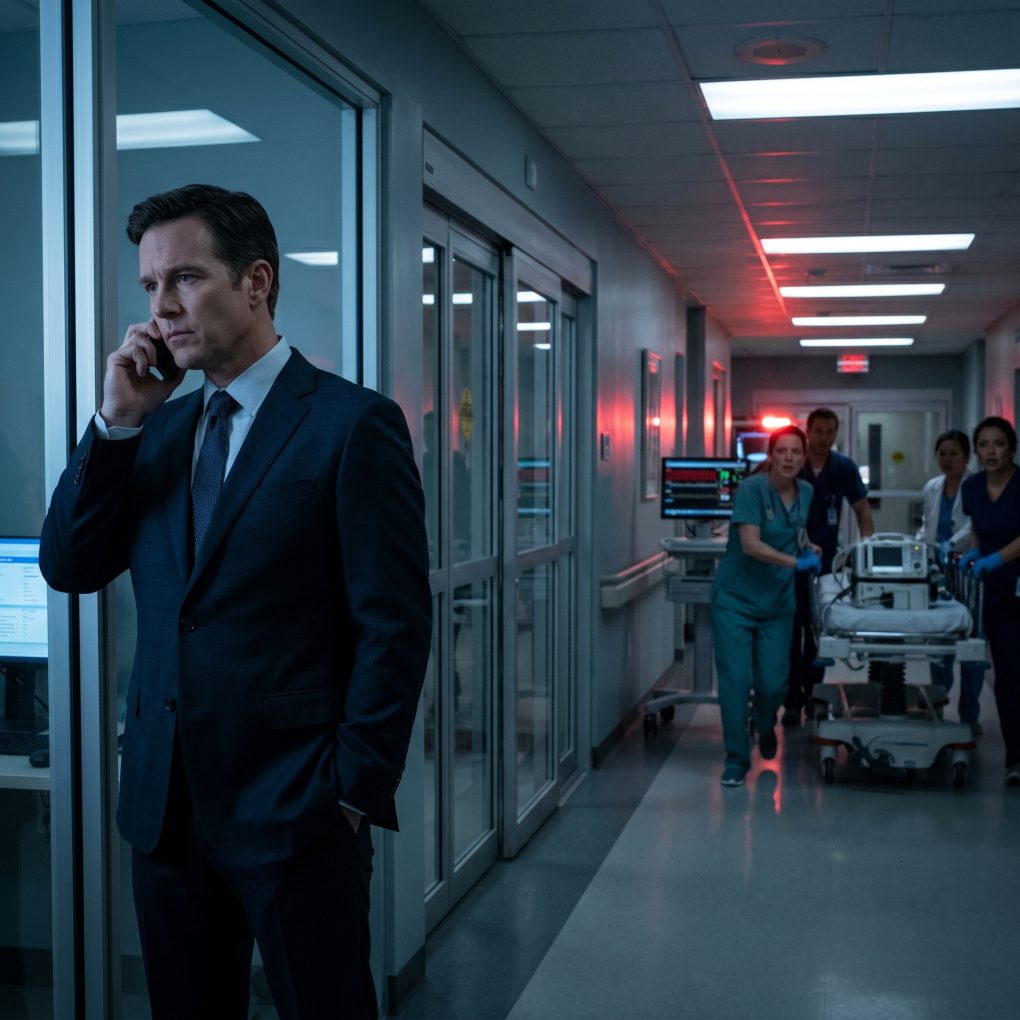
I stayed on the line with my wife while I drove.
Every red light in downtown Houston felt like a personal insult. My hands were steady on the wheel, but only because panic had gone too deep to shake anymore. My wife, Claire, was trying to whisper so Ethan wouldn’t hear her crying from the chair beside his bed. Through the phone, I could hear monitor alarms, hurried footsteps, the hollow mechanical noises of a hospital at night. Then, once, I heard our son’s voice, small and confused.
“Mom?”
Claire choked back a sob and said, “I’m here, baby.”
That nearly broke me.
“Listen to me,” I told her. “Is Renshaw still there?”
“Yes. He keeps saying Ethan might not survive anesthesia. He says moving forward could kill him on the table.”
The wording mattered. Not because it was medically unreasonable—some children really are that fragile—but because of what he was doing with it. Renshaw wasn’t presenting a plan. He was protecting himself from responsibility before anyone else had time to challenge him.
Then Michael Hargrove came back on the line.
He didn’t waste time with greeting.
“I’m in the car,” he said. “I’ve already called the Chief of Pediatric Surgery and the duty administrator. They’re assembling in OR Two.”
I exhaled for the first time in what felt like hours. “Is Renshaw scrubbed?”
“No,” Hargrove said coldly. “And that is becoming part of the problem.”
That told me enough.
By the time I reached the hospital, the lobby doors were sliding open for me before I even touched them. A security officer was waiting. He didn’t speak. Just led me toward pediatrics with a speed that made the whole corridor tilt. On the fourth floor, outside the surgical wing, I found my wife sitting in a blue vinyl chair with blood on her sleeve and terror all over her face. She stood up so fast she nearly collapsed into me.
I held her for exactly two seconds.
Then I saw Renshaw.
He was standing near the nurses’ station with his arms folded, speaking in clipped, irritated phrases to a younger resident. Even before Hargrove arrived, I could see it in his posture: the man had already emotionally stepped away from my son.
The hospital director came through the double doors thirty seconds later, still in his overcoat, followed by the Chief of Pediatric Surgery, Dr. Elena Vasquez, who had obviously been dragged out of bed and was furious about it. Renshaw stiffened the moment he saw them.
Hargrove did not lower his voice.
“Why is this child not in pre-op?” he demanded.
Renshaw’s expression hardened. “Because his condition is unstable and the operative risk is extreme. I’m documenting appropriately.”
Dr. Vasquez looked at the chart, then at the scans on the monitor, then back at him. “Extreme risk is not the same as no action.”
Renshaw snapped, “You didn’t see the drop in pressure.”
“I see a nine-year-old actively deteriorating,” Vasquez replied. “And I see a surgeon using numbers as a hiding place.”
The nurses went dead still.
So did Claire.
Because in one sentence, Dr. Vasquez said aloud what no one else in that hallway had dared say. Renshaw wasn’t only being cautious. He was retreating.
He started to argue, but Hargrove cut him off.
“You are off this case.”
Renshaw actually laughed once. “Over pressure from a parent?”
Hargrove’s face went cold. “Over pressure from me.”
Then Dr. Vasquez turned to the charge nurse and said the most beautiful words I had ever heard in my life.
“Prep the child. We operate now.”
Everything moved at once after that. Consent forms. Blood orders. Pediatric anesthesia. Surgical scrub team. Claire was crying openly now, but this time it wasn’t the helpless kind. It was the body’s release after someone finally says we are trying. Ethan was wheeled past us ten minutes later, pale and frightened, but conscious enough to whisper, “Dad?”
I kissed his forehead and said, “I’m right here.”
He nodded once.
Then they took him through the doors.
Renshaw stood at the end of the corridor watching all of it happen, and for the first time since I’d arrived, he looked afraid. Not for Ethan. For himself.
Because he had just learned the thing men like him forget when they get too powerful inside institutions:
Sometimes the family in the waiting room knows exactly who to call.
The surgery lasted four hours and nineteen minutes.
That is a very long time to sit in a family consultation room and listen to vending machines hum while your whole future balances on people behind a closed door. Claire cried in waves and then apologized for crying, which made me hold her hand tighter every time. I drank terrible coffee. I signed two more forms. At one point, just after dawn began washing the windows pale gray, Michael Hargrove came in and sat across from me like a man who understood that no title in a hospital can make waiting less cruel.
“I’m sorry,” he said quietly.
That surprised me.
Not because administrators never apologize. Because most of them do it too late and too vaguely. Hargrove meant it. He knew what almost happened in his hospital. He knew my son had come within inches of becoming a line item in someone else’s risk calculation.
“What happened with Renshaw?” I asked.
Hargrove looked down at his folded hands. “He’s had complaints. Not for incompetence. For case avoidance in unstable pediatric situations. Enough concern that this will now trigger formal review.”
I nodded once. I had no interest in revenge speeches. My son was still in surgery.
At 6:47 a.m., the door opened and Dr. Vasquez walked in.
Her surgical cap was still on. There were creases around her eyes from hours under bright lights. She looked exhausted, and for one unbearable second I couldn’t read her expression at all.
Then she smiled.
Not broadly. Just enough.
“He’s alive,” she said.
Claire folded in half with relief. I don’t remember standing up, but suddenly I was on my feet with one hand over my mouth and the room drifting slightly at the edges. Dr. Vasquez explained that Ethan had lost significant blood and the repair had been delicate, but they got control of the rupture in time. The next twenty-four hours would matter. There would be pain, monitoring, risk of infection, a long recovery.
But he was alive.
That was enough to make the entire world look different.
We saw him in pediatric ICU an hour later. He was tiny in that bed, all tubes and tape and impossible courage, but his chest was rising on its own. Claire touched his hand and cried silently. I stood there looking at my son and understood something I hadn’t fully let myself feel until then:
If I had arrived twenty minutes later, we might have lost him.
Not because medicine failed.
Because cowardice almost did.
Three days after the surgery, Hargrove called me into his office. Dr. Renshaw had been suspended pending formal review. Two nurses had submitted statements. One resident had confirmed that Renshaw delayed escalation while debating whether the case should be transferred off his service entirely. The hospital would do what institutions always do—investigate, document, protect themselves where possible—but this time they would have to do it under direct scrutiny. Hargrove knew I knew how to make scrutiny permanent. I didn’t need to threaten anything. The possibility sat there between us like another person in the room.
He asked what I wanted.
I told him the truth.
“I want no parent in this hospital ever to hear ‘too critical’ when what a doctor really means is ‘too risky for my record.’”
He nodded, and for once I believed a man in his position might actually carry the sentence somewhere useful.
Two weeks later, Ethan was stable enough to come home.
That night, after he fell asleep in his own bed with dinosaur sheets tangled around his legs and one stuffed astronaut under his arm, Claire sat beside me on the back porch and asked the question she had been carrying since the hospital.
“When you told me five minutes,” she said, “did you already know what you were going to do?”
I looked out at the dark yard and shook my head.
“No,” I said. “I just knew I didn’t have time to ask politely.”
My wife called from the hospital, sobbing, “Please, the doctor refuses to operate on our son. He says our boy’s condition is too critical.”
I asked, “Who’s in charge?” She told me the name. I replied quietly, “Stay on the line. Five minutes.”
I didn’t call an ambulance.
I called the hospital director.
After that, everything changed.
Because sometimes the difference between losing someone and saving them is not money, power, or luck.
Sometimes it is simply refusing to let the wrong man make the final decision.


.jpg)


0 commentaires:
Enregistrer un commentaire